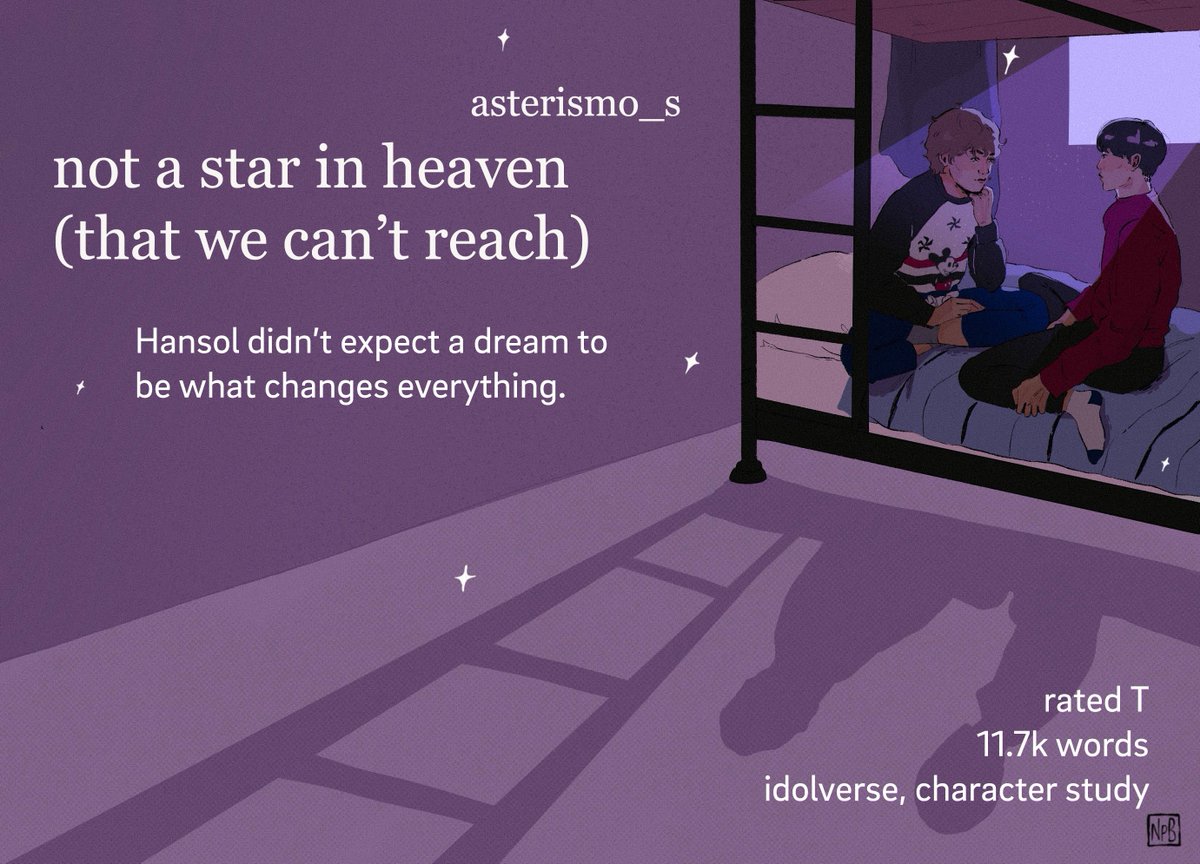
not a star in heaven (that we can't reach)
part 1 of "to, from"
✨ svt, verkwan
✨ rated T, 11.7k words, see further tags on ao3
Heavily based on things we know to be true about Vernon and SVT's early career (what they worked on, lyrics he’s written).
https://t.co/PbVpiNPTze
@inkin_brushes any long-time inkin_brushes reader would know........ main plotline doesn't start until like 2/3's in and we're barely past 50% of tsgel's (currently projected) chapter count
Vernon’s point here is actually much more nuanced than “old K-pop was better” or “K-pop is becoming American.”
K-pop has always been hybrid. Its history is deeply connected to American and European pop, R&B, hip-hop, dance music, and also to the Japanese music industry. Even the formation of what we recognize as modern K-pop in the 1990s happened through taking foreign musical forms and recontextualizing them within Korea’s own language, industry, performance culture and audience.
That’s why the important part of what Vernon is saying is not that K-pop suddenly started borrowing from American pop. It has ALWAYS done that.
The interesting change is how much the distance between the source material and the Korean reinterpretation has narrowed.
Think about the difference between earlier generations and now. A 2nd-gen song could be heavily influenced by an American genre and still sound unmistakably like a Korean production because the influence was being filtered through a very particular Korean arrangement style, vocal structure, songwriting approach, choreography and idol-production system.
Wonder Girls, BIGBANG, 2NE1, Girls’ Generation, etc. were absolutely not “uninfluenced” by Western music. Quite the opposite. But you could often hear the process of localization more clearly.
And that localization was actually one of K-pop’s strengths.
Korea didn’t simply import American pop and reproduce it. Producers took global trends, adapted them to Korean audiences, combined them with Korean industry practices, and eventually developed a system capable of exporting that localized product back into the global market.
That is basically the fascinating paradox of K-pop’s globalization: something can be heavily influenced by global pop while becoming more distinctly Korean through the way those influences are reorganized.
What Vernon is noticing now is almost the reverse side of that process.
The global music industry has become so interconnected that producers, songwriters, choreographers and labels are working across the same international networks, using the same DAWs, sample libraries, trends, genres and songwriting camps, and responding to increasingly similar global market expectations.
So naturally, the “filter” becomes less audible.
It’s not that K-pop stopped being influenced by American pop. It’s that the global pop vocabulary has become so shared that sometimes there is less sonic distance between “K-pop” and “Pop” to begin with.
And honestly, this is why his comment about the 2000s/early 2010s makes sense to me. He isn’t necessarily saying those songs were more original. He’s talking about a period when the process of taking a global influence and turning it into something recognizably K-pop was easier to hear.
That distinction matters.
And honestly, I could yap about this for much longer if anyone is interested 😭 There are some genuinely fascinating articles and discussions on K-pop’s musical hybridity, localization, globalization, and the changing relationship between K-pop and global pop.
The more you look into the history, the more interesting Vernon’s observation becomes.
Every time I see this video I think about what strange & dark times we live in. German kids on trial for trying to stop a genocide. A small group of family & friends supporting them. The rest of the country disinterested as the government is trying to put them away for terrorism
🦔AI companies are bulk-buying rare books, scanning them through high-speed machines that cut the spines off, and shredding the originals. A service called ISBNdb facilitates orders of up to a million books and keeps buyers anonymous. Pre-2022 books are premium because they're free of AI-generated text. A federal judge ruled the practice is fair use because eliminating the original means only one copy exists at a time. Anthropic hired the former head of Google Books partnerships to obtain "all the books in the world."
My Take
This got to me. A bookseller told 404 Media that rare books with almost no surviving copies are being fed into this pipeline. Books that survived wars, fires, and centuries of handling are being shredded so an AI can learn to write a better marketing email.
ISBNdb's website literally says "'AI company destroys two million books' is not a headline that generates sympathy," and they still built an entire business around making it happen quietly. They offer NDAs as a feature. They coach clients to call it "digital preservation."
I've covered AI companies scraping the internet, torrenting libraries, and stealing music. This is worse because it's irreversible. You can re-upload a website. You can reprint a bestseller. You can't replace the last three copies of an 18th-century botanical text once someone shreds them for training data. And the judge said it's legal. So it's going to accelerate.
"We shred rare books and offer NDAs so nobody finds out" is a legitimate business model in 2026. What a timeline.
Hedgie🤗
My parents keep telling me to just break my apartment lease and not pay bc there’s a bad mold problem. My dad said he had to do it several times in his youth and it was fine. I asked if it was before credit scores and they shut up after that.
"The hardest decision we had to make in completing this report was.. not to name the Palestinian children, whose deaths, injuries & suffering we describe.. we didn't name them because we feared the consequences for their families"
He means Israel would go after them too.
You should know that if you get the measles, it will wipe out immunity to anything you had immunity to before you were infected, including any vaccinations