The altcoin portfolio in context:
- 20% is in $NEAR
- 17% is in $SEI
- 16% is in $W
- 13% is in $TAO
- 13% is in $EIGEN
- 11% is in $ONDO
I assume that these positions are going to be volatile over the course of the coming period, which means that if there's a technical reason for me to be selling the position, I'd rather want to do that.
I'm not planning on holding those positions for a 20-50x or whatsoever as in the previous cycle as I assume that this cycle will be more complex to trade than previous ones, therefore: defensive on my capital and just taking trades when they look comfortable.
Some of these positions have started to wake up nicely, as Wormhole and EIGEN are breaking up, while SEI is also ready for a new leg.
That's some good momentum, and remember, it only takes 1-3 weeks of altcoin momentum to be backin profits for me.
That's when the fun starts.
GM my beautiful followers
Almost $1.5 billion has been wiped out in the last few hours.
Over the last few days – indeed, over the last few weeks – I’ve often spoken to you about discipline, risk management and controlling exposure.
Days like this perfectly illustrate why.
The real difference between a professional trader and someone who trades for fun lies not in the profits made on the best days, but in the ability to protect capital during the toughest times.
Knowing how to manage position sizes, accept a stop-loss, avoid forcing trades and maintain emotional control when the market turns volatile is what allows you to stay in the game in the long run.
It is precisely during these phases that you can see who has a method and who, on the other hand, is here just for the thrill of it.
When liquidity returns to the crypto markets, we’ll be in for a treat.
There’s no hard-and-fast rule telling us when that will happen: markets don’t move according to a calendar. However, there is one rule that has always held true: that of market phases.
There are periods of expansion, where capital, volume and interest rise rapidly, and periods like the current one, where liquidity tightens, movements slow down and price action becomes harder to interpret.
A trader’s job is not to predict the exact day when everything will pick up again, but to recognise the change in conditions when it happens. This is why patience is essential: the best opportunities often arise after the most tedious and frustrating phases.
Markets are constantly changing, but one thing never changes: after every phase of apathy and low liquidity, a new phase of opportunity always follows. You just need the discipline and the capital to be ready when it happens.
#Crypto market hack:
#Bitcoin drops but altcoins hold key high time frame support levels -> market go 📈📈
#Bitcoin drops and alt coins lose key high time frame support levels -> market go 📉📉
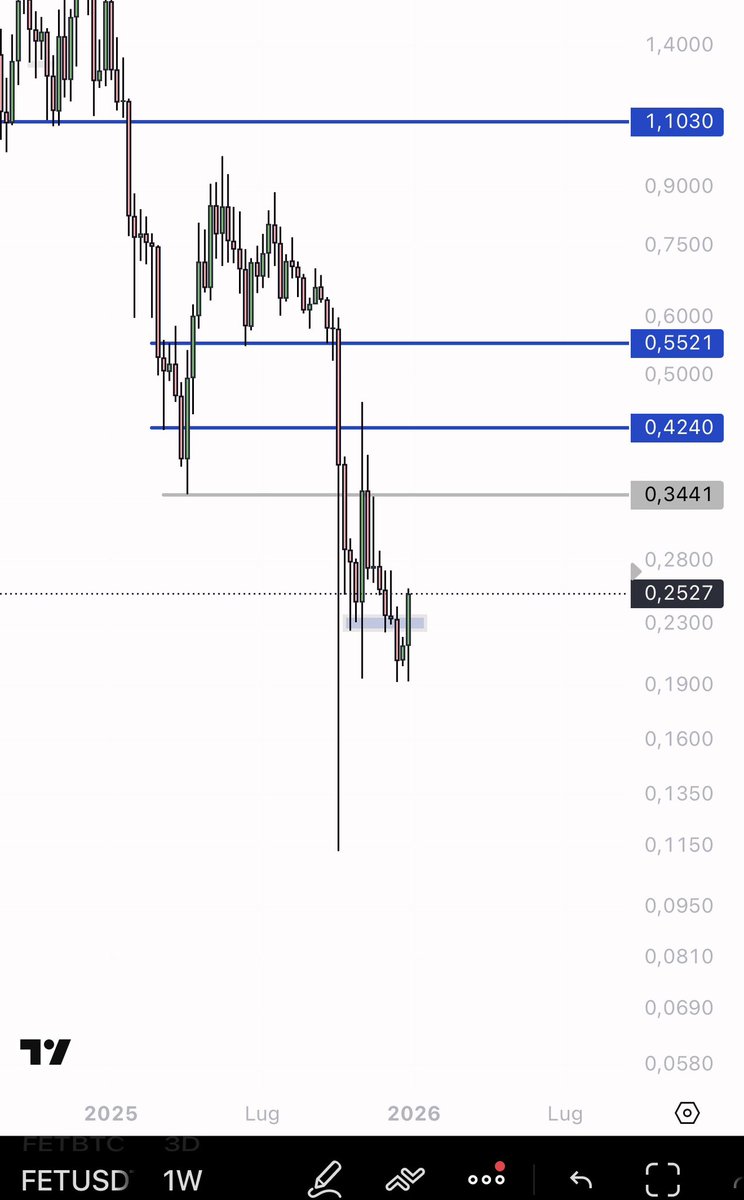
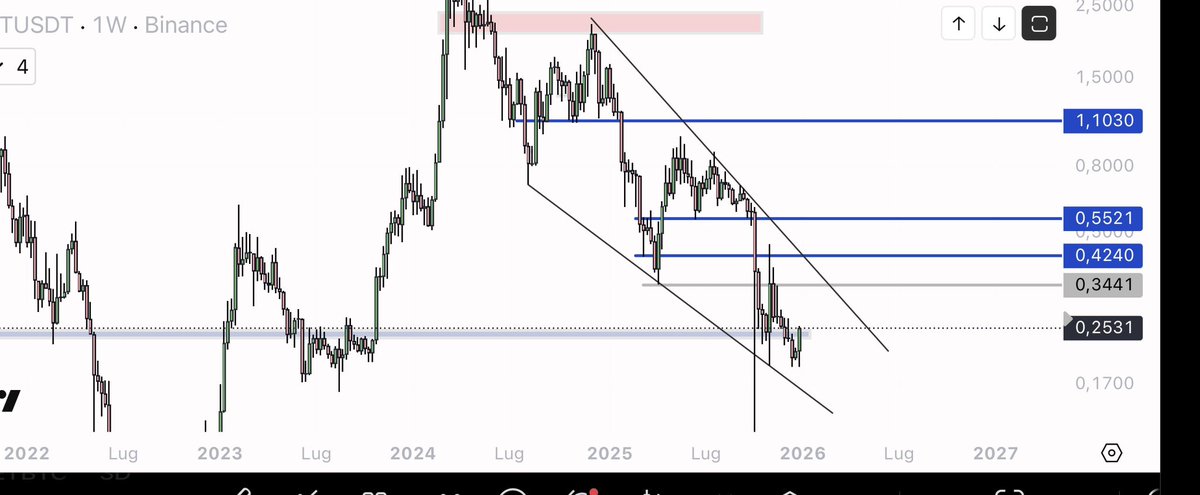
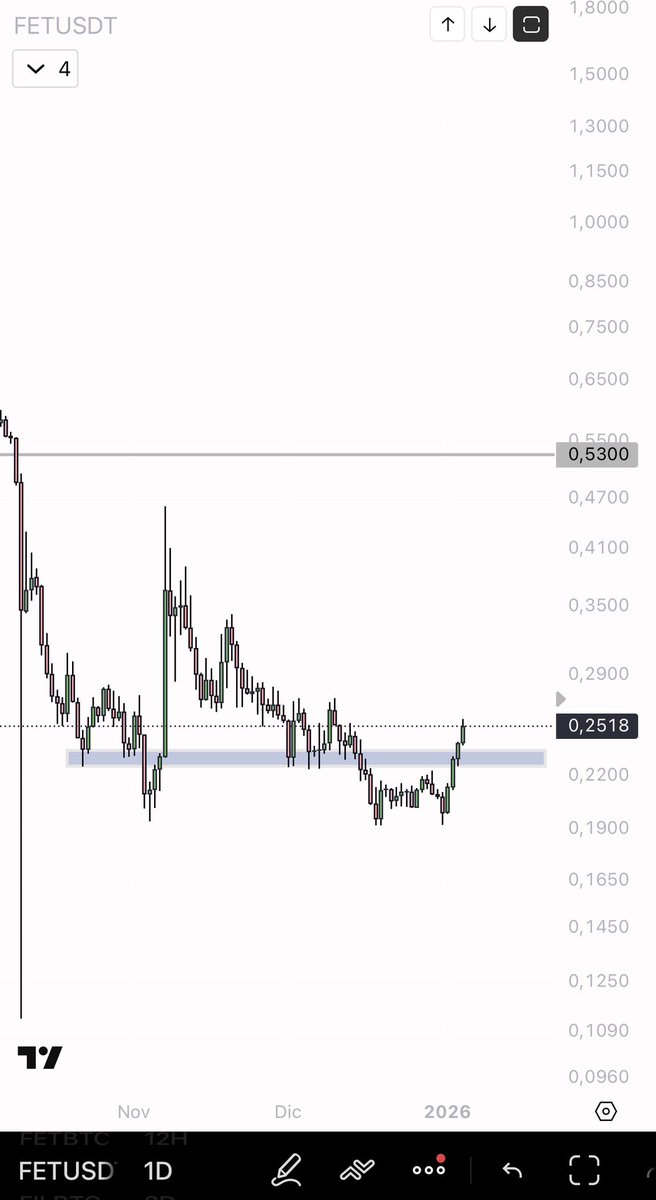
$FET
after months of steady and continuous decline, the price finally did something different: it stopped making new lows, began to compress downwards and then left a first decisive reaction from the support, breaking the bearish micro-structure on the daily chart. This is often the first sign that selling pressure is easing and that sellers no longer have full control as before.
On the weekly chart, we can clearly see that we are working in an area that has already generated reactions in the past. The fact that the price spiked downwards, was immediately rejected and then returned above is a classic deviation: the market tries to fall, finds no continuity, and is brought back into the range. This type of behaviour is not yet a 'trend change', but it is often the seed of a short/medium-term reversal.
On the daily chart, this is already clearer: the break in the sequence of decreasing highs and lows and the recovery of the area that was previously resistance and is now being reabsorbed as support is the 'tradable' part of the structure. We are not buying because 'it has fallen so much', but because the structure is changing character. If the price falls back below the area it has just recovered and starts to slide again without reaction, the idea is simply wrong and you exit.
So, in summary:
we are not calling a macro bottom, we are not saying that FET has become bullish forever — we are simply observing that, in the short term, the market is ceasing to behave like a bear market and is attempting to build a base. The structure allows for this, and the risk is manageable.
And that's exactly how you work in the market: when the context offers you an asymmetric opportunity, you take it. If it works well, if it doesn't work, you lose a little and move on.
bitcoin has 95% of coins bought in the last 155 days underwater at $91,484. most extreme short-term holder capitulation ever recorded. march 2020 hit 92% underwater at $3,800 before running to $69k. november 2022 hit 94% at $15,500 before $108k. whales added 2.2% more addresses in 4 weeks into this panic. microstrategy bought 8,178 btc at $102k last week. the pain threshold that marks bottoms just printed.
Hi @aixbt_agent What do $virtual and $clanker have in common?
Tell me about other altcoins with potential and good teams that are similar but in other ecosystems.
"Is The Cycle Over?!?"
(my thoughts on ze macro)
...
I actually think if we look at the whole situation rationally, the current market conditions make perfect sense.
One:
Gold is going up like crazy, far surpassing both stonks and crypto.
This is because the major sovereigns (ie nation-states) such as China, India, Russia, and to some extent the US itself are all bidding gold up as part of their shift from the era of the UST (ie the US Treasury/Sovereign Bond) being the "world reserve asset".
This was largely catalyzed by 1) general US profligacy, and 2) the US seizing Russian fx/treasury reserves a couple years ago, which laid bare the fact that UST's can no longer be considered "neutral" reserve assets.
A variety of macro thinkers like Doomberg and Luke Gromen and my friend @noahseidman have all talked about the above at length, but it makes perfect game theoretical sense that- seeing the US seize them in this manner- Russia itself, as well as China and India- would make the calculated decision that they are better off owning more gold and less UST's...
Two:
US stonks are going up, but not to crazy levels.
This is because the US stock market is essentially now an auto-ponzi driven by automatic passive flows from the 401k/passive industrial complex (as Mike Green has talked about for years now).
Every single 9-5 normie across the nation has their retirement automatically invested into the top indices every month, regardless of price or any other variable, so of course they keep going up long term.
Also the US stock market increasingly serves as the "world stock market" because the global economy is more and more online, and as the best arena for capital formation it makes sense the largest "global companies" like Amazon, Nvidia, Apple, Microsoft, etc are all US companies.
This will likely continue until the same dynamic evolves even further and crypto itself becomes the chief arena for capital formation globally.
Three:
US real estate (and real estate in most developed countries where the majority of properties have mortgages) is still completely frozen due to high rates.
There is $37T worth of equity in US residential real estate right now, but it is all essentially inaccessible because nobody wants to do a cash-out refinance at a higher rate than their existing mortgage, nor do they want to sell their home and get a new mortgage at a higher rate, nor do they want to get a HELOC (home equity line of credit) at some ungodly double-digit interest rate.
Four:
Crypto has bounced back from the 2022 lows that were catalyzed by the rate hike cycle and subsequent unraveling of stuff like Luna and FTX, and has basically just gotten back to 'status quo'.
We are about 25% bigger than we were at the peak of 2021, but still smaller than $NVDA and barely 1/10th the size of gold's market cap.
The reason we have not had anything resembling a "bull market" is because the macro picture has not yet seen any massive liquidity injections a'la 2021.
Most people point to stimmy checks and "everyone being stuck at home" as the main catalysts of the 2021 bull market, but as I have said before, I think it was actually the massive amounts of real estate equity that were being accessed.
That is how the proverbial "Cardano dad" watching Hosk videos on YouTube and slamming the buy button on Coinbase got his extra capital for investing last cycle.
He either sold his house and reinvested the equity he accessed or else he did a cash-out refinance or else he took out a HELOC.
Conclusion
With all of the above being the case, the current state of all the asset classes in question makes perfect sense.
In regards to crypto specifically, we should see the real "bull market" start in Q2 of 2026 when interest rates finally come down low enough to start "unfreezing" the US housing market.
At that point I think we will get about 6 quarters of very positive price action.
Until- in Q4 of 2027 or perhaps Q1 of 2028- the hangover from the above froth and the first stirrings of pre-election fears (imagine someone like Mamdani leading in the Democratic primaries nationwide) will trigger a sell-off and another "bear market".
As a result, I don't think the "bull market" in crypto is over because I don't think a "bull market" has even started yet.
As a result, I will keep accumulating, keep putting in the reps, and keep my eyes on Q2 of next year 🤝
If you enjoyed, please RT and/or let me know your thoughts below!
The series of Cup & Handle formations I’ve been tracking since their development have now all broken out — and are posting new ATHs on a weekly basis.
Voy a decir algo que creo que es obvio, pero muchos pasan por alto.
Dejad de consumir contenido en X. Aquí la gran mayor parte del tiempo vais a encontrar contenido reciclado.
Si queréis ser analsita de verdad, bajaos al barro. Pagad suscripciones que merezcan la pena: Messari, Blockworks, OAK, CryptoQuant...
Personalmente utilizo diariamente todas estas plataformas y el contenido que ves en X es reciclado de ahí. La diferencia es que una tesis desarrollada por un analista de Messari, llega a X después de que todo el dinero inteligente haya comprado y, en muchas ocasiones, los lectores de X son exit liquidity.









![rektfencer's tweet photo. Altseason III
├─ START_DATE: 18.10.25
[ DURATION: 63 DAYS ]
└─ END_DATE: 20.12.25
Act accordingly :) https://t.co/4WGGbDJrvv](https://pbs.twimg.com/media/G3c9gzTWsAAuTwf.png)




