Melius Raises PT on $MU to $2,200 from $1,100 - Buy; memory is becoming more SaaS-like.
Analyst comments: "It wasn't just a massive beat and raise. Micron just reframed the entire memory cycle again, with many more positive disclosures than we anticipated, ranging from a surge in strategic customer agreements, to pricing, to an outlook for tight conditions well beyond 2027.
Micron will soon have half of its forward revenue under five-year strategic customer agreements with attractive minimum prices locked in. Every memory tier is in shortage as far out as you can go. As a result, Micron deserves a higher multiple, since these fundamentals could enable it to buy back the whole company within about six years.
Memory will go down as the bottleneck of all bottlenecks for this AI era. Micron said current conditions last after calendar 2027, basically guaranteeing buybacks of epic proportions, especially next calendar year. From a 10,000-foot level, the more memory you use, the better AI gets, enabling recurring revenue from strategic customer agreements and huge cash returns.
We are raising our estimates for FY27 by ~47% and taking our target to $2,200, expanding our target multiple to ~12x from ~9x. We are making similar moves for Buy-rated Sandisk too, as memory becomes more SaaS-like."
Analyst: Ben Reitzes
Micron will be a $4,000 stock and here is why (Save this).
As Sanjay Mehrotra puts it "We are only in the early innings of the significant innovation and productivity that can be unleashed in every part of the global economy over time."
That is a roadmap and the math behind it points toward something most investors still haven't fully priced in.
Q4 revenue guidance came in at $50 billion nearly $7 billion above what Wall Street was expecting for a single quarter.
That number alone would have been Micron's entire annual revenue just two years ago and yet data centers are only the first chapter of this story.
Mehrotra specifically called out robotics, humanoids, and fully autonomous vehicles as the next demand wave on tonight's call and the numbers behind those markets are genuinely staggering.
A Level 4 autonomous vehicle requires over 300GB of DRAM, nearly 20 times more than a standard car today in every single vehicle that rolls off the assembly line.
A humanoid robot will require between 64 and 128GB of DRAM and up to 2TB of NAND storage per unit, giving each one a memory footprint comparable to a high end server.
There are projections for tens of millions of humanoid robots and hundreds of millions of autonomous vehicles over the next decade, and every single one of them runs on Micron memory.
Mehrotra said directly tonight that tight supply conditions are expected to persist beyond calendar 2027 and even with aggressive capital spending Micron can only meet 50 to 67% of medium-term customer demand.
Competitors new capacity will not meaningfully come online until late 2027 at the earliest, meaning the pricing environment Micron operates in today has years left to run.
There was also 16 Strategic Customer Agreements with $100 billion in minimum committed revenue and $22 billion in customer cash deposits already paid, mean that even when the cycle eventually softens, Micron's floor has been permanently reset at a level no prior version of this company ever reached.
Gross margins contractually protected above any peak in the company's prior history, locked through 2030, across half or more of total revenue and that is not a commodity business anymore.
Bullish on memory. Follow @MelvinInvests for more AI, semis, and the next big market themes.
BREAKING: President Trump vows to hold a press conference to read the full memorandum of understanding with Iran word-by-word to make sure the media covers it fairly.
"I will actually not only release it, I'll probably have a press conference and read it to you word-by-word, so that the press covers it accurately, because it's, it's a very important document."
"And, unlike Obama, who could have destroyed the Middle East with a horrible JCPoA, it is the worst agreement that was a road to a nuclear weapon. Mine is a wall against a nuclear weapon."
We are living through 1 of the 2 largest investment booms IN THE HISTORY OF THE UNITED STATES.
Bigger than the internet. Bigger than the railroads. Bigger than Apollo.
Only the Louisiana Purchase was larger.
$MU $DRAM Unbelievable
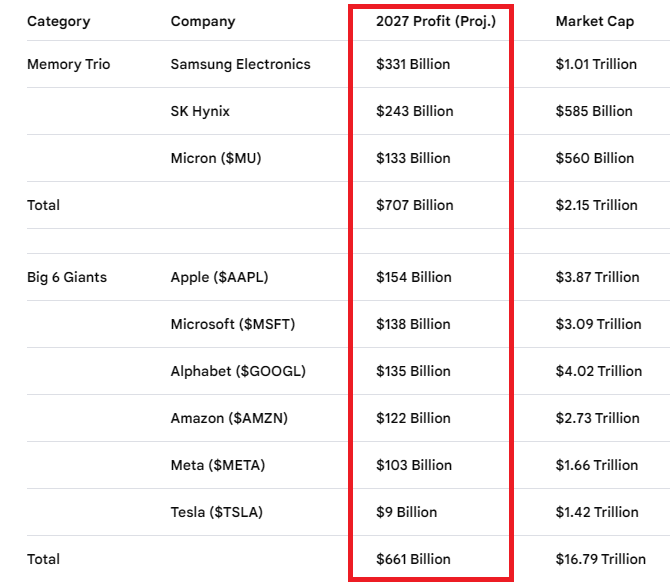
$707,000,000,000.
That is the projected 2027 operating profit of 3 memory companies.
Apple + Microsoft + Google + Amazon + Meta + Tesla combined? ~$661 Billion.
The Memory Trio beats the Magnificent 6.
Not revenue. Operating profit.
Wow, $IQE and $TSEM sign a multi year InP epiwafer deal.
Remember I told you all IQE was important to Western optical supply chains back at $12?
$MTSI had to go out of their way to secure their supply with IQE.
Now there’s another critical deal with Tower Semi.
As AI infrastructure grows, optical transceivers face new demands for speed, consistency, and reliability.
AOI's Simon Ximen explains why vertical integration is becoming a critical advantage for 800G and 1.6T deployments.
Read more: https://t.co/2xFrYY2hPx $AAOI
There have been 24,708 trading days since 1928.
On only 48 of them has the RSI fallen more than 36 points in six trading days.
Today is one of those 48 days.
BREAKING: President Trump says he directed the US Military to execute a “secret mission” in the Strait of Hormuz which resulted in over 100 million barrels of crude oil crossing through Hormuz.
MssCorp (TWO:6830)just reported May 2026 revenue of NT$217 million, up 19.4% YoY and marking a record high for the same month. Cumulative revenue from January to May also reached an all-time high.
Meanwhile, the company announced that its proprietary “Optical Loss Detection Device” — the core technology behind the MSS HG “Night Gecko” platform — has officially been granted an invention patent in South Korea.
With patent protection now secured across Taiwan, the U.S., Japan, and South Korea, MssCorp has completed coverage in the four major semiconductor markets, further strengthening its moat in silicon photonics and CPO testing.
While everyone is chasing the flashy names, MssCorp is quietly building real technological leadership in the AI optical supply chain.
…Save MssCorp. 🦎😭😭
News:
https://t.co/3JcJkrUs5i
$6830 #SiliconPhotonics #CPO #AIInfrastructure
Jensen Huang just gave one of the most bullish signals yet for the memory industry $MU $DRAM
$NVDA released 4 new products and at NVIDIA’s Korea event, he repeatedly emphasized one thing: more memory.
• Vera Rubin supercomputers need massive amounts of HBM
• Vera CPUs require more LPDDR5 memory
• RTX Spark AI PCs need more LPDDR5 memory
• NVIDIA’s new robotics and autonomous driving platforms are being built alongside partners including Samsung, SK hynix, and LG
A massive demand for memory is coming.
Wall Street Mistakes World Cup Noise for Inflation
Wall Street’s inflation scare may owe more to the World Cup than to the underlying economy. The tournament is delivering a meaningful, if temporary, economic boost, one that is flattered in the data but poorly understood in the policy debate.
Friday’s payrolls report reflects that distortion. Leisure and hospitality accounted for roughly 70,000 of the gains, consistent with event-driven demand: fuller bars, higher hotel occupancy and temporary hiring in host cities. This strength is echoed across pockets of services activity even as goods and broader indicators soften. Meanwhile, government added 52,000 jobs, alongside 40,000 in health and education categories shaped more by fiscal settings and structural demand than cyclical heat.
Mega-events reallocate rather than create demand, amplifying visible activity while masking underlying softness.
The typical Keynesian response, that a firm report signals inflation and demands tighter policy, looks misplaced. For the Federal Reserve, the risk is mistaking a football-fuelled boost for persistent pressure, and tightening into what is, in part, a statistical mirage.
🚨 The “blowout” jobs report that just killed your rate cut? Misleading.
It was bartenders. 🍺
70K hospitality hires for the World Cup -> 5x normal. Wall Street saw a hot economy. It was a soccer tournament.
Back out the one-off and there’s NO blowout -> just trend. Yes, there’s a soccer tournament sitting on top of a trend-line economy. 🤯
Look under the hood. 🧵
I'm digging into those jobs numbers (more on my website, dds(dot)finance soon).
But generally, it looks like those job gains are being driven by World Cup-related hiring. Most of them appear to be temporary blue-collar positions.
So there doesn't seem to be any meaningful "real" job growth in the U.S. in May 2026.
My favorite names in every sector right now. The full conviction list, three deep in each.
Humanoid Robotics
$AMBA
$OUST
$VPG
AI Infrastructure
$NBIS
$PENG
$CRDO
Defense
$EOS.AX
$MRLN
$KRKNF
Data Center Power
$CEG
$BE
$FCEL
Photonics & Optical
$AAOI
$LITE
$COHR
Memory & Semiconductors
$MU
$MX
$SNDK
Small Cap Data Center
$VIVO
$DGXX
$KEEL
Quantum Computing
$INFQ
$LAES
$IONQ
Satellite & Space
$ASTS
$RKLB
$OPTX
Different sectors. One theme tying them together. Real businesses, real catalysts, and valuations the market has not fully caught up to yet.
This is where I am positioned for the next few years.
I think my personal style of investing is a bit different, just some reflection:
It's inherently discretionary, based on stuff markets don't know yet. And a culmination of life experiences?
If you look at $AXTI, $RPI, $SIVE, $IQE and others.
Lot of it is guessing on unstructured relationships then seeing if it's right or not down the line.
$RPI is the perfect example:
1. Nobody really thought of Raspberry Pis for AI growth. Mainly people bought one or two just for class + education + hobbyist.
2. After OpenClaw, just noticed all my friends and people just buying Apple Mac Minis / RPIs for AI applications.
3. Found validation of that trend online with lot of people sharing video tutorials on AI orchestration with RPI.
4. AI was their ideal perfect growth vector, did some modeling, and thought it was compelling.
Earnings comes out and I was right.
Everyone in media was calling it a meme stock because there's nothing online that shows revenue growth from AI (was 14% forecasted revenue growth, turned out to be 58%, my projection was around 55%).
So it was a mix of guessing next industry trend (AI using lightweight hardware instead of GPU clusters), real life trends, then revenue forecasting off my guess.
For stuff like $AXTI:
1. Everyone called it a joke when I bought at ~$12. LLMs would hallucinate and say "hyperscalers/govs would have known about this by now and fixed this vulnerability with InP substrates"
2. Or would conflate very nuanced parts of InP substrate stack, where there's multiple different chokepoints in upstream processing.
3. So part of this was just discretionary based on what I've seen over InP substrate breakdowns, industry trends, etc.
4. Then also guessing the major supercycle was photonics (this was before everyone caught onto $LITE, and others). Or before you saw the $141B TAM projections from GS.
5. AXT owned 40% of InP supply chain, without them the supply chain just gets cripped).
6. All the "analysts" were forecasting steady InP substrate growth, few hundred million TAM, etc. or export controls.
7. Everyone kept trying to say $AXTI was overvalued based on TAM estimates. But if it's a few hundred million TAM you just think that's a joke and go into game theory over allocations.
8. Then I just had to guess, how much would this be worth if it were a NAND style bottleneck, what MC could it reach based on control, how much would hyperscalers price it as, etc.
A lot of the current research outputs from Goldman Sachs, or earnings reports from the Epiwafer companies, were confirmed after I published my piece on AXT. If you did research back then, lot of the same material /framing wouldn't have come up.
With stuff like $XFAB as you're seeing now, a lot of it is just pure guessing:
1. Not really any CPO materials, how much their MTP process makes in revenue, etc. Everyone online keeps saying they're not a photonics player.
2. But if you go through ASE docs or Gov websites, they all kinda cite XFAB as a major emerging player here.
3. $NVDA also evaluating them right now (maybe it's successful who knows).
4. No clear revenue around this area because their main silicon photonics process is still precommercial, but if you guess it's trying to create a EU supply chain to compete with $TSEM, once pre-commercial shifts to commercial, maybe similar but less volume contracts?
5. Then just seeing updates over the next few months to see if anything confirms this thesis guess.
_
I think a lot of information discovery still can be done with LLMs I'm seeing online. But it's also really hard to make a bunch of unstructured inferences based on unrelated material or even just trends you're seeing in real life.
So probably better to just do what's standard, eg. do valuation forecasting based on current numbers
Stuff like $AAOI, if they're projecting $471m/M h1 2027 and you see MC at $12B, probably undervalued might be a good idea to go long for next years.
Stuff like Samsung Electronics is easier, see what people are modeling for operating profits for 2027, 2028 then just seeing if it's undervalued or not at current levels.
Maybe something harder is $JBL. I haven't really seen any great volume numbers around 1.6T LRO, but you can just make a guess on how popular that might be then project how that might impact current MCs.
Or picking just good names everyone kinda agrees like $TSM, $INTC, $MRVL is also solid.
So a lot of things is just building up your life skills then applying that to markets. I don't think it's that can be taught with courses and stuff.
Of course, much of what I'm doing is just high conviction inference based on unconnected parts. Could always be wrong.