'The origin and ultimate fate of the universe represent some of the most compelling questions for humanity to explore'
.
Aspiring Theoretical Physicist
JWST found, for the first time, a galaxy with 3 supermassive black holes
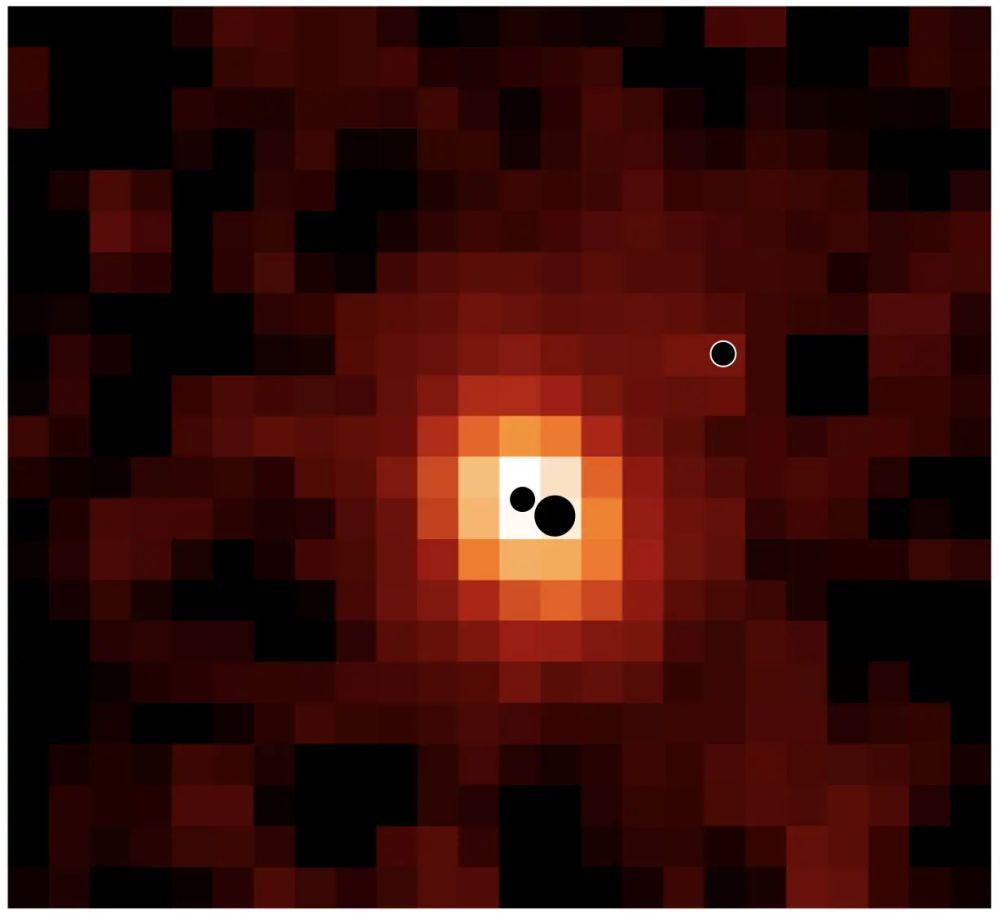
A cosmic family portrait, painted in glowing hydrogen by the James Webb Space Telescope.
This is an ionized-hydrogen map of the distant galaxy J0148-4214. The three black circles mark its resident black holes (shown far larger than their true size for clarity). The most massive and the least massive of the trio sit closest together and are locked on a collision course, destined to merge in roughly 700 million years. The third, more distant black hole will join the dance later, completing a multi-stage gravitational waltz that has been unfolding for billions of years.
Credit: Hannah Übler
Proud to honor the legacy of Launch Complex 36. Rebuilding LC-36A and flying again this year remains our priority. Alongside that work, a separate team is beginning work on LC-36B, the operational home for New Glenn's 9x4. We're sourcing 2,500 tons of steel columns that will be integrated with beams and bracing to form 50'x50'x50’ modules. These modules will be stacked to build the 700-foot-tall launch tower.
Nearly 2,500 meters below the ocean surface, sunlight has never reached — yet entire ecosystems thrive there. Deep-sea hydrothermal vents spew mineral-rich, scalding water, and instead of photosynthesis, bacteria use chemosynthesis to turn hydrogen sulfide into energy. Giant tube worms, blind shrimp, and eyeless crabs all depend on this chemical food chain.
Could life like this hint at what might exist on icy moons like Europa?
Photo by Cristian Palmer (Unsplash)
INDIA’S ROCKET FACTORY: SKYROOT 'INFINITY' GOES ONLINE 🏭🚀
🇮🇳INDIA'S "SPACEX MOMENT" HAS ARRIVED.
Elon Musk built a factory to mass-produce rockets. Skyroot just did the same for India.
PM Modi inaugurated Skyroot’s Infinity Campus. It’s not just a building; it’s a declaration of war on the global launch market. It's the advanced manufacturing processes designed to break the biggest bottleneck in space: Production Time.
And the world is watching Hyderabad today:
🚀 1. THE "PRINTING PRESS" FOR ROCKETS
For 50 years, rockets were built like Ferraris—slow, by hand, one at a time.
Skyroot is building them like Toyotas.
-->This factory can churn out 1 Orbital Rocket every 30 days.
-->While other nations wait years for launch slots, India will soon be launching on demand.
🇨🇳 2. CHECKMATE TO CHINA
China has been flooding the market with cheap commercial launchers (Galactic Energy, iSpace).
-->Skyroot’s Vikram-1 is the direct counter.
-->Cheaper? Yes.
-->Better Tech? All-carbon-fiber body + 3D printed engines.
-->India is now positioned to steal the commercial launch market from Beijing.
⚡ 3. FROM "LAB" TO "EMPIRE"
This is the largest private rocket design & manufacturing facility in India under one roof (60,000 sq ft).
We aren't just researching space anymore. We are industrializing it.
This is the step that turns a "startup" into a "superpower."
🌍 4. STRATEGIC IMPLICATIONS
-->In a conflict scenario involving anti-satellite (ASAT) strikes, the ability to rapidly replace lost satellites is vital. -->A factory that can pump out 12+ launchers a year provides a strategic "replenishment" capability.
-->By bringing manufacturing, testing, and integration under one roof, Skyroot reduces dependency on external supply chains that can be disrupted.
The monopoly of Western space giants is ending. The Indian private sector isn't just "participating" anymore—it's taking over.
The Skyroot era begins now. 🇮🇳🚀
@SkyrootA@PawanKChandana@ajaykraina@AadiAchint@TGD_06
#India #SpaceX #Skyroot #Vikram1 #MakeInIndia #Isro
That's a spectacular and scientifically fascinating object! W49B is one of the most unusual supernova remnants in the Milky Way, and this composite image really shows why.Key highlights that make W49B so special:Asymmetric, jet-driven explosion: Unlike the typical spherical blast wave of most core-collapse supernovae, W49B looks barrel-shaped with bright bipolar lobes. This is strong evidence that the progenitor star was rapidly rotating and ejected powerful jets along its poles — similar to (but much more extreme than) what we see in some gamma-ray bursts.
Element distribution matches theory: The iron is concentrated only in one hemisphere (the purple in the iron+silicon map), while lighter elements like silicon, sulfur, and argon are more uniformly spread. This asymmetry is exactly what models predict for a highly directional, jet-powered explosion.
No neutron star detected: Despite deep Chandra observations, there’s no central X-ray point source, no pulsar, no pulsar wind nebula — nothing. That’s extremely rare. In most supernova remnants of this age (~1,000 years), we’d easily see a bright neutron star if one were there. The absence strongly suggests the core collapsed directly into a black hole without forming a neutron star first.
Youngest known Galactic black hole (candidate): At ~1,000 years old (as seen from Earth), if confirmed, this would indeed be the youngest black hole in the Milky Way by a huge margin — far younger than the next contenders (SS433, W50, or the possible black hole in Cassiopeia A).
It’s still formally a “candidate” because we haven’t directly detected gravitational waves or an accretion signature from the black hole itself, but the lack of any neutron star signature in such a young, nearby remnant is compelling circumstantial evidence.W49B is a smoking gun for the rare class of explosions that can produce black holes without a bright, long-lived neutron star phase — and a beautiful reminder that even in our own galaxy, the deaths of massive stars can be wildly diverse. Thanks for sharing this gem! Definitely one of Chandra’s greatest hits.
100 years ago, in November 1925, Erwin Schrödinger attended a colloquium in Zürich where Louis de Broglie’s bold idea was being discussed: that every moving particle carries a wave-like nature.
After the talk, a colleague made a casual remark if matter behaves like a wave, shouldn’t there be a wave equation for it? For most people, it was a fleeting comment. For Schrödinger, it became an obsession.
By late December, Schrödinger wrote to Wilhelm Wien admitting he was struggling with a new atomic theory, even joking: “If only I knew more mathematics!” Yet he remained optimistic, convinced that if he could solve the problem, “it will be very beautiful.”
He was not the only one wrestling with the new quantum world. Around the same time, the great mathematician David Hilbert remarked, “Physics is much too hard for physicists,” capturing the difficulty of the era.
The breakthrough arrived quickly. On 27 January 1926, Schrödinger submitted the first of four papers titled Quantization as an Eigenvalue Problem. In it, he introduced the wave equation that now bears his name and solved the hydrogen atom with it, offering the first coherent picture of atomic structure.
Meanwhile, Wolfgang Pauli, using the matrix mechanics developed by Werner Heisenberg, Max Born, and Pascual Jordan, had already derived the hydrogen spectrum. Soon, Schrödinger proved that wave mechanics and matrix mechanics were mathematically equivalent two languages describing the same quantum reality.
By mid-1926, Schrödinger had applied wave mechanics to the harmonic oscillator, the diatomic molecule, the Stark effect in hydrogen, and the processes of absorption, emission, and scattering. What began as a struggle became one of the most productive bursts of creativity in the history of physics.
A century later, this moment reminds us of something timeless: great scientific revolutions are built not on certainty, but on persistence and the belief that something beautiful lies beyond the struggle.
Tu Youyou discovered a substance called artemisinin, which can be used to treat malaria. Tu not only found a way to extract artemisinin from a traditional Chinese medicine, she also tested the new drug on herself to speed up the time needed for development.
Her discovery led to development of a new drug that has saved the lives of millions of people.
Learn more: https://t.co/IgCSylSlMB
Another one bites the dust. I was hoping V3’s testing campaign would maybe go smoother but here we are. As always, it’s anyone’s guess when this stuff will be ironed out and when Starship will become operational. Always feels far away on days like today.
To understand quantum mechanics, you must master functional analysis, linear algebra, vector calculus, differential equations, complex variables, and group theory.
Fundamental equations of quantum mechanics inscribed on a black granite wall, located at the Centre for New Technologies (CeNT) at the University of Warsaw in Poland.
Can you recognize the equation?✍️