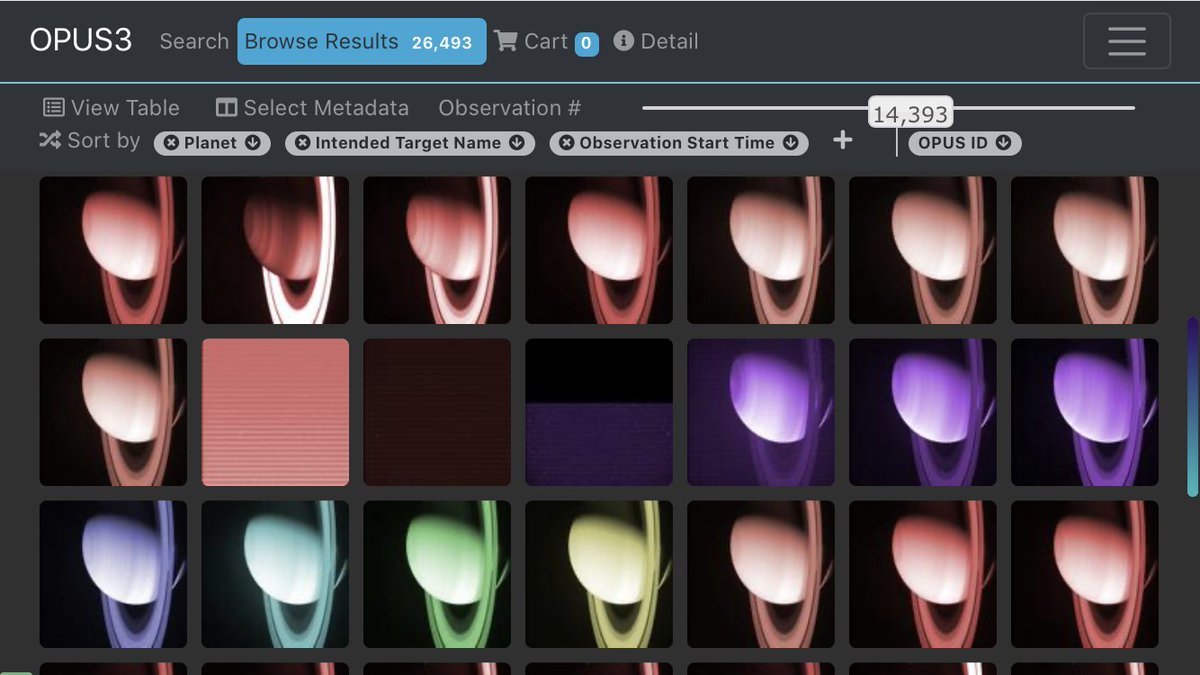
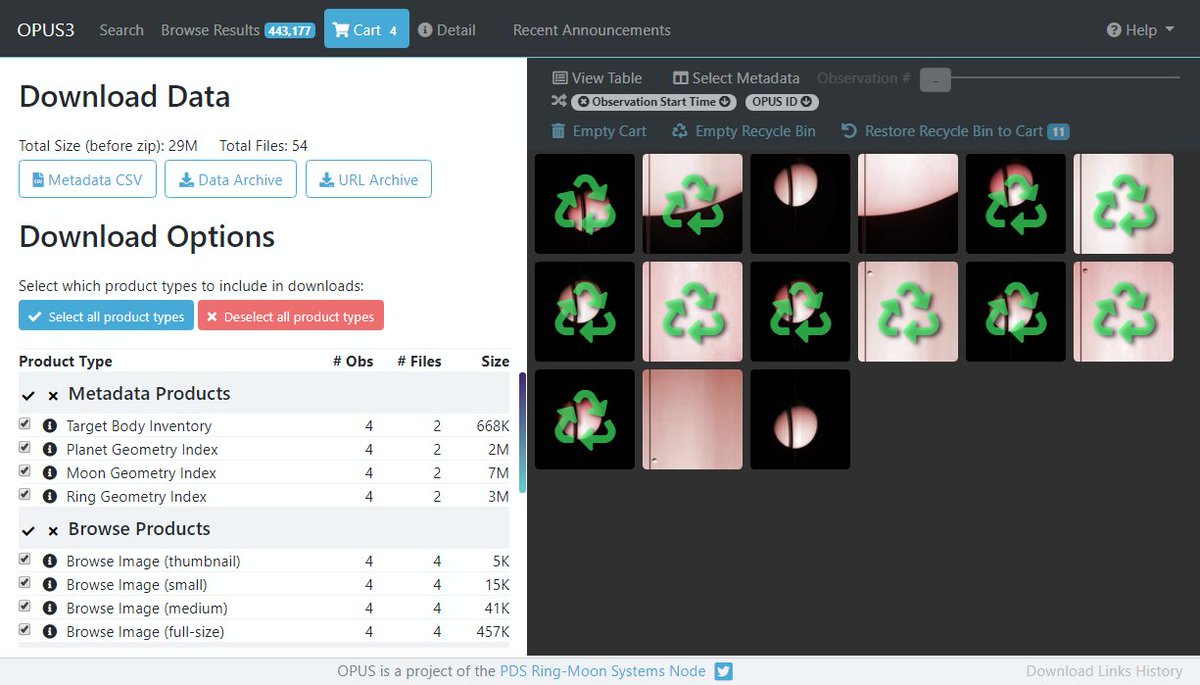
It's been awhile, but we haven't been just sitting around! Here's a summary of improvements to OPUS over the past 6 months, including viewing multiple browse images and downloading old product versions: https://t.co/7rfoyTiHlr
OPUS will be unavailable 10/21 from 0830-1230 PDT for a planned electrical outage, and 10/27-28 as @SETIInstitute starts to move to a new building. We apologize for the inconvenience.
The PDS Ring-Moon Systems Node is hiring! Join us to help archive past and future outer planets mission data and continue to improve our popular search tools. https://t.co/P1lpFohKmo
It's time for another OPUS update! This time we've added some new ways to display longitudes, latitudes, and dates, provided new ways of downloading data, and make other minor improvements. Check us out! https://t.co/qZd2YqOmP3
It's been awhile, but there's a new OPUS update! Chat live with an OPUS team member or browse our new data products or improved metadata. Details here: https://t.co/UdjDjA075f
It's time for another OPUS update! This month we have a new way to select metadata fields, tutorial videos, and support for Microsoft Edge. As always, your comments, feedback, and questions are eagerly anticipated.
https://t.co/S3O82E4Bwv
Want to learn more about OPUS? Join me on June 23 at the free OpenPlanetary virtual conference for two workshops on using OPUS. Then on June 24 we're having an OPUS hackathon!
https://t.co/S2ySTDS1En
It's that time of the month: OPUS Updates! This month we are thrilled to announce that four different types of occultation profiles of Saturn's rings are now available for your searching pleasure.
https://t.co/GbuHaVgLjT
I would like to remind everyone to please take the PDS survey. Yes, I know it's long. But it is really, really important for NASA to get feedback on how the PDS (and OPUS!) is doing. The impact of your comments (or lack thereof) will be felt for years!
https://t.co/887ALz7JZR
This month we bring you improved support for small mobile devices and the ability to sort on multiple fields at once. Read all about it!
https://t.co/61AERBxxRs
NASA has commissioned a survey on the PDS. I know it's a little long (15-20 minutes to complete) but it is extremely important that you give feedback to let NASA know how we're doing. We hope you love OPUS, but never hesitate to send questions or comments.
https://t.co/887ALz7JZR
Happy Holidays from the OPUS team! Our December release is out early and includes user-selectable units for search and other improvements. We will see you in the New Year with new exciting features to come!
https://t.co/pekbuR7LXl
Two major new features in OPUS for November: a recycle bin for the cart, and the ability to do multiple searches on one search field. Full details here:
https://t.co/1QxJvE4FvM
Keep those cards and letters coming!
We are proud to announce the public release of OPUS3. OPUS allows you to easily search more than 1.5 million NASA data products from missions to the outer planets. Please let us know what you think!
More info: https://t.co/fq9AC6hxbn
Use OPUS: https://t.co/CVFQb2DTor
OPUS now allows downloading of a list of URLs instead of a huge zip archive so that you can retrieve the data at your own pace using wget.
https://t.co/w6gsDiZbAS
Come learn about @pdsopus, the awesome outer planets search tool, at my iPoster 315.12 this afternoon! Cassini, Voyager, New Horizons, Galileo, HST...all together in one place, living in harmony, with cool new data and features being added this year. #dps18