Over the past day, sunspot region AR4479 and AR4475 blasted out an M (moderate) flare. They have the highest possible level of magnetic complexity; that means they have a strong potential to fire more M flares and even X (strong) flares!
https://t.co/G3D2oNgiGo
📸 NOAA/ GOES.
A hidden ocean beneath an alien world…Beneath a cracked, frozen shell that gleams like shattered glass under Jupiter’s glow, Europa hides one of the most tantalizing secrets in our solar system: a vast, dark, global ocean — possibly twice the volume of all Earth’s oceans combined. This isn’t just ice and rock. Scientists believe Europa’s subsurface sea is kept warm by powerful tidal forces from Jupiter, driving hydrothermal vents on the ocean floor that pump mineral-rich energy into the water. Liquid water. Chemical nutrients. Constant energy. All the ingredients life needs — right here, in the cold darkness of an alien moon.A silent, ice-covered world on the outside…
A churning, mysterious abyss on the inside that might be teeming with life we’ve never imagined. Europa isn’t just a moon.
It’s a promise.
The most promising place in our solar system to find life beyond Earth
New menu arrival!
Taikonauts on the #ChinaSpaceStation just got a tasty new treat — baked pumpkins!
The #Shenzhou23 crew used the same hot-air oven previously used by the Shenzhou-20 & Shenzhou-21 crews for chicken wings and steaks.
Supermassive black holes are the largest known class of black holes, with masses ranging from hundreds of thousands to millions or even billions of times the mass of the Sun.
They are not “holes” in the ordinary sense, but extremely compact regions where gravity dominates so strongly that, once matter or light crosses the event horizon, it cannot escape.
Observations suggest that almost every massive galaxy contains one at its center, including the Milky Way, whose central bh is Sagittarius A*. Even so, these objects occupy only a tiny fraction of their host galaxies; most of a galaxy’s mass is still in stars, gas, dust, and dark matter.
The difficulty is that sbh are both enormous & observationally elusive. Only two have been directly imaged so far by the Event Horizon Telescope: M87* & Sagittarius A*. Most of the time, we study them indirectly, by measuring how nearby stars and gas move under their gravity, or by detecting the radiation produced when gas heats up before falling inward. When a bh is actively feeding, it can power an active galactic nucleus or a quasar, making the region around it brighter than the rest of the galaxy.
When it is quiet, we infer its mass from stellar motions near the galactic center, using relations between the bh & the velocity dispersion of stars in the host galaxy.
The central unresolved question is how these objects became so massive, especially so early in cosmic history. Stellar-mass bhs can form when massive stars collapse, but that process alone struggles to explain bhs with millions or billions of solar masses only a few hundred million years after the Big Bang.
One possibility is that the first bh “seeds” came from the deaths of very massive Population III stars. Another is that some bhs formed by direct collapse, when a huge primordial gas cloud collapsed almost directly into a massive bh without first forming ordinary stars.
The key issue is whether galaxies formed first & then grew bhs at their centers, or whether some massive bhs appeared early enough to help assemble the galaxies around them.
This is where the Webb result becomes especially important. JWST observed Abell2744-QSO1, a “Little Red Dot” seen as it was only about 700 million years after the Big Bang. Because the object is gravitationally lensed by the galaxy cluster Abell 2744, Webb could study it in unusual detail.
Earlier work suggested that QSO1 might contain a bh of roughly 40 million solar masses, but that estimate still depended on indirect assumptions. Webb’s NIRSpec instrument allowed us to map the motion of hydrogen gas around the center. The gas showed Keplerian rotation, meaning it behaved as if it were orbiting a very compact central mass, just as planets orbit the Sun.
From those gas velocities, the team made the first direct measurement of a black hole mass within the first billion years after the Big Bang. The result is striking: QSO1 appears to contain a black hole of about 50 million solar masses, making up at least two-thirds of the object’s total mass.
That is completely unlike nearby galaxies, where the central supermassive black hole is only a tiny fraction of the galaxy’s mass. Webb also found that the surrounding gas is almost entirely hydrogen and helium, with very few heavier elements, suggesting a very pristine environment with little previous stellar processing.
The implication is that at least some early supermassive black holes may have been “born big.”
QSO1 does not look like a normal mature galaxy that slowly built a central black hole through stellar collapse, accretion, and mergers. Instead, it may be evidence for a heavy seed: either a primordial black hole or a direct-collapse black hole that formed before a substantial galaxy existed around it. In that scenario, the black hole is not merely a late product of galaxy evolution; it may be one of the first major structures around which gas later accumulated.
👉 https://t.co/ZhhwKXzUMX
Happy birthday to my wonderful son. @elonmusk has given me 55 years of joy.
It’s so much fun to celebrate with family and friends.
His cake is a rocket and a moon base 🎂🎂🎉
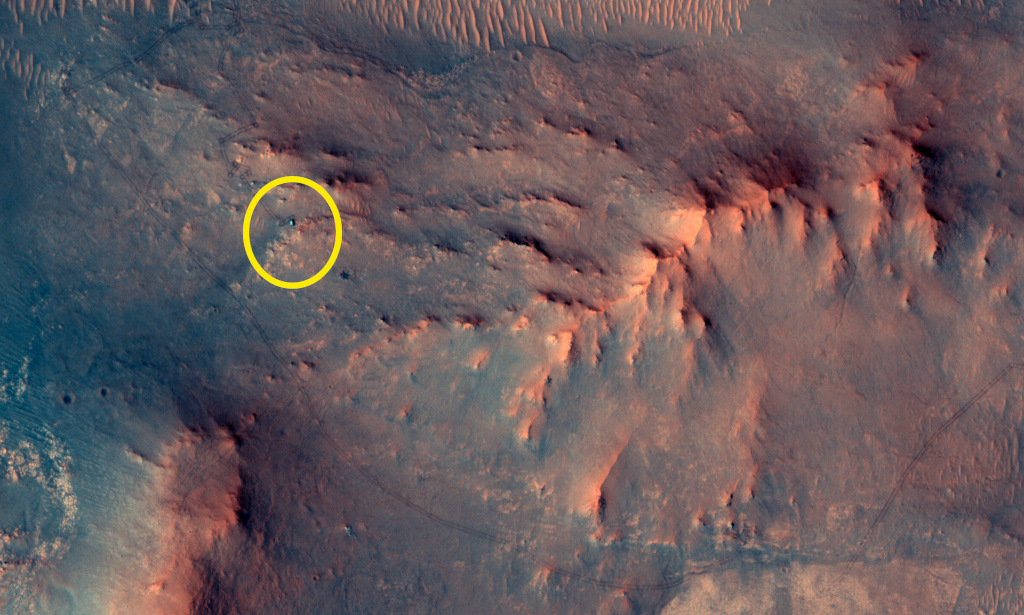
In this recent HiRISE view from the Mars Reconnaissance Orbiter, the little green dot indicated on the surface of the big Red Planet is the Perseverance Mars rover. Recorded on June 13, the car-sized, six-wheeled robot was imaged a day before completing a Martian marathon, traveling a total distance of 26.218 miles (42.195 kilometers) since it began exploring the surface of Mars. That equivalent marathon distance was achieved by Perseverance on its mission sol (Martian day) 1,890, after about 5 Earth years and 4 Earth months of driving. Perseverance is continuing to hunt for biosignatures. In the HiRISE image, the Mars rover's tracks can be seen leading to its location in an area west of its landing site in Jezero crater near an ancient river delta.
Image Credit: NASA, LPL (U. Arizona), MRO, HiRISE
🧵1/7 Une libellule de 900 kg va partir explorer Titan ! 🚁🪐
La mission #Dragonfly de la @NASA enverra un drone sur la plus grande lune de Saturne pour étudier son environnement et rechercher des indices liés à l’apparition de la vie. (avec du #Cnes dedans)
Is this what will become of our Sun?
Quite possibly. The first hint of our Sun's future was discovered inadvertently in 1764.
At that time, Charles Messier was compiling a list of diffuse objects not to be confused with comets.
The 27th object on Messier's list, now known as M27 or the Dumbbell Nebula, is a planetary nebula, one of the brightest planetary nebulas on the sky and visible with binoculars toward the constellation of the Fox (Vulpecula).
It takes light about 1000 years to reach us from M27, featured here in colors enhanced by red for hydrogen and blue for oxygen.
We now know that in about 6 billion years, our Sun will shed its outer gases into a planetary nebula like M27, while its remaining center will become an X-ray hot white dwarf star.
Understanding the physics and significance of M27 was well beyond 18th century science, though. Even today, many things remain mysterious about planetary nebulas, including how their intricate shapes are created.
Image Credit & Copyright: Francesco Antonucci
Voyager's Eternal Voyage
Launched in 1977, Voyager 1 is now traveling through interstellar space. In about 40,000 years, it will pass near another star and could continue circling the Milky Way for billions of years.
🚨 NASA Spacecraft Just Hit a Mysterious “Wall” at the Edge of Our Solar System… 🚨
Out there, far beyond the planets… beyond Pluto… where sunlight fades into darkness, something unexpected happened.
Voyager 1 — a spacecraft launched nearly 50 years ago — kept traveling into the unknown. No sound. No light. Just silence.
And then… everything changed.
Its instruments suddenly detected a strange, intense region. Temperatures rose. Energy surged. It was as if it had reached a boundary… a limit… a place where our solar system simply ends.
Some describe it as a “wall of fire.”
Not flames like we see on Earth… but a powerful, invisible force. A barrier between our Sun’s reach and the endless mystery beyond.
Imagine that for a second…
A human-made object, built decades ago, drifting billions of miles away… touching something no human has ever seen.
What lies beyond that boundary?
Is it just empty space… or something we don’t yet understand?
Voyager keeps going.
Still moving.
Still sending signals from the edge of everything we know.
And the deeper it goes… the more questions it leaves behind.🌌
NASA Bets on a Bold Newcomer: Relativity Space to Lead Humanity’s Next Leap to Mars NASA has just handed a groundbreaking mission to one of the most surprising players in the space industry.For its ambitious 2028 Mars mission, the agency has partnered with Relativity Space — a younger, privately backed company — to design, build, launch, and operate the spacecraft carrying a revolutionary science payload to the Red Planet.The mission, named Aeolus, isn’t hunting for ancient life or scooping up rocks. Instead, it will deliver something equally critical: the first daily, global map of Mars’ atmosphere. Using a suite of four complementary NASA instruments, Aeolus will track winds, temperatures, dust storms, and clouds across the entire planet, every single day.
nasa.govWhy does this matter so much? Because one day, humans will attempt to land on Mars. Every swirling dust devil, every sudden gust, and every hidden atmospheric surprise could decide the difference between a safe touchdown and catastrophe. Aeolus data will sharpen our models, reduce risks, and help make future crewed missions dramatically safer and more reliable. What makes this partnership remarkable is the trust placed in Relativity Space. The company has never flown to Mars before, and its next-generation Terran R rocket is still gearing up for its debut. Yet NASA is betting big on fresh innovation — a clear sign that the future of deep-space exploration increasingly belongs to agile private companies working hand-in-hand with government expertise.And here’s the awe-inspiring reality:The journey to Mars spans an average of 225 million kilometers (140 million miles). Even screaming through space at tens of thousands of kilometers per hour, the trip takes many months. Every successful mission begins with the same spark: the courage to chase what once seemed impossible. This is more than a spacecraft launch. It’s a vote of confidence in the next generation of space pioneers — and a powerful reminder that humanity’s march to the Red Planet is accelerating.Would you put your faith in a rising star like Relativity Space for such a high-stakes mission, or would you prefer established veterans to carry the torch? Drop your thoughts below!
🚨: Voyager 1 is now so far from Earth that a signal traveling at the speed of light takes 23 hours, 32 minutes and 35.444 seconds to reach it — so when engineers send a command, they can wait nearly two days to know whether the spacecraft responded.
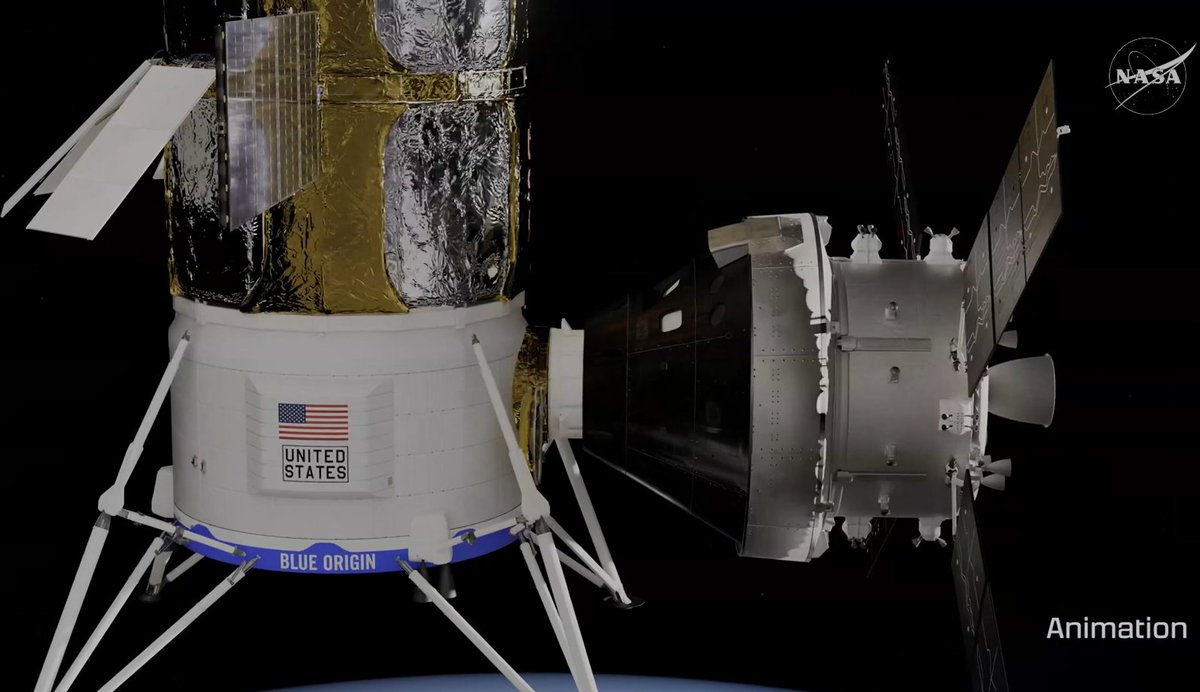
La NASA a également fait le point sur Artemis III et les modules d'atterrissage lunaires lors de l'événement d'aujourd'hui !
Artemis III / SLS
- L'installation et l'assemblage des moteurs RS-25 sont prévus pour cet été
- L'entretoise ICPS est en cours de fabrication à Marshall
- Une version raccourcie du SLS sera mise en place avec Orion cet automne pour les essais WDR
Artemis III / Profil de la mission
- New Glenn sera lancé en premier, suivi du SLS, puis de Starship
- Il y aura 2 jours d'opérations d'amarrage avec Blue Moon
- Il y aura 1 jour d'opérations d'amarrage avec Starship
- La mission devrait durer environ 2 semaines
- La récupération d'Orion est à nouveau prévue dans l'océan Pacifique
Mises à jour sur l'atterrisseur / Blue Origin
- Blue Moon peut rester en orbite pendant 90 jours
- De nouvelles images de l'atterrisseur ont été présentées
- La construction du pad LC-36B se poursuivra pendant la réparation du pad LC-36A
- La NASA est convaincue que New Glenn sera prêt pour Artemis III
- Les astronautes suivent actuellement la formation sur Blue Moon
Mises à jour sur l'atterrisseur / SpaceX
- Artemis III utilisera un vaisseau V3 équipé d'un adaptateur d'amarrage
- La démonstration de transfert de propergol est prévue pour plus tard cette année
- Il existe une option permettant à Orion et à Starship HLS de s'amarrer en orbite basse (LEO) pour les missions d'atterrissage
- Dans ce scénario, Starship effectuerait la TLI
- Cela offrirait davantage d'options d'interruption de mission
[English below🇬🇧] Bravo @astro_luca !! 🇮🇹🇪🇺 Super heureux pour toi, vieux frère 🫂🤝
Comme quoi la qualification de pilote d’essai (à l’EPNER avec la @DGA 🇫🇷 !) peut mener loin 😉🫡
🌎Artemis 3 sera une très belle mission, complexe, en orbite de la Terre, fondamentale pour préparer les suivantes vers la surface de la Lune !
🇪🇺Comme l’a dit le directeur de l’ESA en novembre : l’Allemagne, l’Italie et la France sont en lice dans cette aventure, et toute l’Europe avec elles. (✅ ☑️ ☑️)
Bravo aussi aux autres membres de l’équipage : Randy Bresnik, Frank Rubio et Andre Douglas. Une équipe impressionnante à qui le orange caractéristique de la navette (et des essais en vol) va comme un gant !
/
Congratulations Luca!! 🇮🇹🇪🇺 So happy for you, Brother 🤝
🛫It just goes to show that test pilot training (at EPNER with the French @DGA 🇫🇷!) can take you a long way 🫡
🌎Artemis III will be a fantastic and complex mission in Earth orbit, a crucial step in preparing the missions that will follow to the lunar surface!
🇪🇺As ESA’s Director General said back in November: Germany🇩🇪, Italy🇮🇹 and France🇫🇷 are all part of this adventure, and all of Europe stands with them.
Congratulations as well to the other crew members: @AstroKomrade, Frank Rubio and @Astro_AndreD. An outstanding team for a mission that will pave the way for the next phases of the Artemis programme 🚀🌕
#ArtemisIII #Artemis #NASA #ESA
#LucaParmitano
For those impacted by the earthquake in the Philippines, Starlink Mobile is providing free connectivity to @enjoyGlobe customers in the affected regions.
Families, communities and businesses with compatible LTE smartphones can now stay connected through select apps and SMS even if terrestrial networks are not available
It was visible around the world.
The sunset conjunction of Jupiter (left) and Venus (right) in 2012 was visible almost no matter where you lived on Earth.
Anyone on our planet with a clear western horizon at sunset could see them. That year, a creative photographer traveled away from the town lights of Szubin, Poland to photograph a near closest approach of the two planets.
The bright planets were then separated by only three degrees and his daughter struck a humorous pose. A faint red sunset still glowed in the background. Jupiter and Venus are together again this week after sunset, passing within a degree of each other about two days from today.
Image Credit & Copyright: Marek Nikodem (PPSAE)









![Thom_astro's tweet photo. [English below🇬🇧] Bravo @astro_luca !! 🇮🇹🇪🇺 Super heureux pour toi, vieux frère 🫂🤝
Comme quoi la qualification de pilote d’essai (à l’EPNER avec la @DGA 🇫🇷 !) peut mener loin 😉🫡
🌎Artemis 3 sera une très belle mission, complexe, en orbite de la Terre, fondamentale pour préparer les suivantes vers la surface de la Lune !
🇪🇺Comme l’a dit le directeur de l’ESA en novembre : l’Allemagne, l’Italie et la France sont en lice dans cette aventure, et toute l’Europe avec elles. (✅ ☑️ ☑️)
Bravo aussi aux autres membres de l’équipage : Randy Bresnik, Frank Rubio et Andre Douglas. Une équipe impressionnante à qui le orange caractéristique de la navette (et des essais en vol) va comme un gant !
/
Congratulations Luca!! 🇮🇹🇪🇺 So happy for you, Brother 🤝
🛫It just goes to show that test pilot training (at EPNER with the French @DGA 🇫🇷!) can take you a long way 🫡
🌎Artemis III will be a fantastic and complex mission in Earth orbit, a crucial step in preparing the missions that will follow to the lunar surface!
🇪🇺As ESA’s Director General said back in November: Germany🇩🇪, Italy🇮🇹 and France🇫🇷 are all part of this adventure, and all of Europe stands with them.
Congratulations as well to the other crew members: @AstroKomrade, Frank Rubio and @Astro_AndreD. An outstanding team for a mission that will pave the way for the next phases of the Artemis programme 🚀🌕
#ArtemisIII #Artemis #NASA #ESA
#LucaParmitano](https://pbs.twimg.com/media/HKZpzwuWAAANzze.jpg)


