Homi Bhabha
R Chidambaram,
PK Iyengar,
MR Srinivasan,
VS Arunachalam,
Raja Ramanna,
K Santhanam
K Subramanyam (Jaishankar father)
Every Indian should thank these people for the Indian nuclear weapons program. Daily thank God for them
on the first day of class my astronomy professor asked us why the night sky was dark. if our universe is infinite, how can there be spaces between the stars? he didn't answer the question until the last day-because our universe is relatively young, and is still growing. it is finite. not enough stars or galaxies have been formed to fill up the entire night sky. but what that means to me is that somewhere, in an older universe, the night sky looks like a tapestry of diamonds. somewhere darkness is pale white and glittering. imagine being so surrounded. i haven't gotten that image out of my head ever since you could never navigate under such a sky but god it sounds lovely
Last week I completed the Kuari Pass Trek in Uttarakhand reaching at almost 13,000ft and clicked some pictures from our Khullara campsite and also the arm of our Milky Way.
BREAKING: Sugars essential for life have been found in pristine asteroid Bennu samples collected by NASA’s OSIRIS-REx spacecraft. Combined with previous detections of amino acids and nucleobases, we see that life’s ingredients were widespread throughout the solar system: https://t.co/Tb3HpwZG9J
More on the study led by Yoshihiro Furukawa of @TohokuUniPR⤵️
The Raulane festival, Himachal.
Locals believe that in winter, when the cold turns unforgiving, celestial fairies called Saunis descend from their heavenly palaces to watch over the villages. They guide, they safeguard, and bring a quiet reassurance the community depends on.
Raulane is celebrated to honour them. Two men are chosen as a symbolic couple, the “bride” (Raula) and the “groom” (Raulane). They dress in heavy Kinnauri woollens made for the harsh cold. Masks veil their faces, gloves hide their hands, the idea is to transform a human into a ritual figure, an intermediary between the people and the Sauni spirits.
The central moment unfolds at the Nagin Narayan temple. The two enter in full attire, offer prayers, and begin a slow, symbolic dance. Villagers believe this dance opens a channel between humans and the Saunis. Versions of this festival appear across the Himalayan belt, each region adding its own flavour.
5,000 years old civilisation, preserving a culture so enduring, so unbroken, that even time stands in awe of it.
My girlfriend thought electron spin meant the electron is a tiny sphere spinning on its axis.
But here's the thing: electrons aren't little balls. They're excitations in the electron field, quantum objects without a physical surface to spin.
So how can something "spin" if it's not a classical object rotating?
Quantum spin isn't classical rotation. It's an intrinsic property, a fundamental quantum number. Think of it as the universe's minimum unit of angular momentum (ℏ/2). It's not about motion, it's about how the particle's quantum state transforms when you change your perspective.
THE PARADOX OF CLASSICAL SPINNING
If electrons actually spun like little balls, the surface would move faster than light. Seriously. Based on electron size and measured magnetic properties, the math doesn't work. Classical spinning is impossible. Yet experiments show electrons have measurable angular momentum and magnetic fields.
The resolution: electrons don't spin classically. They're not spinning objects. The angular momentum is intrinsic, baked into the quantum field itself.
HERE'S THE INTUITION
Imagine you have a camera on a 360 degree rotating stand, filming the room around you. When you watch the video, the room appears to spin but nothing actually moved except the stand itself.
Now translate this:
Camera = electron
Room = space
Rotating stand = your coordinate system
When you rotate your reference frame, the electron's spin state changes in the measurements.
The electron's quantum state transforms in a specific mathematical way called a spinor. That transformation is what we call "spin."
THE QUANTUM FIELD VIEW
In quantum field theory, the electron isn't a point particle with properties. It's an excitation in the electron field, a disturbance in the quantum fabric of spacetime. When the electron field has an excitation with angular momentum ℏ/2, we call that an electron with spin 1/2.
The spin isn't stored in some rotating mechanism. It's literally part of how the field configuration carries momentum and energy.
WHY THIS MATTERS
Spin is intrinsic because it's built into how quantum fields behave under rotations. No spinning motion required, just pure mathematical structure. This intrinsic property determines:
The Pauli Exclusion Principle (why only two electrons fit per orbital)
The difference between fermions and bosons (fundamental to all matter)
Particle statistics (how identical particles behave)
THE DIRAC EQUATION CONNECTION
Paul Dirac's equation naturally predicted spin when physicists first wrote down the relativistic equation for electron behavior. Spin emerged from the mathematics without anyone putting it in. The theory predicted both the existence of spin and its value (ℏ/2) before experiments confirmed it.
MEASUREMENT AND QUANTUM MECHANICS
When we measure spin, we get one of two outcomes: spin up or spin down. Never anything in between. This quantization is pure quantum behavior. There's no classical analogy where a spinning object can only spin in two discrete directions.
The Stern-Gerlach experiment proved this. Pass electrons through a magnetic field and they split into exactly two beams, not a continuous spread. This only makes sense if spin is quantized at the most fundamental level.
WHAT SPIN REALLY IS
Spin is the quantum field's intrinsic angular momentum. It's an irreducible quantum number that can't be decomposed into orbital motion or any classical mechanism. It's as fundamental as electric charge, just like an electron's charge or mass, except unlike those it has direction.
Think of it this way: asking "what makes the electron spin?" is like asking "what makes the electron have charge?" It just does. It's built into the electron field's mathematical structure.
This is why physicists hate the word "spin." It's misleading. But we're stuck with it for historical reasons. The name caught on in the 1920s before we understood quantum mechanics well enough. Now it's too late to change it.
In India, when someone does something not acceptable socially or in a civic sense, we are quick to say "they are like that" and move on.
We need to develop a culture of "impromptu benevolent protest" against such behavior.
But always give the benefit of doubt to someone causing an issue, yet just let them know it is not the right thing to do. And others in the vicinity must get ready to back it up if you see a good samartian take an issue with someone.
Let's say someone is spitting on the road, 9 of 10 will move on thinking "why bother telling that guy." One loner may get really riled up and take a confrontational approach.
Both the 9 and the 1 are right. Even the guy spitting in a corner may be right, in the case he is someone who never spits, and probably was choking on something and had to get it out. We may never know.
The attitude to have in such a case should be that of a non-confrontational approach. To let them know people are watching and it is not right. Let them know with something like "Are you OK? I saw you spit at the corner. Children play around here."
Just guilt trip them in a friendly way and they will make their changes over time.
I do this myself to people and invariably they change soon enough. One guy who was talking on phone loudly next to a hospital ward at night even apologised to me few days later when he saw me at the car park.
Similarly, long ago, I was told by one lady in a very friendly way that I was not holding doors for people behind me. And since then, for decades, I have always held the door and lifts for people behind me. No matter they take a minute to come through.
All of us can change for the better and a little friendly social push by one nice person can bring about this change.
And if three people around just stop to look at a person disapprovingly, their attitudes tend to change. A genuine person will always apologize and move on. And we need to let them go.
This sort of social pressure can work wonders in instilling a community civic sense. Just think about the last time your neighbor did something unacceptable?
Like say backing up their car with full backup music on at the middle of the night, or dumping their garbage on the street, or letting their dog sh1t outside your home, on your street, without cleaning up?
And you remained silent because you didn't want to get into an "issue with them?"
This is where the Indian society fails. There are a large number of people in India who are law abiding and care about their city, neighbourhood, and everything. But we let the few bad apples define what we are, with impunity, without that social pressure.
Next time, you see someone do something like throwing trash on the road or speed in your local street, make sure to let them know it is causing you discomfort. And in a non-confrontational friendly way.
If they still do it, or get confrontational, get other good samartians to support you and challenge them. The society will change itself one mohala at a time. India will change.
I am not saying everyone will change. And we must let go of those ones without getting into trouble. But most will change to conform to their society.
Now, for a start, please don't reply telling me how this won't work. Such pessimism guiding our inaction is the biggest issue. A lot of scientific studies show this works. I will leave it at that.
Although the Earth is moving in several ways, spinning on its axis and orbiting the Sun (and even carried through space with our solar system), we don’t feel any of this motion in our daily experience.
The key reason is that all motion is smooth and shared: everything around us (the ground, the atmosphere, our bodies) is largely moving together at the same velocity, without abrupt changes or jolts. Our senses are tuned mainly to detect changes in motion (accelerations), not constant motion.
Since Earth’s rotation (once per day) and its orbital motion are very nearly constant, and their accelerations are extremely gentle, there’s no sensory trigger that shouts “we’re moving!”
Gravity also plays a role. It holds us firmly to Earth’s surface, overwhelming the tiny outward “centrifugal” effect produced by Earth’s spin. The force due to rotation is so small compared to gravity that it doesn’t produce perceptible effects (except extremely subtly, e.g. making us fractionally lighter at the equator than at the poles).
Because gravity supplies the centripetal force needed to keep us moving in a circle with Earth, we don’t feel being “pulled outward” or otherwise disturbed, there is no relative motion or internal stress for our bodies to notice.
In simpler terms: if you’re riding in a car going at constant speed on a smooth road, it seems like you’re stationary unless the car speeds up, slows down, or turns sharply. That’s like being on Earth: everything around you co-moves, so there is no differential motion to sense.
i think, pumping their compensation/salary should be the 1st step,
Indian scientists for the work they do are grossly underpaid, anyone outside would easily hire them, many stay for the love of the country and work, we should reward them handsomly
most politicians will own luxury cars and large houses, most of the scientists will never, those who do wait till retirement to use their PFs to clear house loans etc
Do you remember the demonstration video of Akash engaging multiple highly maneuverable targets at the same time? Akash has proved its mettle in back to back real combat. Undoubtedly, it's one of the best, if not the best, AD in short range domain.
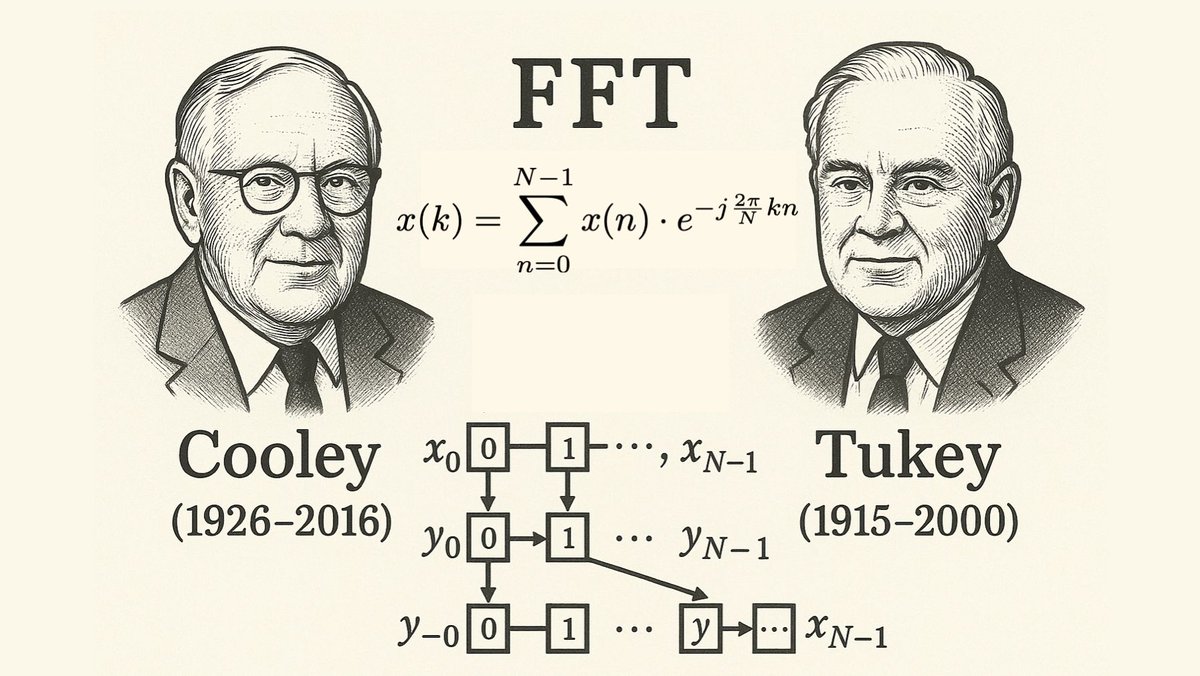
60 years ago this month, the Fast Fourier Transform (FFT) was introduced by Cooley & Tukey (1965) - one of the most important algorithms in signal processing and data analysis.
In 1805, Gauss - studying the orbits of asteroids Pallas and Juno - came up with a method to interpolate their trajectories from discrete samples. What he came up with was mathematically very close to the modern FFT but Gauss never published that work, and didn’t analyze its computational complexity. It predated even Fourier’s 1822 work on heat diffusion - but without the framing or generalization that Cooley & Tukey would bring 160 years later.
In 1965, Cooley & Tukey published their now-famous algorithm that reduced the cost of computing a Discrete Fourier Transform from 𝑂(𝑛²) to 𝑂(𝑛 log𝑛). This leap made real-time signal processing and digital media compression feasible.
From radio telescopes to JPEGs, from audio codecs to quantum mechanics - the FFT is everywhere. It’s one of the most important (and elegant) algorithms of the 20th century - rooted in the genius of Gauss, but brought to life in the computer age.
enough jokes and all we made about dhoni retirement or uncapped player etc. but the fact of the matter is as long as the franchises are okay with senior players being part of the team and players are fit enough to play, nobody should be questioning them. this isn’t a national team. it’s entertainment. and the amount of ad money someone like dhoni pulls single handedly, i doubt if even the whole of pbks can do that. plus he is playing well for his role. so its like a no brainer for csk to keep him. there is money and there is a finisher who even at his 50% is better than most others that they would have to prep in case he chooses to hang his boots. more fun cameos by him we need. what csk needs to fix is everything but dhoni.