ASTS Horizon v1.15.0 is officially live on iOS and Android! Here is what’s new in this build
$ASTS
- The 3D globe now features live day/night shading.
- Swapped out the generic markers for custom ASTSpacemobile-inspired satellite designs.
- New toggle to see the global coverage of the entire network at once.
- Selecting a sat on the map is now instant (no more annoying camera resets or flickering).
- Trails now draw dynamically across the map like a laser.
- And of course, bigger waffles! Enjoy!
@RKLBMan@AlexfromBabylon@Peter_J_Beck Even so, Peter Beck can only imagine what an $ASTS satellite is and takes to be built. He doesn't have all the details. All we can do is assume what they know and what they foresee based on their knowledge.
"Communist politicians"... For someone who wants to operate in sophisticated investment markets, this kind of expression reveals a surprising level of ignorance. You can't analyze markets effectively with a propaganda-fed brain. Try reading a bit more; it will only improve your decision-making.
“We have a design for this, and it’s going into production, I think, next year, which is quite a revolutionary microcell tower thing that you can just put on your roof like installing a dish.”
Really? So, every Starlink Mobile user will need to buy/rent these?
$ASTS $SPCX
Elon Musk reveals SpaceX’s plan to connect every phone on Earth from space, and the rooftop “microcell” that solves the indoor problem:
“We got a plan that broadly enables ubiquitous access on Earth, including via cell phone.”
“We’ll be launching the SpaceX direct-to-cell version 2 constellation starting next year. That will, I think, have 40 times the bandwidth of the current direct-to-cell version 1… where it can connect directly to your phone from space with just your normal phone. There’s nothing that needs to be added to it.”
“There is a missing piece to the puzzle here, which is that if you’re indoors, especially if you have a metal roof, that blocks the signal from space.”
“Instead of having these big cell towers all over the place, having a whole bunch of microcell sites that are scattered throughout densely populated areas.”
“We have a design for this, and it’s going into production, I think, next year, which is quite a revolutionary microcell tower thing that you can just put on your roof like installing a dish.”
“I don’t think this means like AT&T, Verizon, others go out of business or anything. Maybe they’ll lose some revenue here, but I actually think that the demand for bandwidth will be tremendous in the future, and that bandwidth will be driven primarily by superintelligence and robots.”
“While humans can speak at maybe 100 bits per second at a peak rate, the computers can do it at a trillion bits per second.”
I genuinely feel for everyone who bought $ASTS over the past few months.
Watching a stock fall this hard is never easy. It's natural to feel panic.
But let's put things into perspective.
Over the past 6 months:
$ASTS is down approximately 67%.
$RKLB is down approximately 56%.
And Rocket Lab doesn't even face the same satellite deployment bottleneck as AST SpaceMobile.
So is this really just an ASTS execution problem?
In my opinion, a large part of this selloff reflects broader market conditions.
When uncertainty rises, investors tend to sell high-beta, pre-commercial companies first — especially those operating in capital-intensive industries like space.
Here's what matters to me:
The investment thesis hasn't fundamentally changed.
The technology hasn't changed.
The long-term opportunity hasn't disappeared.
Yes, ASTS still needs to launch more satellites. Execution matters, and patience alone doesn't guarantee success.
But space is an incredibly difficult industry. Building something this ambitious takes time.
If connecting ordinary smartphones directly to satellites were easy, someone would have already done it.
That's why I'm still holding $ASTS.
I'm investing in what this company could become over the next decade, not reacting to every short-term price movement.
The real question isn't how much the stock has fallen. It's whether the long-term thesis is still intact.
If you believe in the long-term space economy, follow me.
Let's see where this journey takes us.
Not financial advice.
$ASTS
THE PERFECT STORM FOR ASTS (AND THE SPACE/GROWTH SECTOR). BUT...
I've been thinking about the extraordinary selling pressure in ASTS. Several factors have converged to create what I believe is a perfect storm.
1. Blue Origin pad explosion (May 28)
Increased uncertainty around New Glenn launch capacity and ASTS's satellite deployment timeline.
2. SpaceX IPO (June 12)
Before SPCX went public, investors looking for exposure to the space economy had limited choices. Arguably, ASTS and RKLB together offered one of the closest publicly traded alternatives to SpaceX.
Suddenly, investors could buy SpaceX directly. The scarcity premium may have diminished, and capital had a new destination.
3. AI continues to absorb capital
AI has attracted enormous investment flows, competing with space and other emerging growth sectors for capital.
4. Growth stocks underperform the broader market amid a more restrictive interest-rate outlook
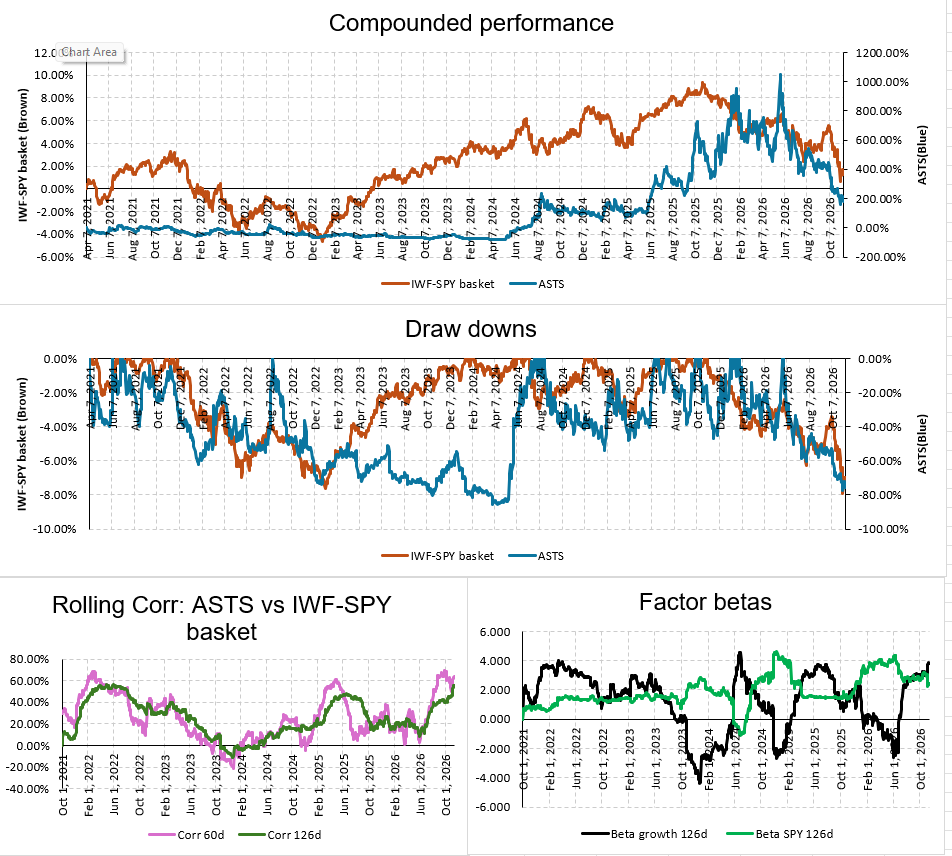
My analysis of IWF (Growth ETF) versus SPY shows significant deterioration in growth stocks relative to the broader market. (See charts.)
More importantly, ASTS's correlation with this growth factor has increased substantially, suggesting broader market forces are playing an increasingly important role in its price action.
5. Short interest increases significantly
ASTS short interest rose from approximately 52.4M shares in mid-May to 67.5M by late October, an increase of nearly 29%.
Not all of this represents outright bearish positioning, but it adds another dimension to the supply-demand imbalance.
6. Positioning amplifies the decline
Leveraged investors, momentum strategies, ETF rebalancing, and potential tax-loss selling can create additional pressure as prices fall.
7. Further SpaceX launch delays
Additional SpaceX launch delays and uncertainty surrounding available launch capacity have reinforced concerns about ASTS's deployment schedule and the timing of commercial revenues.
8. Institutional buyers aren't yet ready to absorb the selling
This may be the most overlooked factor.
Despite its substantial market capitalization, ASTS is still transitioning from development to commercial operations.
Many institutional investors remain constrained by investment mandates, risk limits, and the absence of established recurring revenues and proven unit economics.
Even those who believe in the long-term opportunity may not yet be willing to allocate meaningful additional capital.
My estimate is that roughly 20 million shares have been involved in ownership rotation since the decline began and may still need to find a stable, long-term home.
With many potential institutional buyers waiting for commercial validation, the imbalance between available supply and committed long-term demand could be substantial.
And when natural buyers are limited, the impact of selling can become disproportionate.
BUT... HERE'S WHERE IT GETS INTERESTING.
I believe this entire dynamic could change remarkably quickly as we move into Q1 2027.
What distinguishes ASTS from many other high-growth companies is the potentially enormous unlocking of value that lies immediately ahead.
Years of technological development, spectrum access, MNO partnerships, manufacturing investment, and infrastructure preparation have brought the company to the doorstep of commercial service.
We can see the promised land (launch agreements covering 100+ BlueBirds secured).
The question is no longer simply whether the technology can work. It's increasingly about how quickly ASTS can deploy enough BlueBirds, scale commercial operations, and demonstrate the economics of its business model.
Securing launch capacity for more than 100 satellites is an important achievement. But successful deployment, commercial activation, and ultimately recurring revenues are the milestones that will unlock that potential.
Every additional satellite successfully deployed brings the company closer to a more predictable operating and revenue profile.
And the commercial ecosystem continues to expand.
The potential addition of T-Mobile and Deutsche Telekom is particularly interesting.
Beyond the existing relationships with AT&T, Verizon, Vodafone, Rakuten, and numerous other MNOs, these operators could further expand ASTS's addressable subscriber base and strengthen its position as a global direct-to-device infrastructure provider.
More importantly, the strategic significance goes beyond the number of subscribers.
As additional major MNOs embrace ASTS's technology, the commercial opportunity becomes broader, the potential revenue base more diversified, and the business model increasingly credible.
The transition from signing partnerships to activating commercial services is where that potential begins to translate into actual revenue.
And that matters enormously for institutional investors.
The very investors who may be reluctant to allocate significant capital today could become much more comfortable as commercial service begins, recurring revenues become visible, and execution risk declines.
And then there's the possibility of additional strategic investors.
META is particularly interesting.
Meta representatives have visited ASTS, and Abel hinted at another 3 billion devices during the BlackLift presentation.
Google is already a strategic investor in ASTS.
Could Meta eventually follow a similar path?
Nothing has been announced, and a commercial relationship doesn't automatically translate into an equity investment. But the strategic rationale is certainly worth considering.
A Meta investment, if it materialized, could provide much more than additional capital. It could expand ASTS's commercial ecosystem and potentially accelerate broader institutional interest.
That's when the shareholder base could begin to change and re-ratings happen.
From investors financing a development-stage opportunity to institutions investing in an emerging commercial business.
And this is where I see the potential asymmetry in future capital flows.
The selling pressures have been building for months, while the commercial milestones that could attract an entirely new class of institutional investors are still ahead of us.
If ASTS successfully transitions into commercial operations, it won't simply be a question of existing shareholders becoming more optimistic.
An entirely new pool of institutional capital could begin considering the company investable.
And that potential change in the shareholder base could be just as important for the stock as the commercial revenue itself.
If the macroeconomic environment stabilizes, the combination of improving fundamentals, expanding MNO relationships, growing institutional demand, potential strategic investment, and reversing capital flows could be powerful.
I'm not suggesting everything will happen overnight or that execution risks have disappeared.
But I do believe ASTS is approaching an inflection point unlike that of many other growth companies.
The same stock that has suffered from a perfect storm of selling pressure could eventually benefit from a perfect storm of improving fundamentals and expanding investor demand.
$ASTS: @AbelAvellan called out copycat/wannabe D2D systems as well as all the people who doubted the possibility of broadband D2D when @AST_SpaceMobile started 🔥🔥🔥
"Building these kind of satellites have an extraordinary barrier of entry. Very, very difficult. We have over 3,900 patents and patent pending claims to build them. That by itself, the capital, the knowledge, the IP, is an extraordinarily high level of barrier of entry. When you combine that with the ability to launch, the barrier of entry even got higher. If any of the people that called me crazy a few years back when we started this, and they're now trying to copy us, not good copies, but they're trying to copy us, good luck on building something like this and getting launch. That's just simply the reality. That's just simply the reality."
Timestamped: https://t.co/eFmK3sTi1C
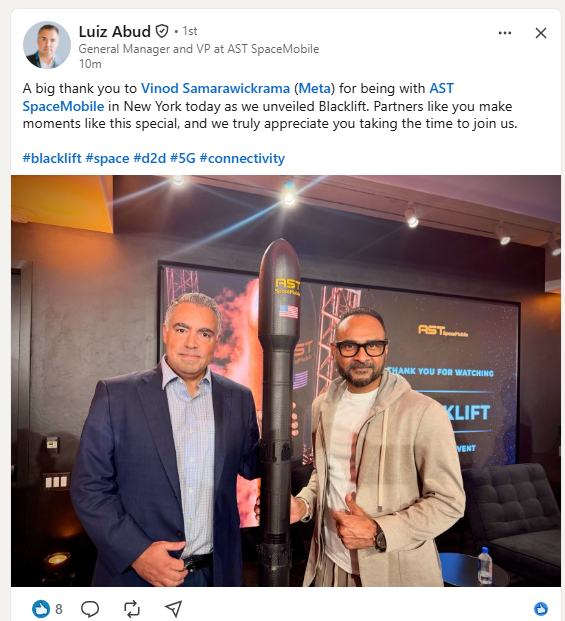
$ASTS $META: Add it to the list of official @Meta connections! Vinod Samarawickrama was at the Blacklift Unveiling Event!
@luizabud1 refers to Vinod/Meta as a "partner". 🤝
https://t.co/ViEZzBVbdO
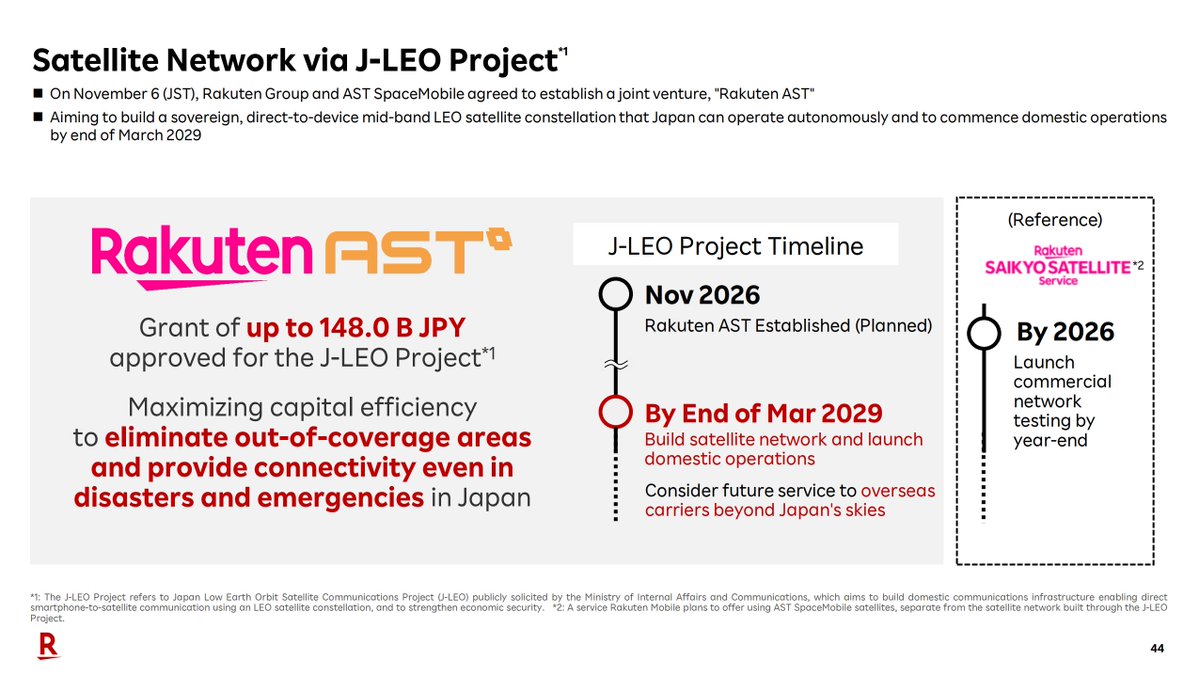
$ASTS: 🚨@Rakuten_Mobile just reported their Q3 2026 earnings! Here are highlights relevant to @AST_SpaceMobile 👇
+ RAST/J-LEO got its own slide highlighting all the usual details. Notably, it reiterates that they will "launch commercial network testing by year-end" 2026.
*Reminder that J-LEO is a separate 136-midband satellite constellation at 43 degree inclination, that is ADDITIONAL TO the American FCC flagged 248-low and midband satellite constellation.
+ Total subscribers as of Sep-26 for Rakuten Mobile gained 1.72M YoY, totalling 11.05M.
https://t.co/q2EfP9Y0XE
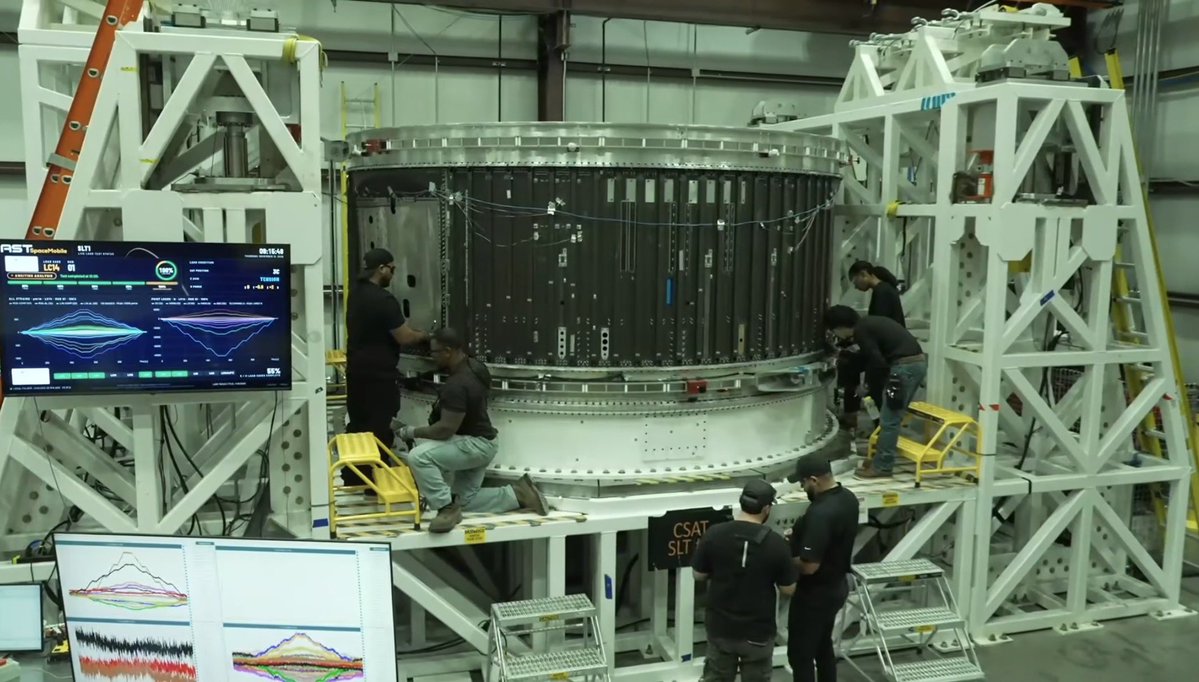
Watching the @AST_SpaceMobile Blacklift unveiling video this morning and something that sticks out to me is just how similar their satellite structures are to rocket body structures.
Not entirely the same obviously but close enough that the pivot into developing and building a vehicle structure doesn’t seem like too much of a leap for them.
$ASTS When asked about foreign countries trusting @AST_SpaceMobile over Starlink...
Abel: 'I'm not Musk and I don't want to be. We're fundamentally different.'
Don’t miss it. The Blacklift Unveiling Event goes live today at 10 a.m. ET. Hosted by award-winning journalist Dr. Fareed Zakaria tune in to hear Abel Avellan and the AST SpaceMobile team discuss how we will serve more people, more places and more markets with our new rocket, Blacklift.
Watch here: https://t.co/PPEos3Jy0w