Really great breakdown of what you can build with workflows.
@slitehq has set up a workflow that helps nurture the audience grown from releasing their ebook.
https://t.co/CebQjmmmVd
Your knowledge base setup won’t work in 2027.
But you'll still need one.
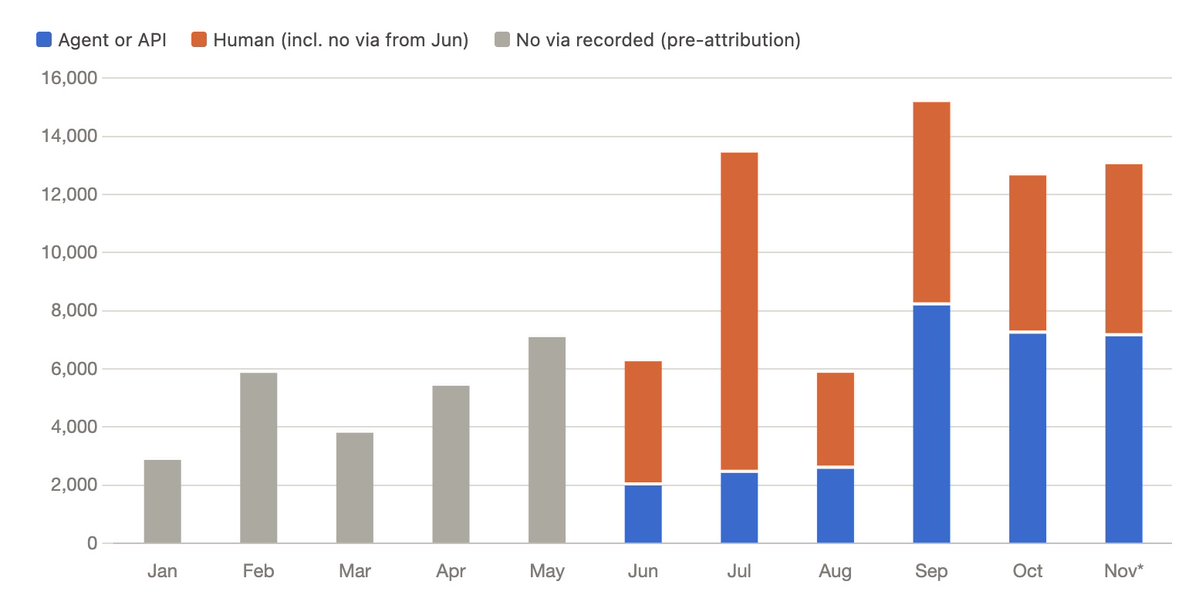
AI now reads all the documentation your team ever wrote, including what's outdated. In the teams we researched for The Knowledge Framework Playbook, agents already make 11% of document reads, yet only 1.3% of key documents are verified.
So where do you start?
On Tuesday 8 December at 6pm CET, @Christophepas shares what we learned from 50 teams, 309 help centers and 16 interviews for The Knowledge Framework Playbook.
In one hour, he'll cover three things.
→ What to fix first
→ Who keeps it true
→ How to keep it true for your team and AI
Bring your questions for the Q&A at the end.
Save your spot here: https://t.co/NB8qvO5Y8m
Cleaning up a knowledge base is mostly about taking things away.
Here's the order we'd follow.
1. Archive what nobody reads
2. Merge the copies
3. Give every document a real name
4. Put each document in the right channel
5. Move records like meeting notes out of the way
6. Give every channel one owner
7. Verify what's left, with an agent on the pages that constantly change
The median knowledge base holds about 5,000 documents. No team can keep that many verified by hand.
In our free Knowledge Framework Playbook, we show you how: https://t.co/eigmZaOosn
We spent the last few weeks on this one with the @slitehq team 🧡
AI now writes and reads your company knowledge. If that knowledge is outdated, you get confident wrong answers.
This is our (free) playbook for keeping it true ⬇️
AI agents now do 20% of the reading in the median knowledge base.
The median doc in there is 505 days old.
And only 1.3% of docs are trustworthy.
We wrote a book on what to do about it.
Out today, free.
https://t.co/ujLKTcc1q6
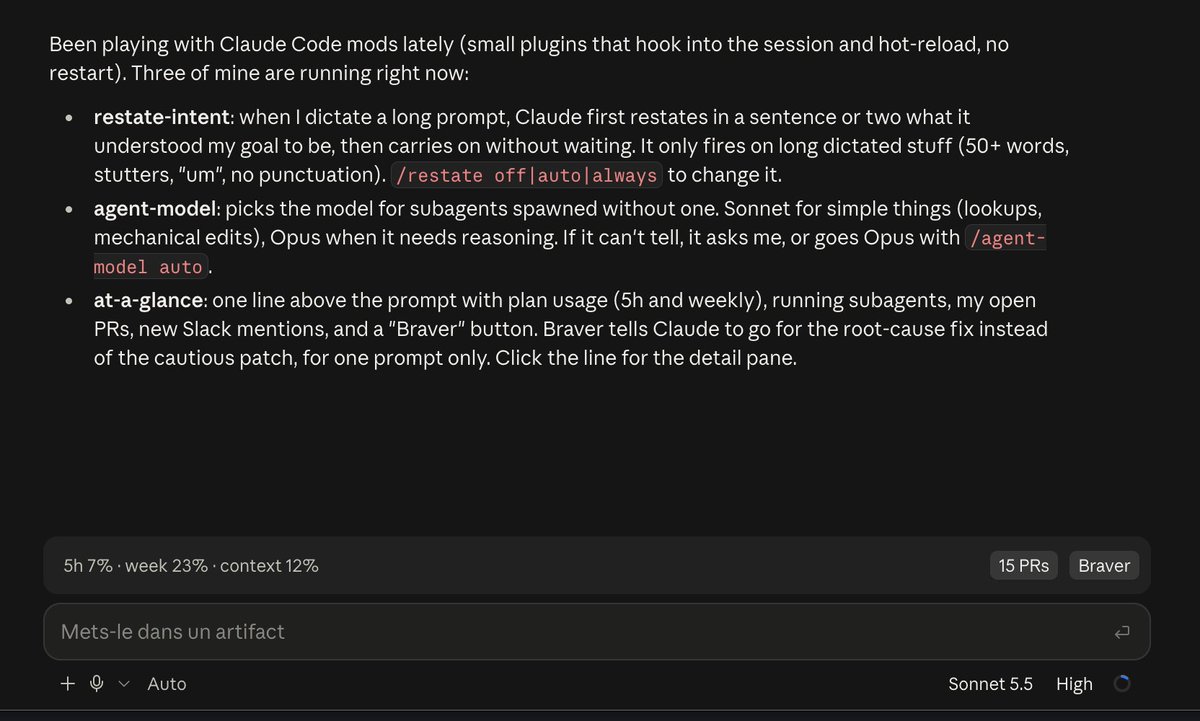
Been playing with Claude Code mods.
3 I'm running right now:
- restate-intent: when I dictate a long prompt, Claude first restates in a sentence or two what it understood my goal to be, then carries on without waiting. It only fires on long dictated stuff (50+ words, stutters, "um", no punctuation).
- agent-model: picks the model for subagents spawned without one. Sonnet for simple things (lookups, mechanical edits), Opus when it needs stornger reasoning. If it can't tell, it asks me.
- at-a-glance (a bit of a melting pot): 1 line above the prompt with plan usage, running subagents, my open PRs, new Slack mentions, and a "Braver" button. Braver tells Claude to go for the root-cause fix instead of the cautious patch, for one prompt only. Click the line for the detail pane.
(Tonight) we're opening up two company brains, live. 🧠
Yochan Khoi shows how Gorgias built Cortex in-house. @Christophepas shows what Slite looks like. You'll see the same four components in both, solved two different ways.
Half the hour is live demo, and we're keeping real time for Q&A at the end, so bring your questions.
Join us, at your local time: 7PM CEST / 1PM ET / 10AM PT
Last chance to save your spot: https://t.co/SyD7aI7oba
@steipete I'd say no in this state, only reason it's not totally unclear it's subagents is the title "Swarm of...". But the design at a glance looks like it's sessions
@poteto@bot so great, thanks for sharing! Any recos to set it up in codex or cc?
wondering if I should have it setup separately by "project" or globally. Not sure how the rules work in cursor (I know you have multiple and not one agent.md)
"Langfuse allowed us to go from reliable changes every few months to iterating multiple times a week..."
@slitehq builds an AI knowledge base that keeps a company's docs current. And they evaluate every change with Langfuse datasets!
https://t.co/B3wKinAo2V