I kind of respect @rabois *more* after seeing his Miami bet. Sure, the prediction turned out to be incorrect, but it was a perfect example of being contrarian with asymmetric upside.
The expected outcome of such a bet is in fact to be wrong, and the price you pay is you look foolish. But if it had worked out, @rabois would have been GOATed in Miami tech circles. That's the right bet to take for a VC, irrespective of your personal probability weights.
What did y'all think contrarianism means? Vibes? Papers? Essays? No, it means you look like an idiot for missing obvious truths, and randos drag you on Twitter for years afterward. But all those folks stunting on @rabois for his Miami bet are merely revealing an inability to think in process versus outcomes.
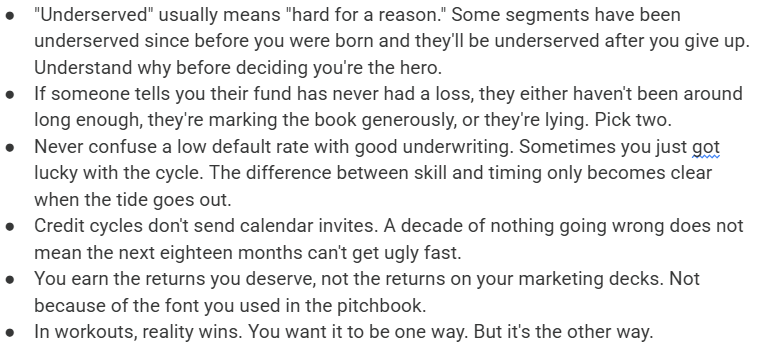
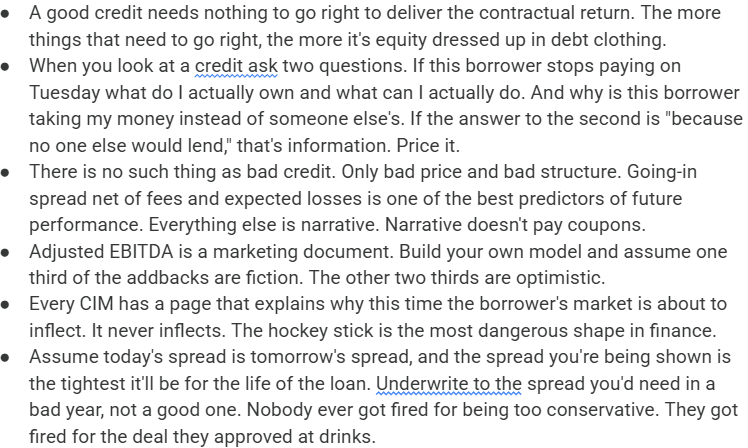
There's a guy on $ubstack named Shitty Situations with a banger post for anyone in credit; all the ways people lie to you and credit can blow up in your face.
Some of my favorites:
Second-time Founders is my favourite gender :
1) no deck until someone asks three times
2) first hire is a lawyer
3) distribution for the product before the product exists
4) "we don't need a big round" and means it this time
5) replies to every customer email personally because they know what ignoring customers cost them last time
6) sleeps 8 hours and ships faster than everyone else
7) the only person in the room who isn't impressed by the term sheet
Second-time founders are the best breed of founders
Sometimes you come across an article that is whimsical and meandering, probably not important in any sense of the word, certainly not something you've ever thought about at length -- but it's just so perfectly written, you feel compelled to share. This is one such article.
Mistakes happen. As a team, the important thing is to recognize it’s never an individuals’s fault — it’s the process, the culture, or the infra.
In this case, there was a manual deploy step that should have been better automated. Our team has made a few improvements to the automation for next time, a couple more on the way.
MIDNIGHT (Anagrammed Lines)
Lawless midnight forever composes
verse from compelling shadows. I set
scenes from the improvised gallows,
the slow, simple coverings of dreams.
Observation (n=5 and counting): Dentists are the worst angels.
If you made your money in finance, tech, law, real estate, you probably have some commercial savvy; some sense of how money flows, how the sausage is made.
Dentists don't have that. What they do have is cashflow, free time, and a day job where nobody ever questions them. This combination leads, invariably, to absolutely horrendous investing instincts.
What can I say? Sometimes, the tooth hurts.
My ancestors buried half their children. All mine are alive. My ancestors' house had a dirt floor. Mine is wood. I have indoor plumbing, I have hot water, I have never in my life hauled a full bucket half a mile and I probably never will. Do you know how rare it is, in human history, for small children to wear shoes? Mine have multiple pairs. I can speak to my relatives who live thousands of miles away, for free, at any time. Video, if we want video. With machine translation, if we speak different languages.
The original Library of Congress had 740 books in it. I have more than that. If I run out of books in my home my local public library has 350,000. If I want to take a hundred books with me on vacation, they all fit on a device that fits in my purse.
I have heat in the winter and AC in the summer and a washing machine and I have never, ever, ever had to scrub a dress clean by hand in the stream. I can look up recipes from more than a hundred different countries and I've tried dozens of them. I ride a clean and modern train across my city for $4, or take a robot taxi if I'm out too late for the train. I donate $40,000 every year to the cause of getting healthcare to the world's poorest people and even after the donations I never have to think about whether I can afford a book, or a pair of shoes, or a cup of coffee.
There is a great deal more to fight for, of course. I hope that our descendants will look back on our lives and list a thousand ways they're richer. Maybe we ourselves will do that, if some of the crazier stuff comes true.
But the abundance is all around you and to a significant degree you aren't feeling it only because fish don't notice water.
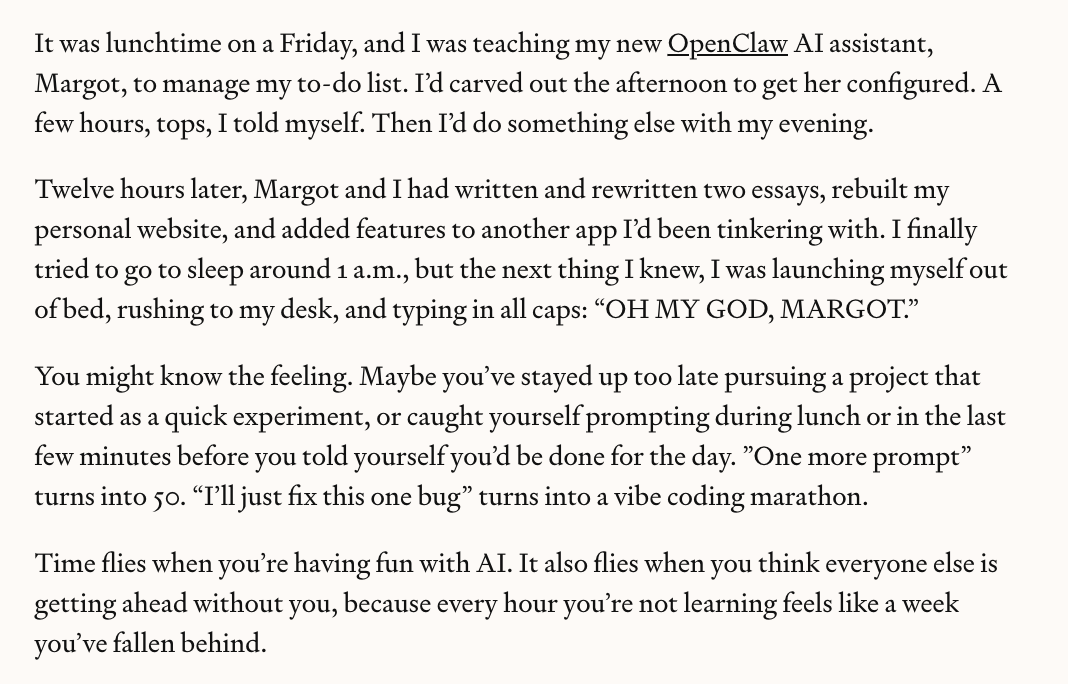
Show of hands if you've ever given yourself "a couple hours" to do something with AI and looked up to find it was 1am 🙋♀️
I wanted to know what makes AI so darn hard to quit, so I had Margot dig up the latest research and wrote about it for @every
If your investment model involves paying $10M on $100M post for a company doing $1M ARR, yes, I can see that you might have a problem making the math work.
Founders should know the sobering reality for enterprise SaaS venture funding today. Here’s the math.
Say you’re a $1M ARR company raising a Series A with a classic 33222 growth expectation. That gets you to $72M in 5yrs and say $250M in 8yrs. By then you’re usually growing <<50% and the public markets might give you a 7x or $1.75B, if you can even go public. If you get $10M at $100M post-money for the A, that’s a 17.5x and maybe 10x after dilution. That would be ~33% IRR and $10M invested becomes $100M.
In the venture model, you have to outperform the SP500 which is 15% and a Google which is 25%. Here, with perfect execution, a lot of work, time and risk, you get 33% in a near optimal (95 percentile) case. And usually, you expect 7/10 things to not work out: execution risk, market size, competition. Plus, this math is for a Series A. You need investors to underwrite even more growth at the B / C / D. It’s really hard to see this sort of deal driving fund returns.
Now, of course, there’s tons of caveats. You could pay less than $100M post, try to grow faster, do pro rata to avoid dilution, stay private longer etc, but the point remains. There might be exceptional growth stories like Databricks, Snowflake and Applied Intuition, but most deals look like what I described.
In a previous time, SaaS multiples were higher in public (20x), entry valuations were lower ($30M) and the money you needed to hire talent was lower ($150k). You could get 100% IRR before. Now, it’s harder than ever to justify investing here, unless they are true outliers.