Prospera revisited
One year after the quoted tweet I returned to Prospera for another series of events at the intersection of longevity biotech, crypto, AI, and special jurisdictions.
So, here is a new thread with some updates, and new impressions, after one year.
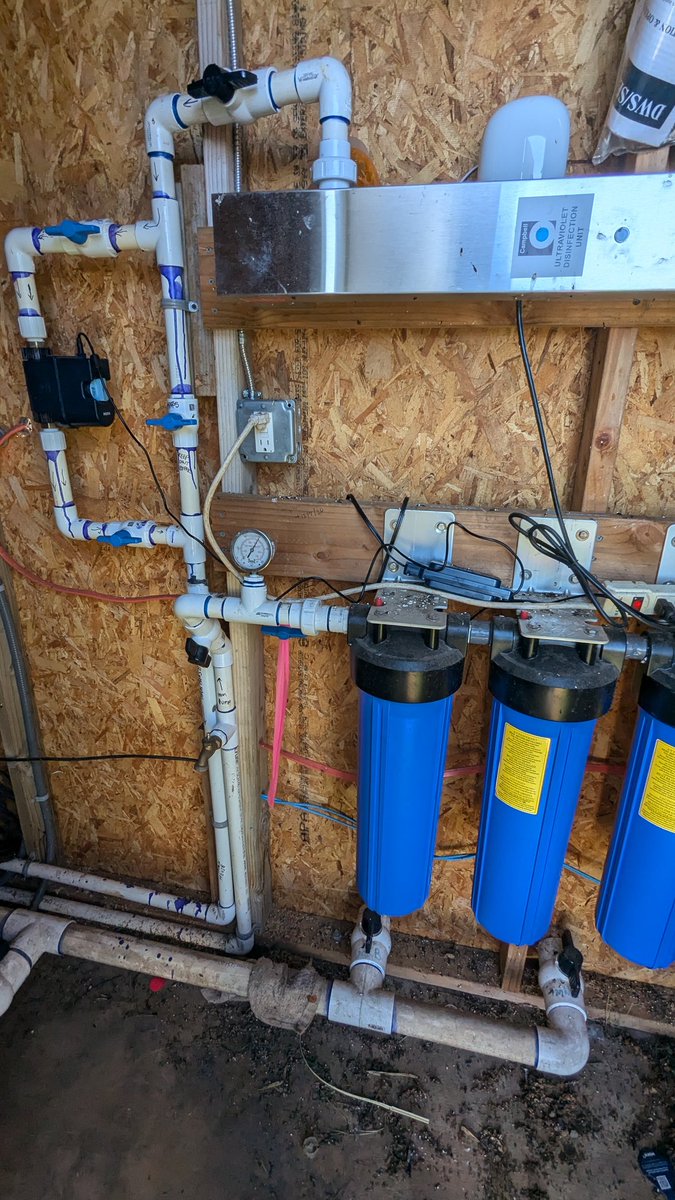
@levelsio We are on 100% water catchment with whole house filtration system
... 3 levels micro filtration cartridges + UV filter + Flo sensor. I've done this setup in several houses.
An increasing # of cos are leaving Delaware to incorporate in Nevada or Texas
*Texas: Tesla, SpaceX, ...
*Nevada: Dropbox, Neuralink, TripAdvisor, Pershing Square, TradeDesk, ...
Ben Potter & Sarah Axtell at Latham Watkins have analyzed DE vs NV vs TX & allowed me to share their full pdf
New paper from Fournier & Sinclair labs: We find that multiple sclerosis (MS) accelerates neuronal aging & its reversal via OSK-reprogramming preserves vision in an MS mouse model, suggesting new strategies for treating MS & potentially other neurological diseases
🧵…
We just dumped unifi in two of our places. Just wasn't worth the trouble. Switched to Google Wi-Fi connected to cable internet and second system is all starlink with starlink hotspots. Starlink is backup insurance.
Whatever you decide to use, hard wire one hotspot per floor. We have concrete floors as well.
Great idea.
Here's another one I've been working on...
--------
Temporary Capital Gains Tax Reduction to Increase U.S. Housing Supply
--------
A temporary reduction in the long-term capital gains tax rate on the sale of residential properties to 10% for a four-year period.
This targeted intervention aims to alleviate the critical U.S. housing shortage by incentivizing property sales and increasing market inventory.
The United States faces a severe housing shortage, estimated at approximately 6 million units. This scarcity drives up prices, limits affordability, and hinders economic growth. A significant contributing factor is the "lock-in" effect, where homeowners and investors delay selling properties to avoid substantial capital gains taxes.
Deferring the sale of properties and deferring taxes, also results in less tax revenue for the government.
Proposed Solution:
A temporary reduction in the long-term capital gains tax rate to 10% on the sale of one residential property per taxpayer (primary residence or investment property) per year, for four years.
Key Features:
* Tax Rate: 10% long-term capital gains tax rate.
* Duration: Four years.
* Eligibility: Applies to the sale of one residential property per year, per taxpayer (primary residence or investment property).
* Price Cap: Applies to properties sold for under $5,000,000.
* Single-family residential properties in 1031 exchanges (regardless of holding period).
* Single-family residential homes held in trusts.
* Single-family residential homes held by companies 100% owned by trusts.
Expected Impact:
-----------------------
* Increased Market Listings:
By reducing the tax burden, this proposal will incentivize homeowners, investors, and trusts to sell properties, significantly increasing the supply of available homes. The inclusion of 1031 exchanges and trust-held properties is specifically designed to unlock a substantial pool of potential listings.
* Reduced "Lock-In" Effect:
The lower tax rate will mitigate the disincentive to sell, encouraging property owners to bring their homes to market sooner.
* Addressing the Housing Shortage:
The anticipated increase in housing inventory will directly address the critical shortage, providing more options for buyers and easing upward pressure on prices.
* Enhanced Market Liquidity:
Increased transaction volume will improve market liquidity, making it easier for buyers and sellers to connect.
* Increased tax revenue from the same of properties that would otherwise not be sold.
Rationale:
To put this in perspective, the top 200 housing builders only build about 500,000 units per year. We currently have a deficit of 6 million houses. So at the current rate it would take about 10 to 12 years to fill that gap. Cities and states are doing everything they can to increase the supply of housing including approving the use of ADUs, changing zoning to a lot more density etc etc.
Reducing the capital gains tax to 10% for 4 years has the potential to unlock millions of housing units... Especially from boomers who are sitting In large homes because they have built equity in them and don't want to pay exorbitant taxes. Same for investors. People sitting on two or three or four residential rental properties would be inclined to sell them making them available for others to purchase as their primary homes.
There are currently approximately 4 million single-family home sales per year at just over $400,000 on average.
So let's assume a new policy like this would incentivize another 500,000 units to be sold each year for 4 years = 2 million units x $400,000 each = $800 billion In total transactions that would have otherwise been locked up.
So at a minimum we would be talking about opening up 2 million homes to new owners and adding tens of billions of dollars in additional tax revenue, not to mention unlocking all of that wealth to the sellers who can then use it for other investments.
Let's unlock 2 million homes...
We need to liberate millions of homes that are currently locked up (interest rate and other handcuffs)...and we need to do it quickly so more people can own a home.
Policy Idea below... Thoughts?
--------
Temporary Capital Gains Tax Reduction to Increase U.S. Housing Supply
--------
A temporary reduction in the long-term capital gains tax rate on the sale of residential properties to 10% for a four-year period.
This targeted intervention aims to alleviate the critical U.S. housing shortage by incentivizing property sales and increasing market inventory.
The United States faces a severe housing shortage, estimated at approximately 6 million units. This scarcity drives up prices, limits affordability, and hinders economic growth. A significant contributing factor is the "lock-in" effect, where homeowners and investors delay selling properties to avoid substantial capital gains taxes.
Deferring the sale of properties and deferring taxes, also results in less tax revenue for the government.
Proposed Solution:
A temporary reduction in the long-term capital gains tax rate to 10% on the sale of one residential property per taxpayer (primary residence or investment property) per year, for four years.
* 10% long-term capital gains tax rate.
* Four years.
* Applies to the sale of one residential property per year, per taxpayer (primary residence or investment property).
* Price Cap: Applies to properties sold for under $5mil
* Single-family residential properties in 1031 exchanges (regardless of holding period).
* Single-family residential homes held in trusts.
* Single-family residential homes held by companies 100% owned by trusts.
Expected Impact:
* Increased Market Listings:
By reducing the tax burden, this proposal will incentivize homeowners, investors, and trusts to sell properties, significantly increasing the supply of available homes. The inclusion of 1031 exchanges and trust-held properties is specifically designed to unlock a substantial pool of potential listings.
* Reduced "Lock-In" Effect:
The lower tax rate will mitigate the disincentive to sell, encouraging property owners to bring their homes to market sooner.
* Addressing the Housing Shortage:
The anticipated increase in housing inventory will directly address the critical shortage, providing more options for buyers and easing upward pressure on prices.
* Enhanced Liquidity:
Increased transaction volume will improve market liquidity, making it easier for buyers and sellers to connect.
* Increased tax revenue from the same of properties that would otherwise not be sold.
To put this in perspective, the top 200 housing builders only build about 500k units per year. We currently have a deficit of 6 million houses. So at the current rate it would take about 10 to 12 years to fill that gap. Cities and states are doing everything they can to increase the supply of housing including approving the use of ADUs, changing zoning to a lot more density etc etc.
Reducing the capital gains tax to 10% for 4 years has the potential to unlock millions of housing units... Especially from boomers who are sitting In large homes because they have built equity in them and don't want to pay exorbitant taxes. Same for investors. People sitting on two or three or four residential properties would be inclined to sell them making them available for others to purchase as their primary homes.
There are approx 4 mil single-family home sales per year at just over $400k on average.
Let's assume a policy like this would incentivize another 500k units to be sold each year for 4 years = 2 mil units x $400k each = $800 bn In total transactions that would have otherwise been locked up.
we would be talking about opening up ~ 2 M homes to new owners and adding tens of bn in tax revenue, not to mention unlocking all of that wealth to the sellers who can then use it for other investments
@Jason@friedberg@theallinpod
I’ve said it before & I’ll say it again: not using AI-especially in medical diagnostics or in screenings like the one below-has now become completely unethical & unacceptable. MDs who reject this because it isn’t “standard care”are liable in failing to properly care for patients!
In mice, a lack of vitamin D leads to decreased SIRT1 levels & bone loss that’s counteracted by resveratrol.
Consistent with a RCT study of post-menopausal women showing resveratrol improves bone density https://t.co/2PexsHL0O6
@levelsio@rameerez Been using these for several years on our farm here on Maui...mostly while I'm on our Kubota tractor or Scag Mower. While they are good by themselves, I prefer wearing earbuds under them. Great sound. Double noise cancellation.
1) DeepSeek r1 is real with important nuances. Most important is the fact that r1 is so much cheaper and more efficient to inference than o1, not from the $6m training figure. r1 costs 93% less to *use* than o1 per each API, can be run locally on a high end work station and does not seem to have hit any rate limits which is wild. Simple math is that every 1b active parameters requires 1 gb of RAM in FP8, so r1 requires 37 gb of RAM. Batching massively lowers costs and more compute increases tokens/second so still advantages to inference in the cloud. Would also note that there are true geopolitical dynamics at play here and I don’t think it is a coincidence that this came out right after “Stargate.” RIP, $500 billion - we hardly even knew you.
Real: 1) It is/was the #1 download in the relevant App Store category. Obviously ahead of ChatGPT; something neither Gemini nor Claude was able to accomplish. 2) It is comparable to o1 from a quality perspective although lags o3. 3) There were real algorithmic breakthroughs that led to it being dramatically more efficient both to train and inference. Training in FP8, MLA and multi-token prediction are significant. 4) It is easy to verify that the r1 training run only cost $6m. While this is literally true, it is also *deeply* misleading. 5) Even their hardware architecture is novel and I will note that they use PCI-Express for scale up.
Nuance: 1) The $6m does not include “costs associated with prior research and ablation experiments on architectures, algorithms and data” per the technical paper. “Other than that Mrs. Lincoln, how was the play?” This means that it is possible to train an r1 quality model with a $6m run *if* a lab has already spent hundreds of millions of dollars on prior research and has access to much larger clusters. Deepseek obviously has way more than 2048 H800s; one of their earlier papers referenced a cluster of 10k A100s. An equivalently smart team can’t just spin up a 2000 GPU cluster and train r1 from scratch with $6m. Roughly 20% of Nvidia’s revenue goes through Singapore. 20% of Nvidia’s GPUs are probably not in Singapore despite their best efforts. 2) There was a lot of distillation - i.e. it is unlikely they could have trained this without unhindered access to GPT-4o and o1. As @altcap pointed out to me yesterday, kinda funny to restrict access to leading edge GPUs and not do anything about China’s ability to distill leading edge American models - obviously defeats the purpose of the export restrictions. Why buy the cow when you can get the milk for free?
Despite resveratrol's health and longevity benefits in animals, results in humans have been mixed. Why?
New article suggests it's because resveratrol lacks water-solubility & provides solutions to increase its effectiveness in people... 🧵
A student asked, why does cell repair turn off when times are good? Why not keep them on all the time?
The answer reveals how to live a long, healthy life...🧵