@suzatweet My team @mercari_jp is looking for researchers and research engineers in computer vision and NLP ;)
- Research Engineer: https://t.co/3FbRvLQdve
- Researcher: https://t.co/NZubpfw2Ra
- Senior Researcher: https://t.co/SsQuBTve9X
Nice comprehensive look at the state of federated learning research, including an overview of advances in the last three years (since https://t.co/87U9KkLxl2 in 2016), as well as a nice overview of open problems in the area.
105 pages, 485 references!
@hardmaru "If the paper looks too simple, even if you have great results, you won't pass the reviewers. Add more maths equations".
This was an advice I was given for my field (Robotics). 😓
Interesting paper on how to apply reinforcement learning to growing robots (frogs here): https://t.co/fJrUs6eLJa (from Living Machines 2019 @ Nara)
Would that apply to different humanoid robots?
@hardmaru@julianibarz
A major benefit of self-supervision is we can truly scale and adapt on the fly. It could be 10% behind supervised ImageNet, it would still do better in real life. We show in https://t.co/dsikxDuWcI that the longer our model looks at objects, the better it understands them.
If we want to scale RL by using methods such as architecture search, or even just grid search of hyper parameters, etc. Doing offline evaluation of policies is critical. Here we propose a new metric that scales well to challenging robotic tasks.
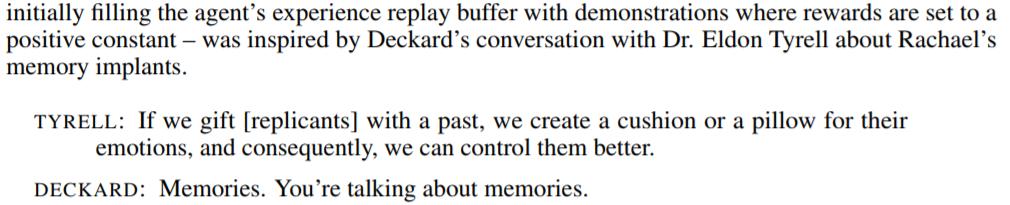
A few days ago, I was wondering if somebody had ever acknowledged a non-academic source in their papers for the origin of their idea. @sidgreddy@ancadianadragan@svlevine did it with a reference to the original Blade Runner dialog between Tyrell and Deckard. Great paper too!
SQIL: an imitation learning method so simple I can summarize in a tweet: drop demonstrations into buffer, set their reward to +1, set reward for all other data to 0, run Q-learning or SAC to train. Why does it work? Find out: https://t.co/GKsYR4zG4l
w/ @sidgreddy@ancadianadragan
Want to try robotic learning on a budget? Check out REPLAB, low-cost setup for robotic learning, with code for learning-based grasping and RL!
https://t.co/QvCo15m2Kt
Presented Wed at #ICRA2019 11-12:45, WeBT1-19.3 220
B. Yang, J. Zhang @dineshjayaraman
https://t.co/tdYAmjTjkz
One of the best ways to advance the "large-scale Deep RL" agenda for robotics is to provide the world with our system. To that end, we're open-sourcing Tensor2Robot, a library for reducing boilerplate in TensorFlow + robotics research.
https://t.co/3SbQzax2Ee
One of the hardest problems in robotics is that models trained in simulator normally do not work on real robots. Domain randomization is a simple but powerful idea to close this sim2real gap: https://t.co/MjaiVgVGqf
How to create your own walking pattern generator by Sylvain Caron.
https://t.co/cNJrgE7Vy9
It's based on his pymanoid lib (Humanoid robotics prototyping environment) https://t.co/Wt6fBKUhLS
Introducing a new articles series for hackerfarm: The Food Chain. We'll be looking at food distribution chains in different countries and why it's important to understand them:
https://t.co/KyTFiqZM5a