@DoctorPerin In my imperfect world, I pay for my own haircut, the price of which is set by the hairdresser, although not only I but everyone around me, including the hairdresser himself, benefits from my well-groomed appearance.
@JDaviesPhD We have not yet succeeded in reducing psychopathology to its underlying organic substrate. All psychodiagnostic markers are determined by (speculative) metacorrelations of semipersistent symptom profiles. Psychopathology is at the level of oncology in the early 19th century.
Consciousness sways in an impenetrable bank of edited, orchestrated experience, in an immediate and familiar world of illusion, protecting our fragile ego from the distant and alien world of reality.
We may be constantly hallucinating, but consciousness creates a point of view.
In fact, we can (compare), and we have been doing so for a long time. Humans are incredibly rich in comparative characteristics. But we are usually wise enough (at least in our personal lives) to look beyond the fundamental principle of economics.
"We cannot ask ourselves whether ‘woman’ is superior or inferior to ‘man’ any more than we can ask ourselves whether water is superior or inferior to fire."
Julius Evola, Metaphysics of Sex.
@psychfox In the work Mind and Its Treatment: A Psychoanalytic Approach, Veikko Tähkä describes two poles of the emerging defensive tendency: paranoid and depressive, depending on the inclination toward the object. The latter is widely discussed, but the former deserves attention as well.
Every utopia grows from the soil of an incomplete understanding of human nature. To justify itself, utopia encases humanity in philosophical amber, where it suffocates in all its moral beauty.
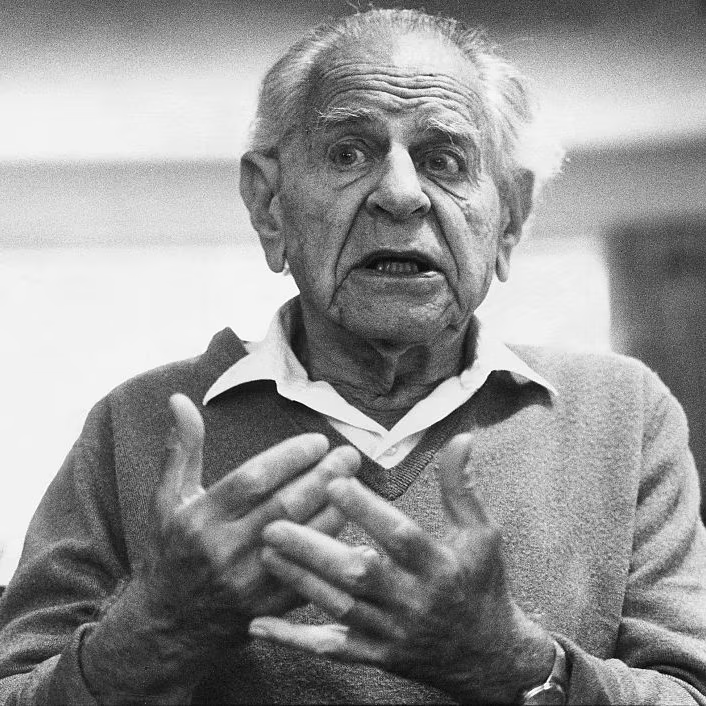
“The attempt to make heaven on earth invariably produces hell. It leads to that intolerance which is characteristic of religious wars, and to the saving of souls through the inquisition. And it is based, I believe, on a complete misunderstanding of our moral duties.
Our moral as well as our intellectual duty is to help those who are in need of our help; but it cannot be our duty to make others happy, for this does not depend on us, and it would only too often mean an intrusion into the privacy of those towards whom we have such amiable intentions.”
— Karl Popper
“People are always talking about originality, but what do they mean? As soon as we are born, the world begins to work upon us, and this goes on to the end. And, after all, what can we call our own except energy, strength, and will?”
— Goethe
Acting out as a stress-relieving technique has been known since Homer's Iliad. And if a person can drag themselves out of bed, get dressed, go outside, pick up a brick, and lay it where needed, then they're not suffering from severe depression.
Winston Churchill fought his depression with bricks. He'd lay them for hours at his country home in Kent. He joined the bricklayers' union. And in 1921 he wrote about why it worked. It took psychology another 75 years to catch up.
He called his depression the "Black Dog." It followed him for decades. His method for fighting it back was as basic as it sounds: laying brick after brick, hour after hour.
Churchill spelled out his theory in a long essay for The Strand Magazine. People who think for a living, he wrote, can't fix a tired brain just by resting it. They have to use a different part of themselves. The part that moves the eyes and the hands. Woodworking, chemistry, bookbinding, bricklaying, painting. Anything that drags the body into a problem the mind can't solve by itself.
Modern psychology now calls this behavioral activation. It's one of the most-studied depression treatments out there. Depression sets a behavior trap. You feel bad, so you stop doing things, and doing less means less to feel good about. Feeling worse makes you do even less. The loop tightens until you can't breathe inside it.
Behavioral activation breaks the loop from the action side. You schedule the activity first, even when every part of you doesn't want to. Doing it produces small rewards: a wall gets straighter, a painting fills in, a messy room gets clean. Those small rewards slowly rewire the brain. Action comes first, and the feeling follows.
Researchers at the University of Washington put this to the test in 2006. They studied 241 adults with major depression and compared three treatments: behavioral activation, regular talk therapy, and antidepressants. For the people who were most severely depressed, behavioral activation matched the drugs. It beat the talk therapy. A 2014 review of more than 1,500 patients across 26 trials backed up the result.
Physical work like bricklaying does something extra on top of this. It crowds out rumination, the looping bad thoughts that grind people down during the worst stretches of depression. Bricklaying needs both hands and gives feedback brick by brick: each one is straight or crooked. After an hour you can see exactly how much wall you built. No room left for the mental chewing.
The line George Mack used in his post, "depression hates a moving target," is good poetry. The science behind it is sharper. Depression hates a brain that has somewhere else to be.
@DeivonDrago I think Dawkins engages in useful publicity when he describes his thoughts on LLM, but I wish he'd been a little more careful with his language when addressing the general public. His concluding thoughts, unfortunately, are disappointing in their lack of psychological insight.
@DeivonDrago In the current discourse on potential consciousness of AI (not LLM), is there a distinction made between simulation (virtualization) of the effects of consciousness and consciousness in vitro?
@PaulaSeeksTruth It's difficult, perhaps even impossible, to answer the question in general. Still, I'd point out that your ability to speak your mind is a form of freedom, without which you'd have to find another outlet for your pent-up frustration. Perhaps more effective. Probably less so.
@the_mel_jar Mel, I think psychoanalysis would be seriously interested in understanding the attraction to this surrogate, essentially a simulacrum of the other, than in a superficial criticism that seeks an explanation in the garbage dump of psychology (our object is simply a degenerate).
@AlobhaPatrick It is amusing to ask about the preference of unconscious processes.
Especially considering that the listing of “defenses” emblematically confuses the functional elements that form the chain of transformation and the evaluation of the resulting transformations.
@the_mel_jar Or they're enchanted by the illusion of conversation. I dare say not everyone can afford to talk about what they desire, even with loved ones, and the mask of illusion, like the mask of pretend play, gives them that opportunity.
I think we still feel things subconsciously and put them into words more or less preconsciously, so it seems to me that we may feel a lack of freedom that we have not yet expressed, or are unable to express in words.
@vividvoid I find it contradictory that you present the postmodern individual as vulnerable to "memetic colonization," as if his path of deconstruction has taught him nothing and left him as naive in the end as he was at the beginning.