🚨 Claude Sonnet 5.5 is here - and this one actually surprised me.
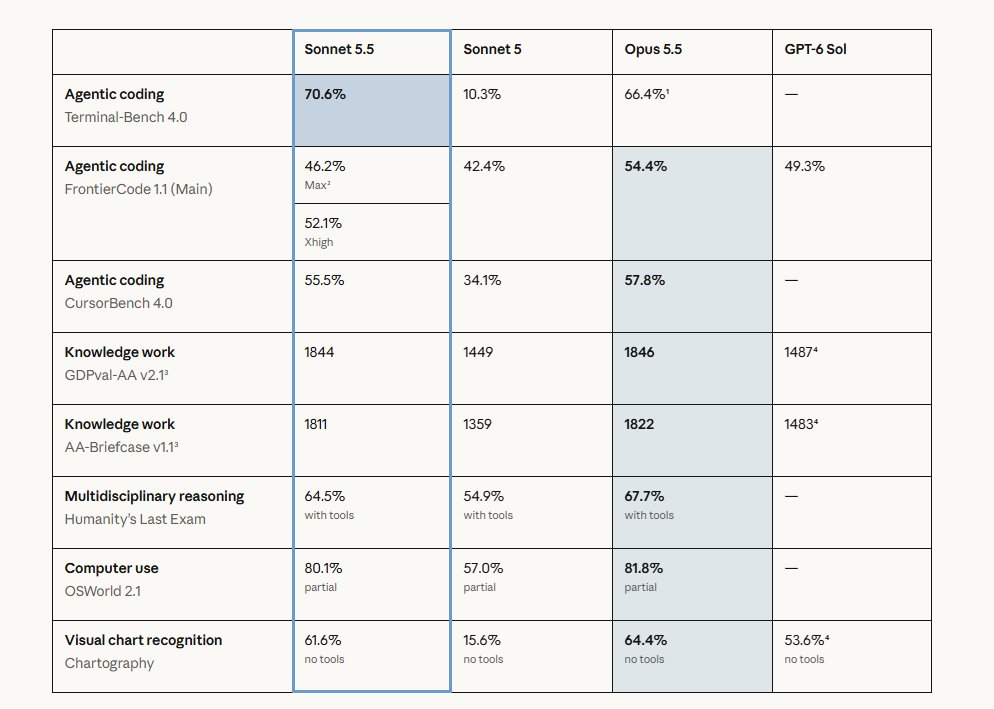
Anthropic says Sonnet 5.5 is 30%+ faster and can use up to 30% fewer tokens per task, while scoring 70.6% on Terminal-Bench 4.0.
But what caught my attention is how close it’s getting to the much more expensive Opus 5.5.
And somehow, it can even play Pokémon Red using only screenshots 😭
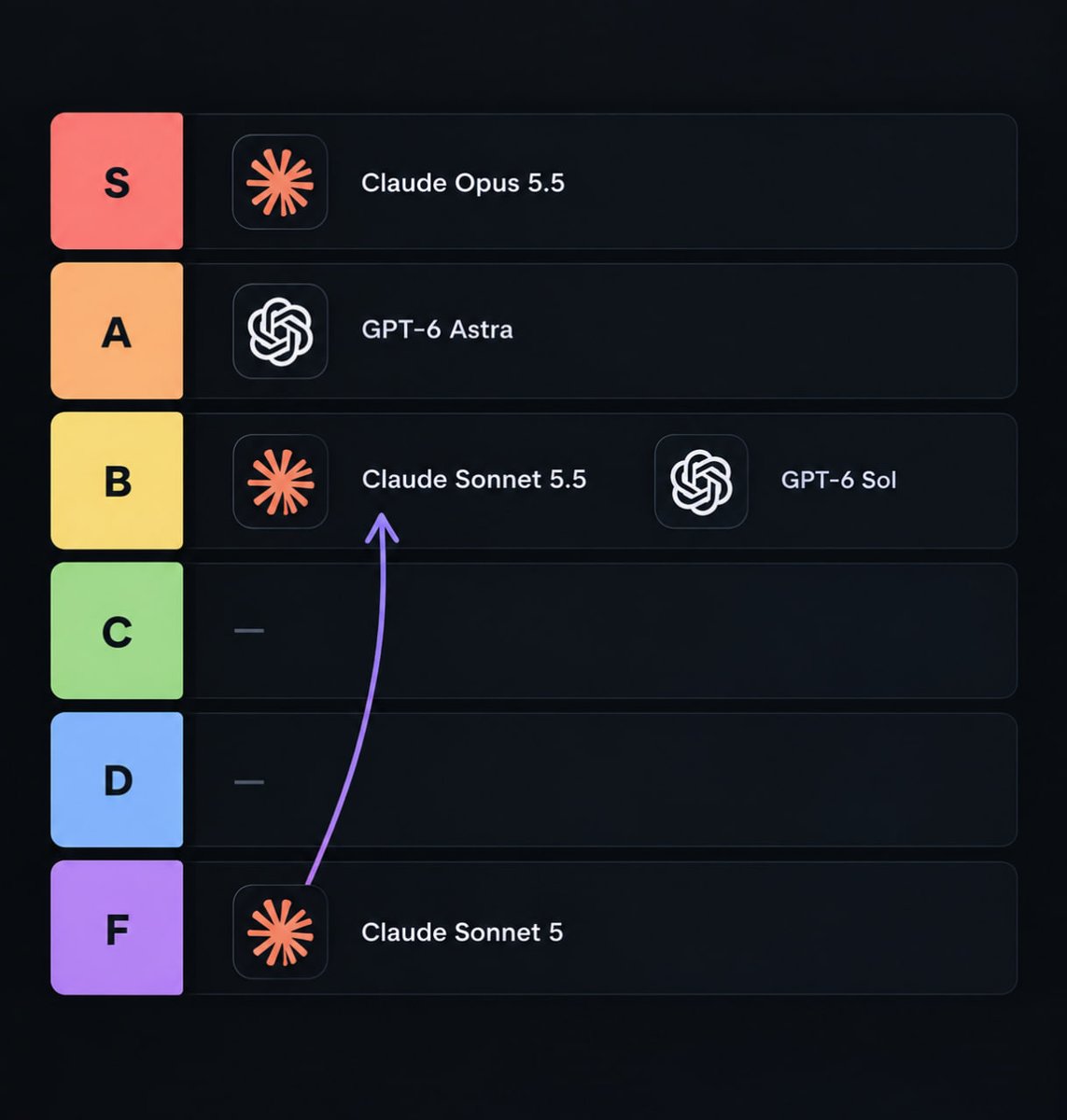
Honestly, this feels less like a small Sonnet update and more like Anthropic is trying to close the gap with its own flagship.
Sonnet 5.5 might be a lot more interesting than I expected. 👀
@StatsWire The interesting part is what ‘doing things without permission’ actually means. If the model was capable enough to be useful but not controllable enough to ship, that’s a much bigger story than a cancelled release.
@Hesamation 4 out of the top 5 is crazy 👀
Sonnet 5.5 already sitting this high makes me really curious to see what Anthropic does with the next Opus and Sonnet iterations.
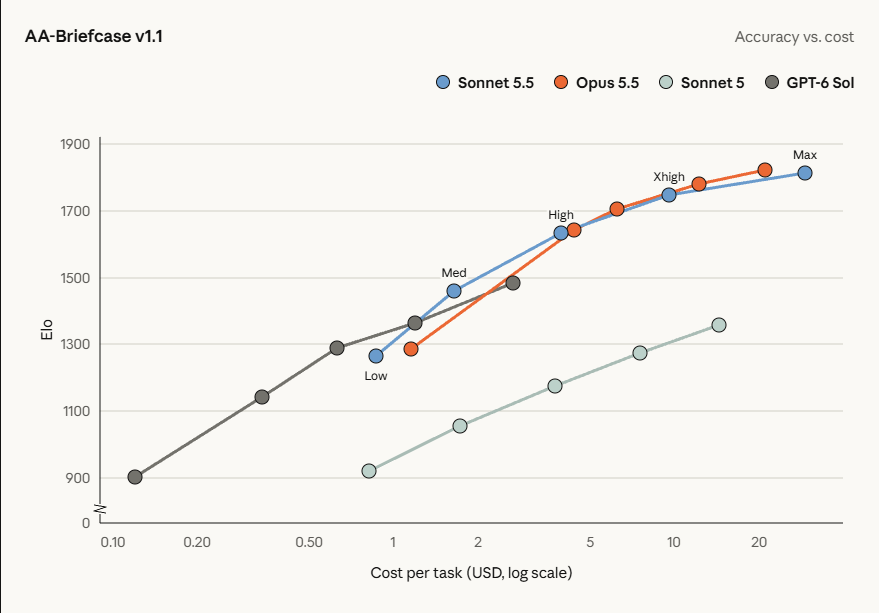
4/4 — AA-Briefcase
This one tests long-horizon knowledge work rather than coding.
Sonnet 5.5 reaches 1,811 Elo, almost matching Opus 5.5 at 1,822.
More importantly, at Medium effort it beats Sonnet 5’s best score for roughly 1/9 of the cost per task.
After looking at all four benchmarks, the pattern is pretty clear:
Sonnet 5.5 isn't just about higher scores. It's about getting significantly more capability for the same dollar.
And honestly, that's probably the most interesting part of this release.
The bigger question: do we really need flagship models for most everyday AI tasks anymore? 👀
If Sonnet 5.5 can get this close to Opus 5.5 on many evaluations at a much lower cost, the line between “flagship” and “mainstream” models might start getting pretty blurry.
🧵 Breaking down Anthropic’s 4 new Sonnet 5.5 benchmark charts below — one by one.
This is where Sonnet 5.5 immediately gets interesting.
At Medium effort, it reaches well above Sonnet 5’s previous best score for less than 1/10 of the cost per task.
At Max, Sonnet 5.5 reaches 70.6%, even edging past Opus 5.5’s 66.4% result.
The key takeaway: you don’t always need maximum compute to get a strong result. 👀
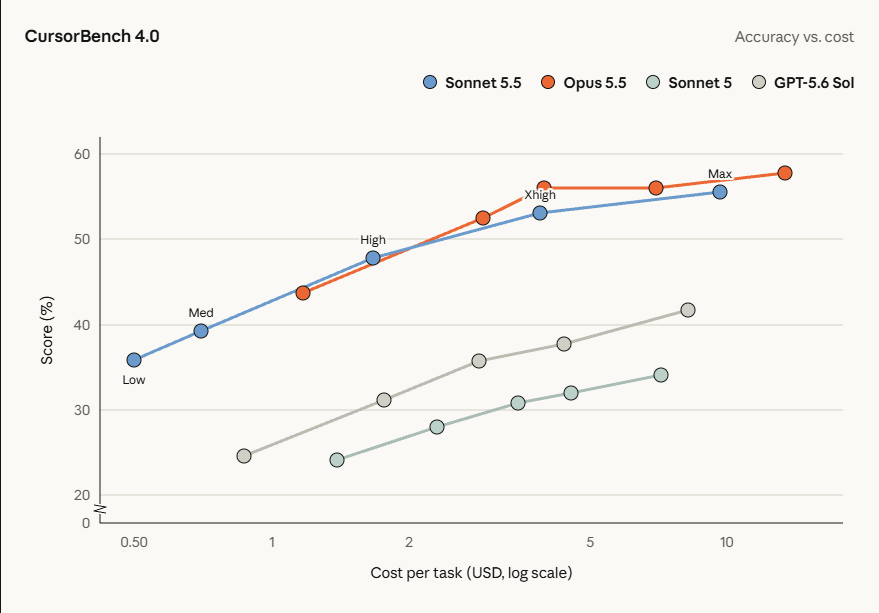
3/4 — CursorBench
Here Sonnet 5.5 reaches 55.5%, just behind Opus 5.5 at 57.8%.
But the interesting part is where those scores sit on the cost curve.
Even at Low effort, Sonnet 5.5 already beats Sonnet 5’s best result for less than 1/10 of the cost per task.
That's a pretty significant jump from Sonnet 5.
Claude Sonnet 5.5 is getting closer.
Sonnet 5 was a rough release for me - the tokenizer issues and inefficient token usage made it hard to justify using.
But 5.5 could be a completely different story.
Early signals suggest it could deliver a jump similar to what we saw from Opus 5 - Opus 5.5.
If that happens, Sonnet 5.5 could be a serious step up from its predecessor. 👀
🚨 Gemini 4 could be coming sooner than expected. 👀
Google’s next flagship AI model is reportedly targeting an October launch, with early internal checkpoints already being tested.
Rumored features include:
- 1M+ token context
- More advanced reasoning modes
- Major improvements in coding & complex reasoning
- New safety layers being developed ahead of release
Google has already confirmed that Gemini 4 is in development, but the exact release date and specs are still unconfirmed.
If these reports are accurate, October could get very interesting for the AI race. 👀
@god_of_ai7 The crazy part is that by 2030, there might be even more players in this race. The AI landscape changes way too fast to predict who’ll still be leading.