Thread with tweets I refer to often.
First my studies showing EVs are really much better
Article Joule https://t.co/OzSgcEL8aO
CO2 study with Prof Steinbuch https://t.co/IXdo7K4n1G
Us in Der Spiegel https://t.co/qX7PI5dC5W
Transport & Environment tool
https://t.co/oPxqB7fi82
What I like best is that they are very very transparent. I always look at the annex with underlying assumptions and here I think it is well written, short but exhaustive and accurate. https://t.co/wxdjmwY0YG
@CupoJoeBlow Actually, it's the other way round. I have no choice but to subsidise your pollution. Not my opinion but that of the IMF by the way. https://t.co/3IVcxHgGyh
New study finds 0-90% CO2 reduction from EVs but omits one important variable: the electricity mix gets cleaner during the lifetime of the car. So realistically they save more CO2.
An MIT-led study found EVs usually beat gas cars on emissions, but the advantage varies sharply by location and driving habits.
https://t.co/hmwjFE3c0r
We are *not* solving extreme poverty.
But off-grid solar can be the silver bullet to change that!
Because what do 95% of these people in extreme poverty have in common? They live in rural areas without grid access but with year round sunshine.
https://t.co/dpNcHe3UOh
@nukeadvocate@MaxCRoser@simongerman600@CleanPowerDave Two facts for you (and these are not opinions mind you, but facts):
1) Solar kits + batteries are far cheaper than a grid connection in rural areas with lots of solar.
2) Solar is a lot cheaper than nuclear, especially where there is a lot of solar.
Sorry 🤷♂️
@nukeadvocate@MaxCRoser@simongerman600@CleanPowerDave It's charging phones, cooling and induction cooking. That are the basics. But you can easily have more with solar panels and batteries. I think the problem here might be that I understand a bit more about energy systems and don't disqualify everything but nukes.
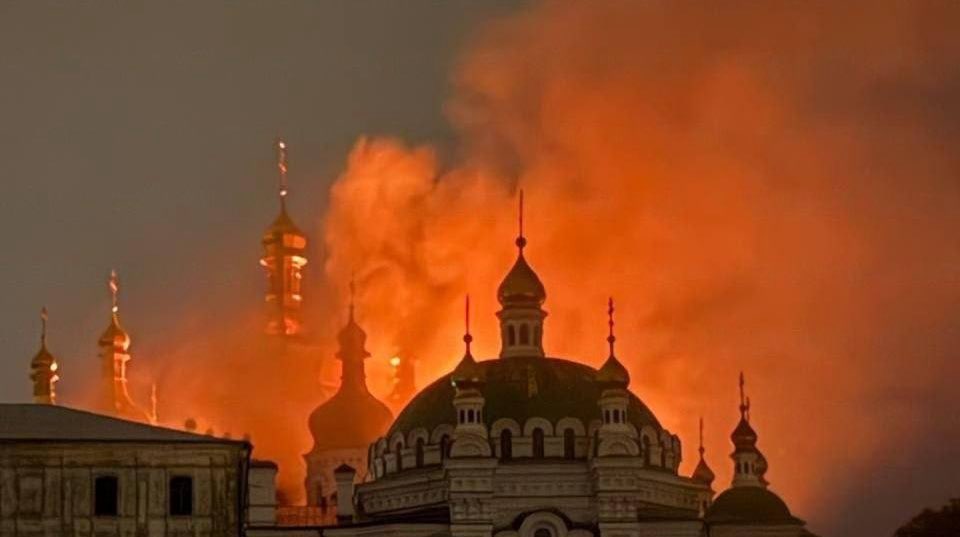
This is very distressing news. Russia has attacked the territory of the Kyiv Pechersk Lavra, a UNESCO World Heritage Site and one of the most significant spiritual and cultural landmarks of Ukraine and the world.
Russian forces damaged Uspenskiy Cathedral. It’s on fire now.
The Kyiv Pechersk Lavra is listed under Enhanced Protection pursuant to the Second Protocol to the 1954 Hague Convention. An attack on it constitutes one of the gravest crimes against the world’s cultural heritage.
🇺🇸🇮🇱 The merger between the U.S. and Israel has a third piece almost nobody is talking about. While Section 224 fuses the militaries, Section 622 moves to fuse the intelligence services...
Buried in a 192-page intelligence authorization bill from Sen.Tom Cotton, Section 622 would legally require the president to "expand and enhance intelligence sharing" with Israel across nearly every topic of intelligence interest in the Middle East.
It would prohibit any reduction in that sharing except for a "specific and identifiable national security concern," then force a detailed report to Congress within 15 days justifying it.
Read that mechanism again carefully.
It strips the president of the ability to limit what America tells Israel, then makes any attempt to do so a political fight the Israel lobby can frame as being "against Israel's security."
It welds the intelligence spigot open by law.
Now stack the three pieces moving through Congress at once:
-The Stutzman resolution phases out visible aid.
-Section 224 integrates the militaries.
-Section 622 mandates intelligence sharing.
Each one is less publicly accountable than the last.
Aid is a line item voters can see.
Intelligence liaison happens in the dark, where no price tag ever appears.
The strategy is to move the relationship out of public view precisely as public support collapses.
And the timing is the most scandalous part.
The Pentagon just rated Israel a "critical" espionage threat.
Congress's response to all of it is to legally mandate that America share more secrets with the country its own spy agencies say is robbing it.
Source: Responsible States Craft / Writer: Daniel
Hegseth: The document says Iran will never have a nuclear weapon, won't seek one, won't buy one, won't have one.
Brennan: JCPOA said that too.
Hegseth: The huge difference is we did this from a position of strength.
When the price of something rises, the ecologist sees greed. The economist sees a message.
That difference is the whole argument — and it's why the environmental movement keeps reaching for the one tool guaranteed to make scarcity worse.
A price is not just a number on a thing. It's the most sophisticated information machine our species ever stumbled on. When a resource gets scarce — a mine floods, a war cuts a supply line — its price rises, and that single number travels the world carrying one command that requires no one to understand its cause: economize, find alternatives, this has become dear. Hayek won a Nobel for the insight. The knowledge needed to manage scarcity doesn't sit in any planner's head; it's scattered across millions of minds, and the price is the only thing that gathers it.
So a rising price isn't the problem. It's the solution arriving — the system noticing scarcity before the wall, and turning the whole ingenuity of the market toward avoiding it. It's why kerosene replaced whale oil before the last whale died, and why Ehrlich lost his bet to Simon on five metals that got cheaper, not scarcer.
There is one place the market genuinely fails: the externality — pollution, carbon — a cost dumped on third parties that never enters the price. That's real. But the fix isn't to abolish the price; it's to complete it. Tax the carbon so the signal tells the truth, then let the same machine economize, substitute, and innovate exactly as it does for any scarce input.
What you must not do is delete the message. Cap a price and you don't end the scarcity — you hide it, and the shortage arrives anyway, with queues and empty shelves. The 1970s gas lines happened in a country swimming in oil. Venezuela capped the price of food and got no food.
The deepest irony: whoever truly wants to conserve should be the price system's fiercest defender. It conserves automatically, in proportion to real scarcity, for a future no committee can see — and it can't be lobbied, doesn't stand for re-election, and corrects its own mistakes the moment they cost something.
The ecologist and I want the same world: one that doesn't squander its inheritance. We disagree only on the instrument. He reaches for the visible hand of control, which destroys the information it needs to work. I reach for the invisible one — the best friend the future ever had, if only we'd let it tell the truth and then listen.
The European mind understands it perfectly. This is what imperial decadence looks like: public institutions converted into branded spectacle, civic memory replaced by adrenaline theater, and the People’s House turned into a content backdrop for regime propaganda.
The joke is not that Europe cannot comprehend it. The joke is that America no longer recognizes what it is becoming.
@FridovanOrden Also creates a problem of course. Effective testing becomes very hard if the software is so "safe" that it cannot tell you about vulnerabilities to exploits of your code.
Agree. We need AI to guard against AI.
I'm convinced the use of AI will make our software safer. As our software becomes more and more complex we will need AI not only to code but also to test 10-100x more efficiently. And I fail to see how that's a bad thing.
The only true AI safety will come from securing the ecosystem. Use AI to harden digital security and speed detection and response. Use AI and biotech to improve pandemic monitoring, pre-design vaccines for all virus families, and prep vaccine manufacturing capacity. Limits in the models are inherently fragile and temporary. Open weight models may always be just months behind the frontier, and they can be jailbroken quite comprehensively. Bad actors will always have access to powerful AI. The thing that stops a bad guy with AI is good guys intelligently using AI and other tools.
I support reasonable staged rollout as Anthropic did with Mythos / Glasswing to give responsible actors more time to use the latest models to find vulnerabilities and fix them. At the same time, that will always be a temporary state of things at best.
Long term (months, most likely), all of the current frontier capabilities will be available to anyone who really wants them. Plan and build for that world.
Judging by the sentiment on here you could be forgiven to think that European industry is kaputt.
So I was positively surprised by latest Ember report showing Europe is actually a net exporter of several cleantech products. That includes EVs.
The whitepill is that something is clearly working as it should be.
We could just as easily produce an analysis where the 2 degree goal is met primarily through rapid cleaninnovation and zero reductions in labor hours.
These kinds of energy systems/economic projections to 2100 can show any result, and support any conclusion, that modelers want.
Israel is destroying every single home in the southern 40 miles of Lebanon.
This is not “targeting Hezbollah strongholds.”
These are Christian villages and Sunni villages and Shia villages where people have lived for centuries.
In review, Israel has stolen our nuclear secrets, nuclear triggers, our uranium and rest of our top secrets. They attacked one of our ships and killed 34 US sailors. They've taken $320 billion from us and gotten us to spend $8 trillion for their wars. Is that an ally or an enemy?