I’m Mubbu.
I run founder-led content strategies for 60+ business owners doing $1M/yr-$700M/yr.
But my story started way before Mogul Media existed.
A little about me:
- At 14 I got my start making money online through affiliate marketing. built a network of Instagram theme pages and learned how to grow audiences.
- At 16 I started my first agency
- At 18 I dropped out and moved to Pakistan to build my companies. I spent 3 years living in an 8x8 room inside my office while building my businesses.
- In 2020 I started this X account anonymously and grew it to 100,000 followers without showing my face.
- I eventually turned everything I’d learned about content and distribution into Mogul Media.
Today:
-Done multiple millions of dollars through X.
-Lead a team of 26 people.
-Building out our dream office and content operation.
-Managing personal brands for 60+ founders across SaaS, agencies, and established businesses.
-Get to work with some of the most successful founders in the world.
I’ve been obsessed with building businesses and figuring out distribution since I was 14.
A decade later that’s still what I spend my days doing, just at a completely different scale.
Excited to keep sharing the journey here.
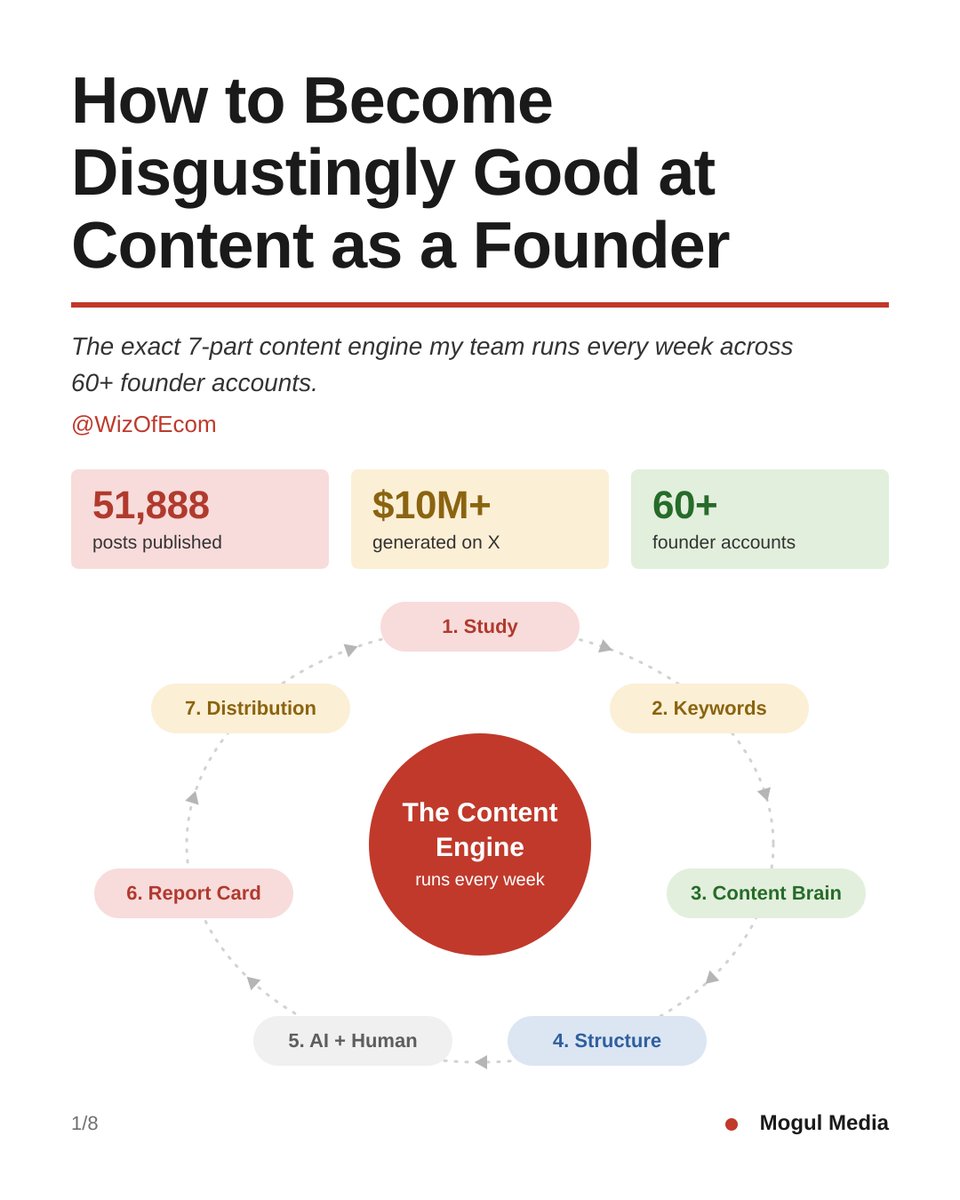
HOW TO BECOME DISGUSTINGLY GOOD AT CONTENT CREATION AS A FOUNDER:
My content playbooks have been used by 450+ founders doing $1m ARR all the way to $700m ARR to build their personal brands.
And I've generated over $10 MILLION through my personal brand alone.
I've combined everything we've learned into a repeatable playbook for turning founder expertise into attention, authority, and actual customers:
GREAT CONTENT IS ENGINEERED BEFORE YOU WRITE A SINGLE WORD.
You could have 20 years of industry experience and incredible business results.
But if you don't know how to package that expertise into content people actually want to consume, most of it will never reach the right audience.
Before writing anything, we collect three things:
1 - MARKET RESEARCH: Study the founders, competitors, and industry leaders your ideal customers follow. Save their winning hooks, topics, formats, and structures.
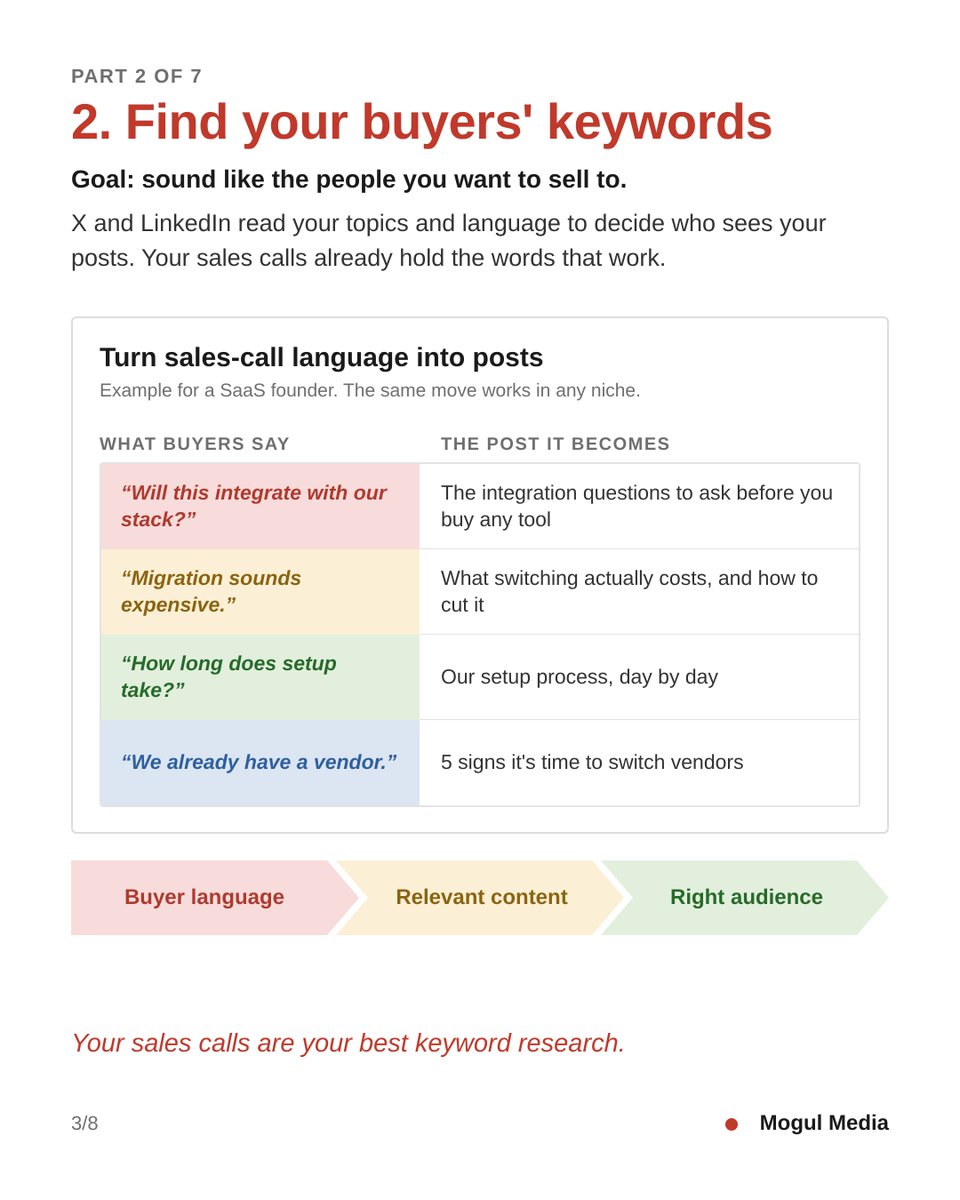
2 - BUYER KEYWORDS: Mine sales calls, customer conversations, and industry discussions for the actual problems, questions, and terminology your prospects use.
3 - YOUR CONTENT BRAIN: Organize everything you've learned from running your business into stories, opinions, and proof.
Now you have the raw material.
The next step is turning it into content worth reading.
There are three things we focus on:
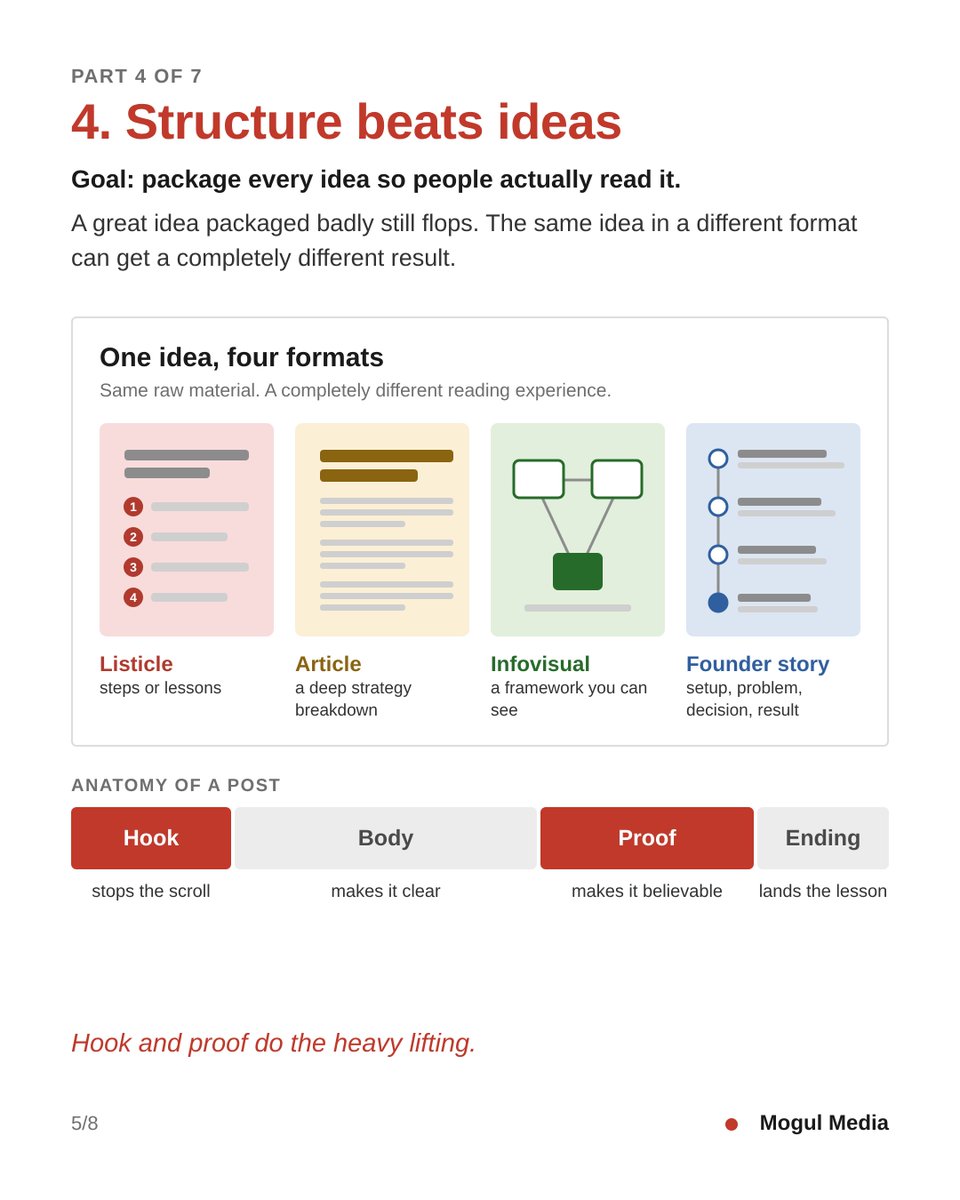
1) STRUCTURE: Match each idea with the right vehicle. A technical process might become a Google Doc screenshot. A founder experience might become a story-based listicle. An operating framework might become an infographic.
2) AI: Use AI to organize research, develop briefs, and assist with drafting. Feed it your actual experiences, historical content, and proven examples. Keep human judgment involved in every final decision.
3) DISTRIBUTION: Identify your Dream 100, participate in relevant industry conversations, and use timely newsjacking to get your expertise in front of potential buyers.
Then comes the part most founders overlook.
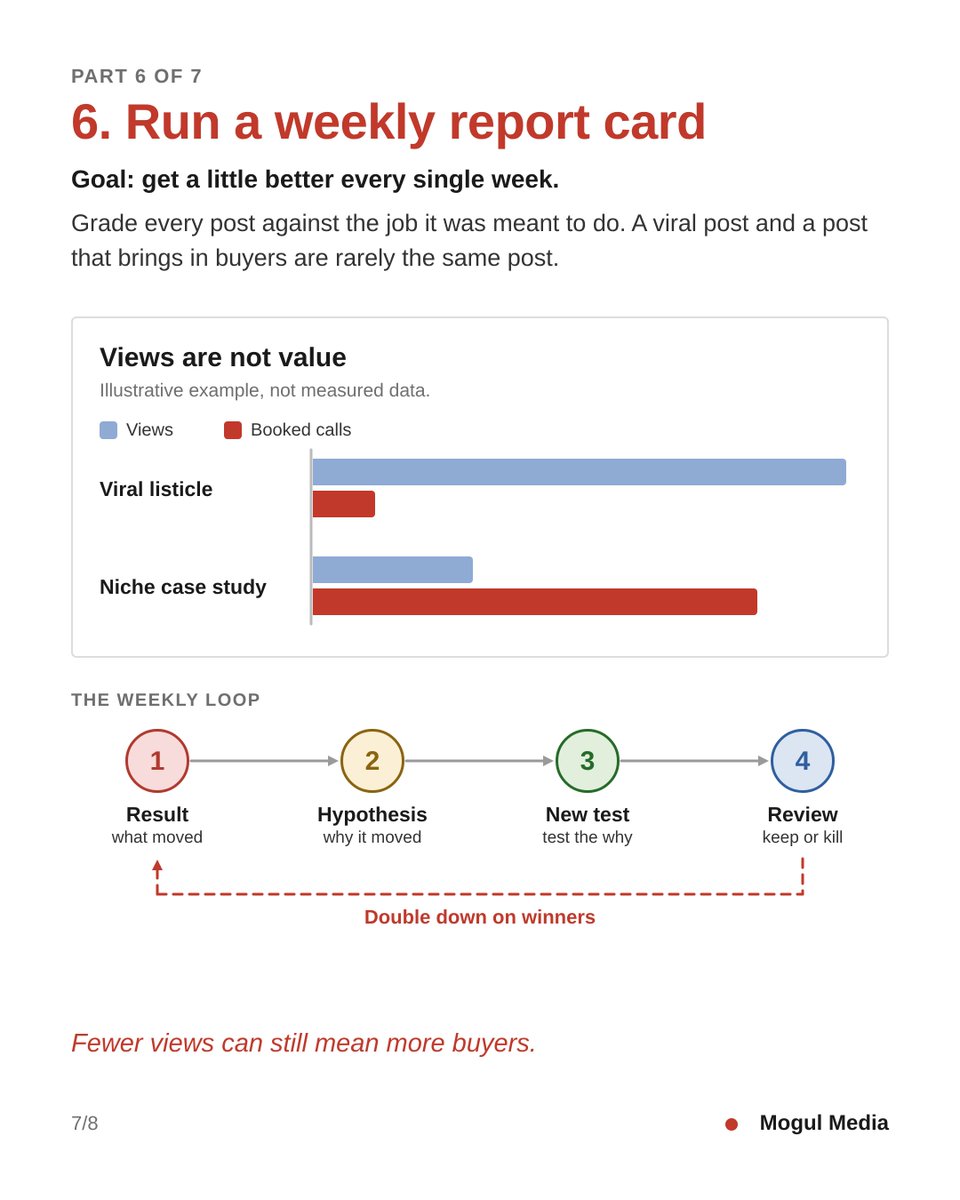
THE WEEKLY REPORT CARD.
Every week, we look at:
> Which TOPICS attracted the right audience.
> Which HOOKS and FORMATS performed best.
> Which posts generated meaningful engagement, profile visits, and QUALIFIED conversations.
> Which winning ideas we should repeat, improve, or test in a new format.
That data feeds directly into the following week's strategy.
RESEARCH → CREATE → MEASURE → IMPROVE.
Repeat this process every week, and you start developing an actual understanding of what makes your content work.
I recorded a full whiteboard masterclass breaking down the full system with the frameworks and examples we use across our founder accounts.
Watch the full video below.
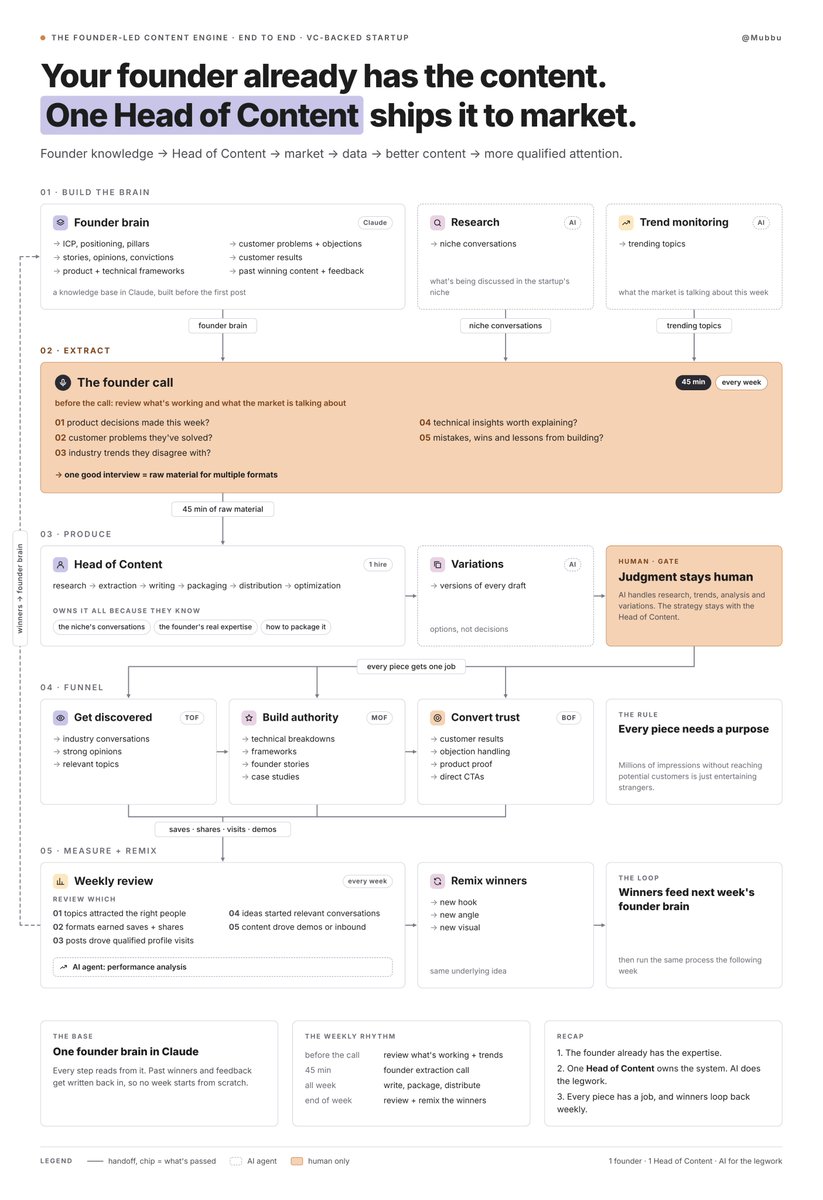
How I'd build a founder-led content engine for a VC-backed startup:
Technical founders are sitting on YEARS of content they haven't figured out how to distribute.
And yet, their marketing team is spending hours trying to come up with things to post.
The solution?
Hire ONE strong Head of Content to turn the founder's knowledge into a repeatable distribution system.
Exact 5-step setup to install:
1. Build a founder brain before writing a single post
Create a central knowledge base in Claude with:
- ICP, positioning, and content pillars
- Founder stories, opinions, and convictions
- Product expertise and technical frameworks
- Customer problems, objections, and results
- Previous winning content and feedback
The goal is to build a system that understands the founder well enough to extract and develop their ideas without starting from scratch every week.
2. Make the Head of Content own the entire operation
One person should be responsible for:
Research → Extraction → Writing → Packaging → Distribution → Optimization
They should know what conversations are happening in the startup's niche, what the founder has genuine expertise in, and how to package that knowledge into content people actually want to consume.
Use AI agents for research, trend monitoring, performance analysis, and content variations.
Keep the strategic judgment with the Head of Content.
3. Extract 45 minutes of the founder's brain every week
Before the call, review what's working and what the market is talking about.
Then ask the founder about:
- Product decisions made that week
- Customer problems they've solved
- Industry trends they disagree with
- Technical insights worth explaining
- Mistakes, wins, and lessons from building
One good founder interview should give you enough raw material to create content across multiple formats.
4. Build a content funnel that actually supports growth
TOF: Get discovered by the right people through industry conversations, strong opinions, and relevant topics.
MOF: Build authority through technical breakdowns, frameworks, founder stories, and case studies.
BOF: Convert accumulated trust through customer results, objection handling, product proof, and direct CTAs.
Every piece of content needs a purpose.
A startup generating millions of impressions without reaching potential customers is just entertaining strangers.
5. Run the same optimization loop every single week
Review:
- Which topics attracted the right people
- Which formats generated saves and shares
- Which posts drove qualified profile visits
- Which ideas started relevant conversations
- Which content generated demos or inbound
Take your winners and create new variations.
New hook. New angle. New visual. Same underlying idea.
Then repeat the process the following week.
Founder knowledge → Head of Content → Market → Data → Better content → More qualified attention.
If you're building a personal brand as a founder, I'm begging you:
- stop trying to appeal to everyone
- develop strong convictions about your industry
- choose how you want people to perceive you
- repeat your core beliefs until people associate them with you
- back up your opinions with actual proof
Here's exactly how I'd approach each one:
1. DEVELOP STRONG CONVICTIONS
Figure out EXACTLY what you believe about your industry and what you think everyone else gets wrong.
Your strongest opinions should come from years of experience, mistakes, customer conversations, and actual results.
For me, one of those beliefs is micro-authority.
I'd rather be deeply known by 3,000 people who could actually buy from me than have 300,000 followers who will never become customers.
That's a conviction I continuously reinforce through my content.
2. CHOOSE YOUR ARCHETYPE
Decide how you want people to experience you online.
I generally think about 3 archetypes:
1. Educator: teaches complex concepts and makes them easy to understand
2. Operator: shares real experiences, decisions, and lessons from building
3. Challenger: questions conventional wisdom and pushes against industry norms
You can use all three, but ONE should remain dominant.
The goal is for people to recognize your thinking and communication style before they even see your name.
3. REPEAT YOUR CORE BELIEFS
One of the biggest mistakes founders make is constantly jumping between unrelated topics because they're afraid of sounding repetitive.
Pick the ideas you want associated with your name and find different ways to communicate them.
One conviction can become:
- a long-form article
- a technical breakdown
- a founder story
- an info visual
- a client case study
- a strong opinion post
Same underlying belief. Different packaging.
You should be reinforcing the same core ideas until your audience starts associating them with you automatically.
4. BACK EVERYTHING WITH PROOF
Strong opinions get attention.
Proof is what makes people believe you.
If you're going to make a claim about your industry, show people WHY you believe it.
- Client results
- Case studies
- Your own business experiences
- Actual performance data
- Lessons from things you've tested
Keep reinforcing what you believe until people go from:
"He keeps saying this." To: "He's probably right."
The ultimate goal of building a PREMIUM personal brand is to have people recognize your ideas before they even see your name.
My Biggest Announcement Ever:
I will be mentoring you for 8 weeks to help you set up a marketing agency for $90.
Yes, 8 weeks where I will help you choose a skill, create an offer, get clients, and retain them
Keep reading
We are hiring cracked engineers
You will be working on something industry first. You will play a key role in delivering one of the most impactful financial instruments ever released onchain
If you have experience building at the exchange layer and a sheer refusal to lose…
Dm
I just open-sourced /Inkworks, a skill for creating interactive 3D projects.
• completely FREE
• MIT licensed
• install: npx skills add Moh4696/inkworks-skill
🔗: https://t.co/oRKnfUMllP
New form of company will be:
- 6 cracked best friends
- sit around the same table every day
- solve hard problems
- 10x’d by bots/dots
- disintermediate entire industries
Base backs its communities
If you're building products, creating content, or growing communities on Base, you could be eligible for a grant of up to $5,000
Learn more about grants in the thread below ↓
We've raised $2.5M from HF0 to build fast & secure inference for robots.
Abstract runs your robot's AI in our cloud with a 30ms round trip, so the robot doesn't need a GPU on board and costs less to build.
One API key gets you eight robot models, π0.5 and MolmoAct2 included.
We're also backed by Susa Ventures and angels from OpenAI, Anthropic, and NVIDIA.
You can sign up to get your API key now:
https://t.co/6fsL7wlBcC
And DM us to get $1,000 in inference credits.