The most consistent mistake I see young would-be founders make is to care too much about investors' opinions and not enough about users' opinions. They've been trained their wholes lives to seek out and please the gatekeepers. But this is where gatekeepers stop mattering.
We asked GPT-6 Astra to edit Qwen3.5-0.8B weights to improve math.
It directly changed only 0.016% of weights, fixing 0.8B's reasoning loops & improving math up to 6x and even instruction following 3x, without gradients or training.
We call this Weight-Space Programming: frontier LLMs can now natively read/write neural network weights! 🧵
Blog: https://t.co/bOWCcFhCVq
As engineering, product, design, DS, etc. melt into a new kind of role, I was reflecting on what roles might look like in the future. For example, when I look at the Claude Code team I see what I think is five archetypes:
1. Prototyper: comes up with brand new ideas; churns out many ideas, most of which don't ship
2. Builder: quickly turns a prototype/idea into production-grade product/infra
3. Sweeper: cleans up the UI, simplifies the code and system, unships, optimizes performance
4. Grower: takes a product that has been built and iterates on it to improve Product-Market Fit
5. Maintainer: owns a mature system to make it secure, reliable, fast, and efficient as it scales
Many people span across 2 roles, and sometimes 3 roles. I also notice that these roles are not really tied to job function -- eg. across Anthropic, some designers match category 1, some 2, some 3; same for engineers, PM, DS.
A healthy team needs a mix of these, depending on the product:
- A product that is new and pre-PMF needs people that are strong at 1+2+3
- A product that is growing and has found PMF needs 2+3+4 and some 5
- A product that has strong PMF needs 3+4+5 and some 2
Maybe product roles of the future will look more like this, and less like the domain-specific roles of today?
The problem isn’t that AI is intelligent. It isn’t. The problem is that too many adults (but not all) are at once mechanistic, imitative, unimaginative, stupid, formulaic, influenceable, & gullible, arrogant beyond their skill set, & too expensive to maintain.
@ChaseLochmiller@OpenAI GPT-6 Astra, trained on ~100K+ NVIDIA Grace Blackwell NVLink72. From ChatGPT to o1 to Astra in 4 years.
AGI has arrived. Congratulations @OpenAI team.
400K GPUs coming online next.
Recent thoughts:
The Shift to Long-Horizon Tasks
The most likely breakthrough this year will be in long-horizon tasks. We are moving toward a stage where Large Language Models (LLMs) learn to complete extended, complex missions by interacting with Agent environments. This is perhaps where the true value of LLMs lies. Take cybersecurity as an example: imagine a model that continuously hunts for software bugs and vulnerabilities. While it sounds like a search process, it’s actually the model learning the high-level intuition and methodology of a professional hacker. Unlike humans, AI can run 24/7 without fatigue. It could potentially find exploits at a much higher frequwill ency and claim bounties on platforms like HackerOne or BugCrowd. It sounds fun, but fundamentally, it's a revolution that displaces the hacker. If even hackers are being "disrupted," one can only imagine the impact on general programmers.
From One-Person to None-Person Companies
Building on long-horizon capabilities, Autonomous Agent Systems (AAS) will inevitably become the next frontier. Last year, we were discussing the rise of the "One Person Company" (OPC). I didn't expect us to move so quickly toward the "None Person Company" (NPC). It’s an ironic twist—we might all end up as NPCs in this new ecosystem.
Engineering the Impossible: Memory and Learning
To realize the vision above, we must solve three technical pillars: Memory, Continual Learning, and Self-Judging.
I used to think these would require massive paradigm shifts and years of research. However, the pressure from both the technical and application sides is so intense that we are seeing these capabilities emerge through ingenious engineering "tricks":
Memory: Long context windows (1M+) and RAG have significantly bridged the gap.
Continual Learning: While true continual learning remains difficult, the release cycles are shrinking. Global models are updated monthly; domestic models are catching up. If we reach weekly updates by next year, it will effectively function as continual learning.
Self-Judging: This remains the most elusive, yet models like Opus 4.7 are already demonstrating early self-correction and judgment capabilities.
The Self-Evolving Endgame
The most difficult—and most promising—path is Self-Evolution. The current wave is incredibly fierce. I suspect that models like Claude may have already achieved a baseline for self-training: writing their own code, cleaning their own data, generating synthetic data, and then training on it. It might "waste" some compute, but it saves the most precious resources: human labor and time. In the LLM era, speed is everything. Rapid iteration is what creates the cognitive gap between leaders and followers. Claude’s rumored 2-million-chip cluster for next year is likely dedicated to exactly this: autonomous model self-training.
Technical Summary:
1M Context: Necessary baseline.
Memory & Continual Learning: Prerequisites, likely solved first via "tricky" engineering.
Harnessing Environments: The breakthrough point.
Self-Judging: The tipping point.
Full Self-Training: The endgame.
Redefining AGI and the Industry
If this is the road to AGI, then AGI’s definition should be the sum of all human collective intelligence, not just an individual’s intelligence. It must possess the creative capacity to produce something as profound as the "Theory of Relativity"—meeting the bar set by Hassabis.
During this transition, every APP will need to be reconstructed as AI-native. In fact, we might move past the concept of APPs entirely. The most significant challenge will be the reconstruction of the operating system itself. In the future, you won’t see a traditional desktop; you will see an LLM OS, where applications are "generated on demand." This challenges the 80-year-old Von Neumann architecture and represents a total upheaval of the computer science industry.
The Irreversible Wave
From completing long-horizon tasks to fully autonomous operations, every sector—Security, Finance, Law, E-commerce—will be reshaped. Many friends have reached out lately, asking how to transform their enterprises to keep pace with AI. But few truly realize that this irreversible process has already begun. As this massive technical wave hits, we must be prepared to act, but we must also start thinking seriously about how to regulate it.
🚀 Day 0: Warming up for #OpenSourceWeek!
We're a tiny team @deepseek_ai exploring AGI. Starting next week, we'll be open-sourcing 5 repos, sharing our small but sincere progress with full transparency.
These humble building blocks in our online service have been documented, deployed and battle-tested in production.
As part of the open-source community, we believe that every line shared becomes collective momentum that accelerates the journey.
Daily unlocks are coming soon. No ivory towers - just pure garage-energy and community-driven innovation.
i love openai, and everything i’ve done over the past few days has been in service of keeping this team and its mission together. when i decided to join msft on sun evening, it was clear that was the best path for me and the team. with the new board and w satya’s support, i’m looking forward to returning to openai, and building on our strong partnership with msft.
We are encouraged by the changes to the OpenAI board. We believe this is a first essential step on a path to more stable, well-informed, and effective governance. Sam, Greg, and I have talked and agreed they have a key role to play along with the OAI leadership team in ensuring OAI continues to thrive and build on its mission. We look forward to building on our strong partnership and delivering the value of this next generation of AI to our customers and partners.
The two biggest psychological limitations for most people are:
- Vision
- Commitment
Vision: What exactly do you want, and how clear is it to you....and
Commitment: What are you willing to do, to make it happen.
Sharply Defining the terms is half the battle.
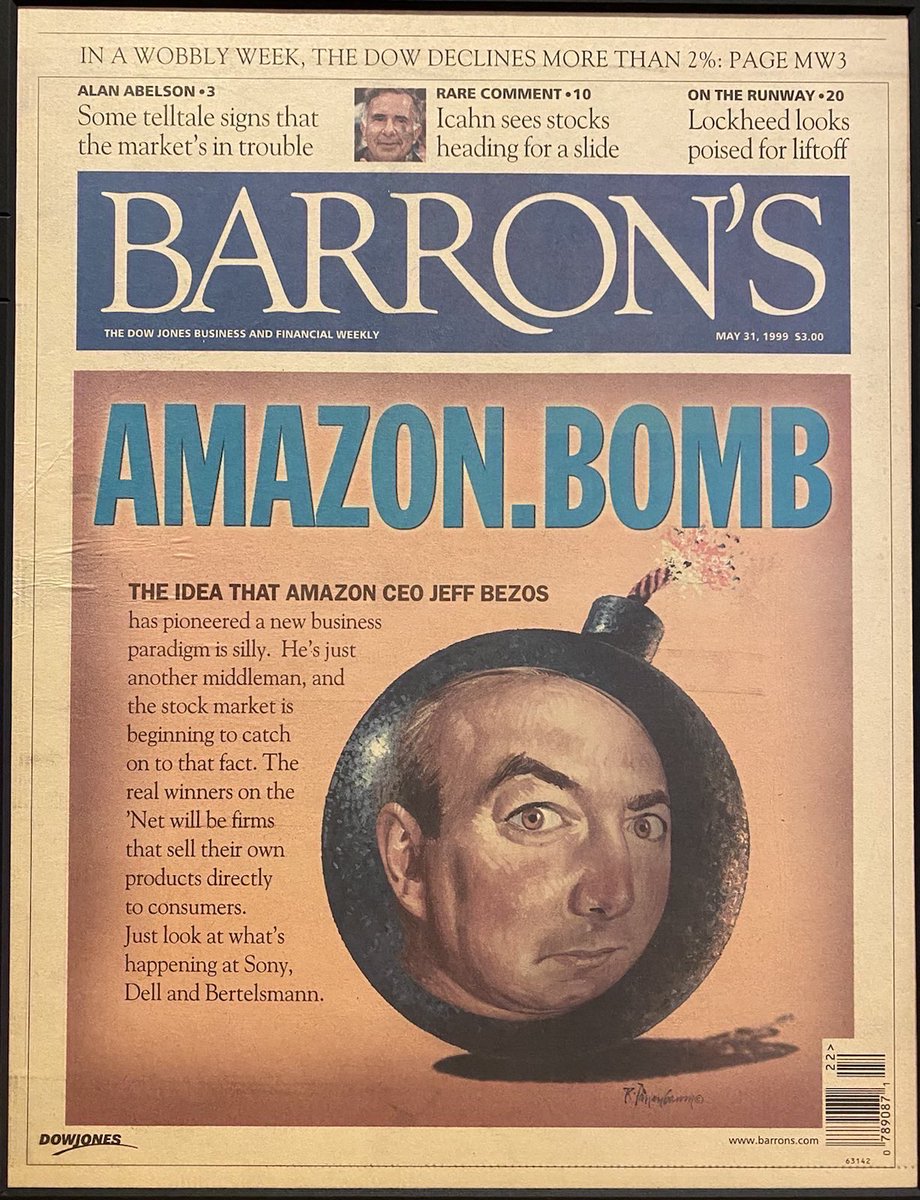
Listen and be open, but don’t let anybody tell you who you are. This was just one of the many stories telling us all the ways we were going to fail. Today, Amazon is one of the world’s most successful companies and has revolutionized two entirely different industries.
The main reason people quit pursuing ambitions and fantasies isn't the effort required, it is the extra pain that comes from knowing you are trying and failing. Not trying and failing feels a lot less painful.