The Fable 5 model @AnthropicAI released today is wildly impressive. I've been using it for the past hour.
If you have a Claude Pro, Max, or Team plan, it's available until June 22nd.
A friend called me last week and asked, "How many people do you think use AI daily for complex work?” My answer was 1 in 5.
My LinkedIn feed is wall-to-wall AI. Every podcast I listen to mentions Claude or ChatGPT, and half my conversations end up there too. It feels like everyone is using AI.
But that's the bubble. So I went looking for the actual data.
84% of humans on Earth have never used AI. Not once. Of the remaining 16%, almost everyone is using free chatbots – ChatGPT for a recipe, Claude for a quick draft, that kind of casual touch.
About 0.3% of the planet pays $20/mo for AI. And the share who use it as a real coding collaborator? Roughly 1 in 2,500 people. That's the single bright dot in the corner of the graphic.
If you pay for a Claude or ChatGPT subscription, you're in the top 0.3% of humanity. If you've used AI to build something real, you're in a tier so small it barely registers as a stripe.
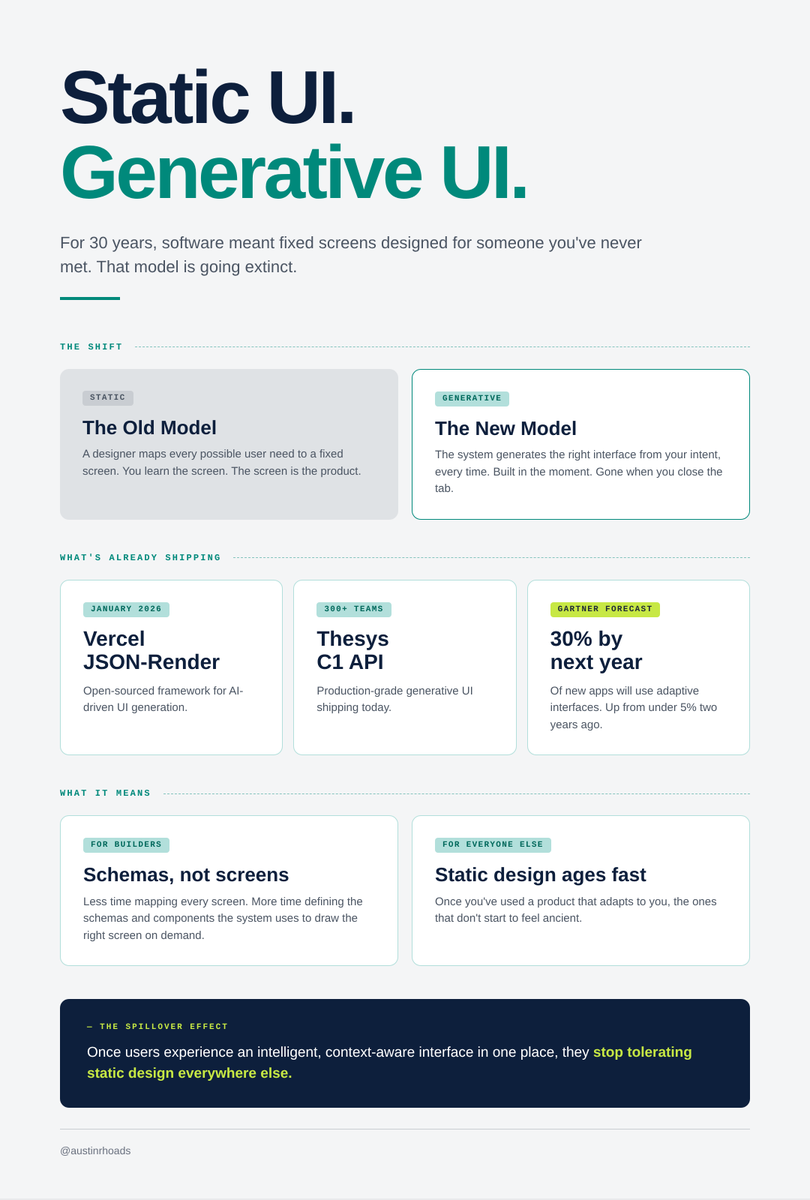
Generative UI piqued my curiosity this week. I’ll summarize what you need to know in 15 seconds.
Instead of displaying pre-built screens, systems will generate the right interface from your intent, every time.
By next year, @Gartner_inc forecasts 30% of new apps will use adaptive interfaces.
For thirty years, software has worked the same way. A designer maps every possible user need to a fixed screen, and you learn the screen. The screen is the product. We've all been trained to navigate menus, click through tabs, and fill out forms designed for someone we've never met.
That model is becoming a relic of the past.
If you're shipping software right now, ask this… Does your next dashboard even need to exist?
I think a lot of them don't. Most dashboards assume every user wants the same view of the same data on the same screen. That assumption is going extinct.
For builders, the design job is shifting. Less time mapping every screen, more time defining the schemas and components the system uses to draw the right screen on demand.
And once you've used a product that adapts to you, the ones that don't start to feel ancient.
This is often called the "spillover effect". Once users experience an intelligent, context-aware interface in one place, they stop tolerating static design everywhere else.
We’re entering Software 3.0. Here’s what you need to know as we move from “vibe coding” to “agentic engineering”.
Key point = outsource your thinking, not your understanding. @karpathy calls the new paradigm Software 3.0:
• Software 1.0 was code.
• Software 2.0 was training neural nets on datasets.
• Software 3.0 is prompting. The LLM is the interpreter, your context window is the program.
The "code" you write is increasingly text you hand to an agent, and the agent figures out the rest. Which means the bottleneck for building quickly moves up the stack.
A few things that fall out of this:
1) Look for verifiable wedges. Find domains where ground truth exists or can be generated. That's where you can run your own reinforcement learning and fine-tuning on top of a frontier model, even when the frontier labs aren't paying attention. The labs can't compete on data they don't have access to. They won't accidentally erase what they aren't looking at.
2) Build for agent-legibility. Docs, APIs, auth, deployment, all of it gets rewritten so agents can actually use the system. The companies that rebuild for that world early will compound. The ones treating AI as "ChatGPT, but for X" will look quaint fast.
3) Taste and spec quality become the founder's real moat. Agents are excellent at filling in details. They are terrible at knowing what to build. What we build, why, and what the right primitives are. That's the work that doesn't get automated.
You can let agents do the work. You cannot let them be the person who actually understands the customer, the domain, and the system. The understanding is the part you can't delegate. It's also the part that determines who's still building real companies five years from now.
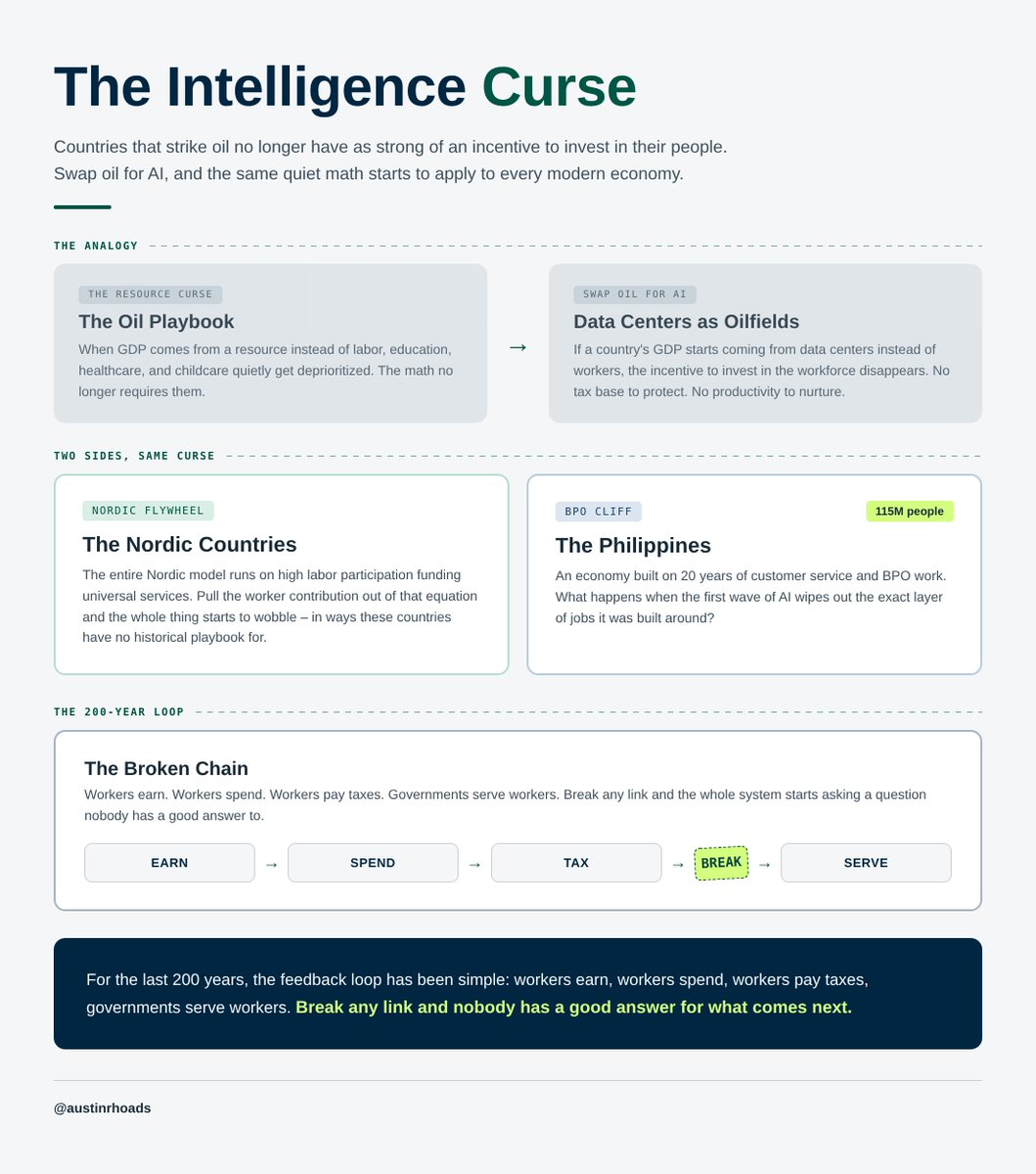
Ever heard of the intelligence curse? I’ve been thinking about something @tristanharris said in a recent @ChrisWillx episode, and I can't shake it.
The logic is simple. Countries that strike oil don’t have as strong of an incentive to invest in their people anymore… Because GDP is now disproportionately tied to the resource instead of the human labor. Education, healthcare, childcare all quietly get deprioritized because the math no longer requires them.
Now swap oil for AI.
If a country's GDP starts coming from data centers instead of workers, the incentive to invest in the workforce begins to disappear. No tax base to protect. No productivity to nurture. No political voice that actually needs to be listened to, because the revenue is coming from somewhere else entirely.
Two especially interesting cases to consider here are the Nordic countries and the Philippines.
The entire Nordic model runs on a flywheel of high labor participation funding universal services. Pull the worker contribution out of that equation and the whole thing starts to wobble in ways these countries have no historical playbook for.
The Philippines is the other side of the same coin. I've spent significant time there, and an enormous share of that economy runs on BPO and customer service work. What happens when the first wave of AI wipes out the exact layer of jobs the country built its last 20 years around? Are a handful of AI labs going to fund a social safety net for 115 million people?
Here's the part I keep getting stuck on… For the last 200 years, the feedback loop has been – workers earn, workers spend, workers pay taxes, governments serve workers.
Break any link in that chain and the whole system starts asking a question nobody has a good answer to… Who is actually buying the things AI produces if the humans who used to buy them no longer have incomes?
Do you ever feel AI costs you more time than it saves? I've burned afternoons with Claude in Excel asking for tiny formatting tweaks I could have finished in five minutes. I saw a client run into the same trap this week.
Here's a rule: AI gets you to 80%. You finish the last 20%.
**Where Claude in particular earns its keep:
1) First drafts. Blog posts, memos, decks. Feed it your voice and go.
2) Summarizing long documents. 50-page PDF in, one-pager out, with page references so you can verify.
3) Thinking out loud. Pressure-test a decision. Ask it to argue the other side.
4) Working with your files. In Claude Cowork, it reads your local folders and builds docx, pptx, and xlsx files end-to-end.
5) Step-by-step reasoning on messy problems.
**Where Claude costs you time:
1) Precise math. Don't trust it as a calculator unless it's running code.
2) Real-time facts without search turned on. It guesses, and it sounds confident doing it.
3) Vague prompts. "Write something good" gives you something generic.
4) Being the source of truth. Verify names, dates, quotes, and numbers.
5) The last 20% of polish. Tiny formatting tweaks in Excel. Final sentence edits in a doc. Open the file and finish it yourself.
Claude is a very good employee. However, it still needs your direction, and it still needs you to close the last mile.
I ran an experiment this week. I asked AI what sunscreen to buy for sensitive skin under $15. It handed back a short, ranked list. No aisle. No scrolling.
That small interaction is how a lot of shopping is going to feel in the next few years.
For decades, shopping has meant browsing. You walked a store aisle, or you scrolled a search bar. Either way, you compared and picked.
When an AI agent does that work for you, the browsing step disappears. You ask for what you need, and an answer shows up. One product, maybe three. Already filtered for your skin, your budget, and what you've bought before.
A few things shift when that becomes normal:
1) Discovery gets simpler, and smaller. No endcaps, no banners, no sponsored rows pretending to be recommendations. The agent gives you an answer. Whether you trust the answer becomes the new question.
2) Smaller brands get a real shot. For years, the brands at eye level were the ones that paid to be there. Agents don't see eye level. A better product with better data can land right next to the giants, at least until the giants catch up.
3) Your data matters more than ever. The agent knows your skin type, your budget, and what you bought last time. That's powerful when it works in your favor. It's also worth asking who owns that picture of you.
4) Impulse sticks around. Grab-and-go, convenience, the 2 a.m. snack run… Those moments are hard for a remote agent to replace. The shift is about the trips you plan, not the ones you fall into.
The store isn't going anywhere. But a second way to shop is being built right next to it, and most of us will be living in both before we notice the switch.
I spend 7+ hours per day using AI. Most of that time is now focused on automating processes inside Claude Cowork and testing AI agents. Here's the detail most new AI users miss:
AI is only as good as the context you give it. And context DEGRADES.
Most people treat AI outputs as “magic” and blindly trust whatever the model hands back. That is the trap.
This morning I tried to combine findings from two Claude threads into a third to build an investor-ready document. The output looked polished. The reasoning had quietly fallen apart. Most people wouldn't have caught it.
When threads get compacted, when agents hand off to agents, when conversations run long… The nuance gets smoothed away. The output still sounds confident, even when it is not accurate.
Recent research on multi-agent AI systems has found failure rates between 40% and 80% depending on the benchmark. Most users have no idea.
When something actually matters, I do four things:
1) Run audit loops. I have a fresh instance check the work, not the same thread that produced it.
2) Never let a single long, rambling thread carry an important output. I rebuild deliberately.
3) Verify specifics against source material, not the model's own memory.
4) Treat AI as a brilliant intern, not an oracle. Brilliant interns still need review.
The models will get better. Fast. But right now, if you’re using AI like magic, you are likely shipping work that looks right and isn't.
Any best practices I missed here?
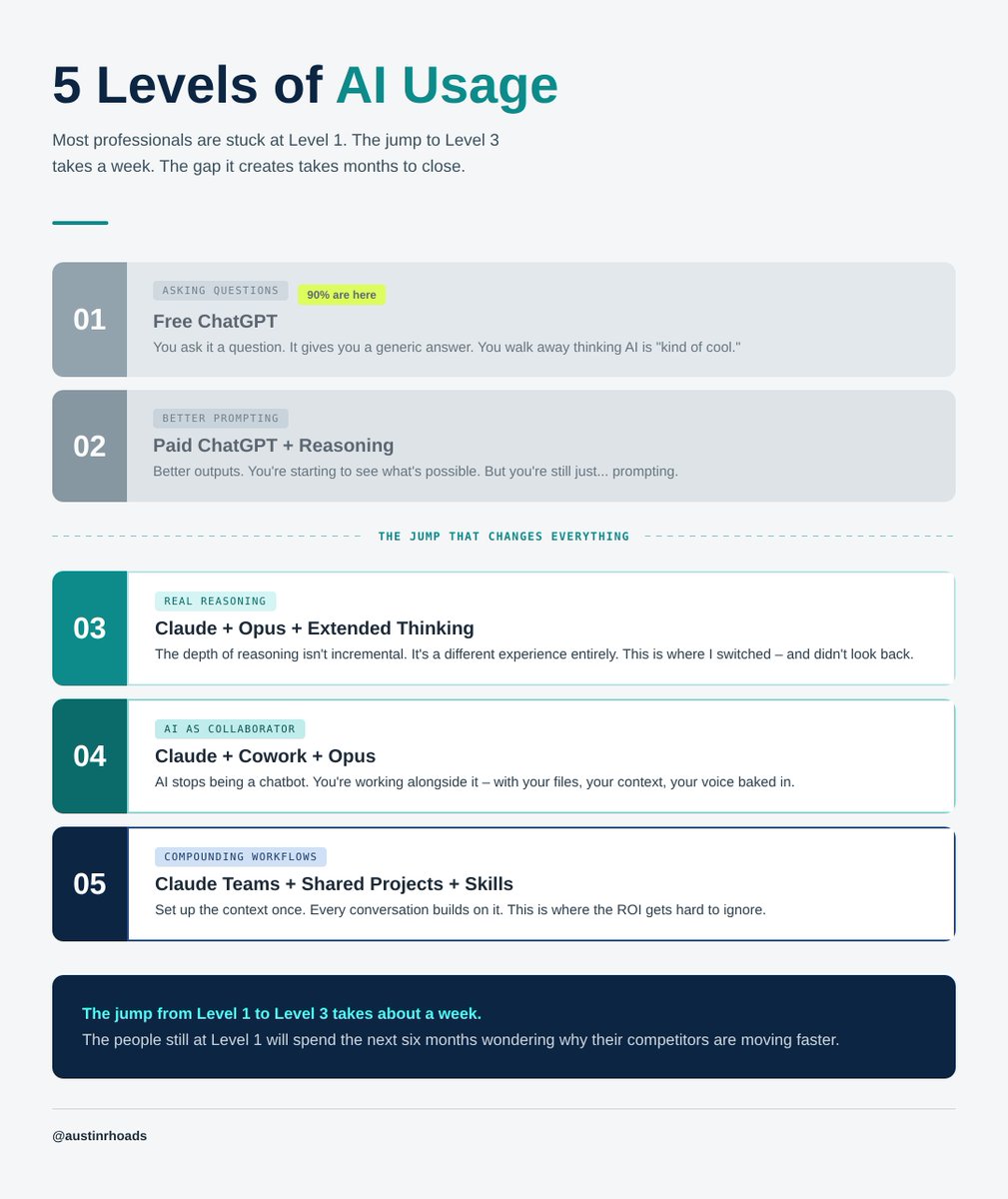
*Newsflash! If you’re still using ChatGPT, you are behind the times. Most people using AI are stuck at Level 1. I keep seeing the same pattern over and over.
There are really only a few levels to how people use AI right now, and the gap between each one is massive.
• Level 1 – Free ChatGPT. You ask a question, get a generic answer, and walk away thinking "yeah, AI is kind of cool I guess." This is where 90% of professionals still are.
• Level 2 – Paid ChatGPT with reasoning. Better outputs. You're starting to see what's possible. But you're still just prompting.
• Level 3 – Claude with Opus and extended thinking. This is where I landed a few months ago and the difference was immediate. The depth of reasoning, the ability to work through complex problems, the quality of the writing – it wasn't incremental. It was a different experience entirely.
• Level 4 – Claude’s Premium plan with Cowork and Opus. AI stops being a chatbot and starts being a collaborator. You're working alongside it with your files, your context, your voice baked in. I built my entire voice profile through this process. The output doesn't sound like AI. It sounds like me.
• Level 5 – Your whole team on Claude with shared Projects, custom Skills, and workflows that compound. Set up the context once, and every conversation builds on it. This is where the ROI gets hard to ignore.
Here's what gets me. The jump from Level 1 to Level 3 takes about a week of intentional effort. But the people still sitting at Level 1 will spend the next six months wondering why their competitors seem to be moving faster.
I believe the days of merely selling “software tools” are coming to a close.
People and businesses will buy end-to-end OUTCOMES.
Build the full solution, not the tool.
Every tech company is going to do WAY more layoffs.
There isn't a single Board that isn't asking their CEO...
"How can we do the same things with XX% less people?"
Bigger question – *IF* AI replaces a significant number of jobs and GDP is largely driven by data centers and compute, governments will no longer have an incentive to invest in their people.
With no tax base to protect and no political voice to listen to, what happens then?
Everyone says AI will replace most jobs.
But if there are no jobs, there’s no income.
No income means no spending.
So how does the economy even function?
What am I missing?
AI helped me condense 10 years of my life into a single markdown file last week. How I think. How I write. How I learn. How I operate my businesses. All of it, in ONE text file.
Sound crazy? Here's what I learned.
I sat through a 100-question interview with Claude over four hours, and I learned more about myself in that session than I have in years of self-reflection.
I uploaded examples of how I write. I shared decks I've presented. I walked through the writers and thinkers who inspire me. Claude kept pushing back every time I got vague. That’s where the real answers lived.
Most people hear this and freak out. "Me? My life? My style? Condensed into a text file? That's wild." I had the same reaction before I did it.
The thing is, intelligence (human or artificial) centers on pattern recognition. It's what makes these AI models so powerful in the first place.
And the uncomfortable part is that the way we are as people is also just made up of a series of patterns. The words we reach for. The hooks we won't touch. The structures we default to when nobody is watching. We don't see them because we're inside them. A machine sees them in four hours.
Sure, this might sound dystopian. However, I'd argue everyone who touches AI tools should have a markdown file of their own voice that they use in every thread.
I'm sick of seeing the same generic canned AI garbage on LinkedIn. Every post reads like it was assembled from the same three templates. Isn't it time we gave it some character?
Give me a shout if you want the prompt I used so you can complete this exact same exercise.
What happens when we stop thinking for ourselves?
We’re already outsourcing crucial decisions to AI:
• How to handle conflict
• Which career path to choose
• How to improve relationships
The more we outsource decisions, the less we learn/grow. And the less human we become.