@elonmusk 🙏💙🙏
Autism Ready America (@AutismReadyUSA) is a new initiative working to ensure the safety of all autistic individuals and deliver lifelong, appropriate support systems.
We’re advocating for a comprehensive, congressionally mandated & federally funded national program with better training, crisis response, and real resources for autistic Americans and their caregivers.
Join the movement on Facebook:
https://t.co/xSNNuzzFIi
Your support could help create meaningful change for millions of families. 🙏💙🙏
#AutismReadyAmerica #AutismAdvocacy
Hello
Is there anybody in there?
Just nod if you can hear me
Is there anyone at home?
Come on now
I hear you're feeling down
Well, I can ease your pain
Get you on your feet again
Relax
I'll need some information first
Just the basic facts
Can you show me where it hurts?
There is no pain, you are receding
A distant ship smoke on the horizon
You are only coming through in waves
Your lips move but I can't hear what you're saying
When I was a child I had a fever
My hands felt just like two balloons
Now I've got that feeling once again
I can't explain, you would not understand
This is not how I am
I have become comfortably numb
I have become comfortably numb
O.K.
Just a little pin prick
There'll be no more ah!
But you may feel a little sick
Can you stand up?
I do believe it's working, good
That'll keep you going through the show
Come on, it's time to go
There is no pain you are receding
A distant ship smoke on the horizon
You are only coming through in waves
Your lips move but I can't hear what you're saying
When I was a child
I caught a fleeting glimpse
Out of the corner of my eye
I turned to look but it was gone
I cannot put my finger on it now
The child is grown
The dream is gone
I have become comfortably numb
The Senate Anti-Fraud Task force is exposing a potentially MASSIVE Medicaid fraud scandal in Maine.
As Chair, I sent preserve and production demands to Gainwell Technologies and Sandata. If we don't get satisfactory answers, take note @DOJFraudDiv. 🧵
🌌 Astronomers have captured one of the clearest views of a young solar system forming 400 light-years away. Using ALMA, they observed the star PDS 70, where two giant planets are carving paths through a disc of gas and dust. One planet, PDS 70c, even has its own disc that could one day form moons. It's a remarkable glimpse into how our own Solar System may have looked over 4.5 billion years ago.
This is probably the clearest example of an actual academic collapse.
Weiss entered MIT in 1950, initially studied electrical engineering and then transferred to physics. During his third year, a painful romantic breakup overwhelmed him.
In his own Nobel autobiography, he states plainly;
“I failed all my courses at MIT and had to leave as a student.”
He was no longer progressing toward a degree. He returned to MIT not as a student but as an hourly electronics technician in Jerrold Zacharias’s atomic-beam laboratory. He punched a time clock and worked alongside machinists and laboratory technicians.
That apparent demotion became his real education. Weiss learned machining, sheet-metal work, soldering, welding, electronic design and the improvisational craft of experimental physics.
Instead of merely solving prepared textbook problems, he helped graduate students construct the instruments required for their research and worked on an early caesium atomic clock. With Zacharias’s support, he eventually completed his undergraduate degree and entered graduate school.
Decades later, Weiss became the central experimental architect behind laser-interferometric gravitational-wave detection.
He shared the 2017 Nobel Prize in Physics with Kip Thorne and Barry Barish for decisive contributions to LIGO and the observation of gravitational waves.
A cosmic butterfly frozen in its final, violent dance.
Using near-infrared vision, Hubble has unveiled a striking S-shaped pattern of glowing, singly ionized iron within NGC 6302 — the Butterfly Nebula. This luminous trail marks the central star system’s most recent, high-speed ejections of gas, racing outward far faster than the older material expelled in earlier outbursts.
At the heart of this spectacular nebula, one or more dying stars are shedding their outer layers in dramatic pulses over the past few thousand years. The result is an ethereal “butterfly” whose radiant wings consist of superheated gas reaching temperatures above 36,000°F (20,000°C). These wings are tearing across space at an astonishing 600,000 miles per hour — fast enough to circle Earth in just two and a half minutes.
NGC 6302 lies roughly 3,800 light-years away in the southern constellation Scorpius. Even at that immense distance, the nebula’s chaotic beauty and furious motion remind us of the dramatic final chapter in the life of sun-like stars.
This Hubble image captures the raw power and fragile grace of stellar death, where a star’s last breaths sculpt one of the most striking nebulae in our galaxy.
Despite its many historical inaccuracies, Braveheart got one surprising detail right: its women's costumes....
In the 13th and early 14th Centuries, noblewomen typically wore high-necked, long-sleeved gowns with loose silhouettes that reflected both their social status and the modesty expected at the time. Their hair was usually covered with veils or wimples, making the flowing hair and revealing dresses often seen in modern medieval films largely inaccurate.
Because fabric was extremely valuable, garments were carefully cut and fitted without the fabric-intensive tailoring techniques used today. Sophie Marceau's portrayal of Isabella, with her high-necked gowns, covered hair, and understated wardrobe, closely matches the fashion worn by aristocratic women of the early 1300s.
📷 : Sophie Marceau as Princess Isabella of France in the 1995 film Braveheart, wearing a period-accurate, high-necked gown with a wimple head covering.
#drthehistories
The moment Roy (Robert Taylor) suddenly returns…
Just with her eyes, Vivien Leigh made the whole world tremble and cry. No long dialogue needed — just that gaze. In one look, her eyes lit up with hope… then faded into utter despair.
Oh, how cruelly ironic. The most beautiful love story, toyed with so mercilessly by fate…
Her eyes didn’t just act — they told the entire story. They made us fall in love, feel the pain, and cry right along with her character. 💔
#WaterlooBridge #VivienLeigh #RobertTaylor #ClassicHollywood #OldHollywood #VintageRomance #TragicLoveStory #GoldenAgeCinema #FilmNoirVibes #CinemaMagic
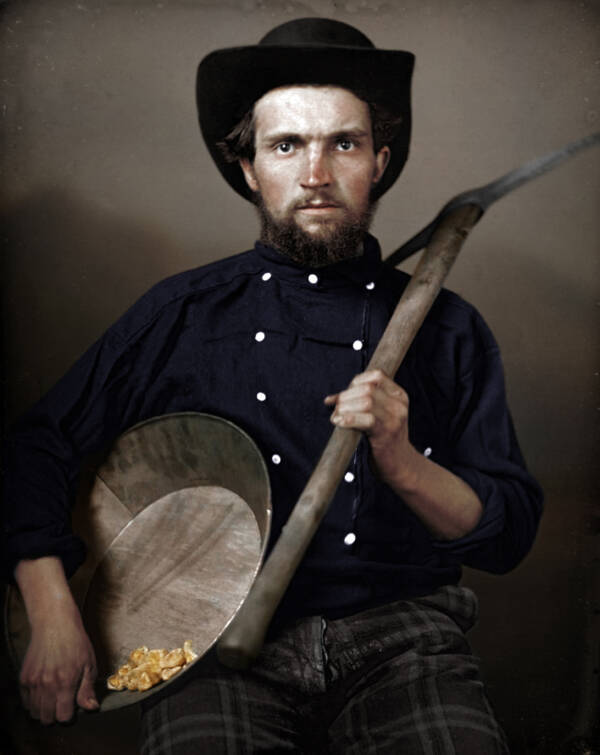
A portrait of an unidentified gold miner in California taken around 1851, during the Gold Rush that began in 1848 and forever changed the landscape of California and the western United States.
Kevin: Did you have any kids?
Bird Lady: No. Oh, l wanted them. But the man I loved fell out of love with me. That broke my heart. And whenever the chance to be loved came along again, I ran away from it. I stopped trusting people.
Kevin: No offense, but that seems like sort of a dumb thing to do.
Bird Lady: I was afraid of getting my heart broken again. You see, sometimes you can trust a person, and then, when things are down, they forget about you.
Kevin: Maybe they're just too busy. Maybe they don't forget about you, but they forget to remember you. l don't think people mean to forget. l think it just happens.
Bird Lady: I'm just afraid if I do trust someone, I'll get my heart broken again.
Kevin: I understand that. l used to have this really nice pair of rollerblades. l was afraid if l wore them, l'd wreck them. So l kept them in a box. Do you know what happened?
Bird Lady: No.
Kevin: I outgrew them. I never wore them once outside. l just wore them in my room a couple times.
Bird Lady: A person's heart and a person's feelings are very different than skates.
Kevin: Well, they're kind of the same thing. lf you aren't going to use your heart, then what's the difference if it gets broken? If you just keep it to yourself, maybe it'll be like my rollerblades. When you do decide to try it, it won't be any good. You should take a chance. Got nothing to lose.
Bird Lady: A bit of truth in there somewhere.
Rest in peace, Brenda Fricker (1945-2026) 🕊️
🎞️ Home Alone 2: Lost in New York (1992)
🎥 Dir. Chris Columbus
Margaret Taylor, wife of President Zachary Taylor, who was the First Lady of the United States for just over a year until her husband died in office in 1850.
Gary Sinise says his son was diagnosed with a 1 in a million spine cancer after his wife was diagnosed with stage 3 breast cancer
‘The week the album went to press,Mac lost his battle with cancer he died on January 5 2024, he was a pure soul a gentle loving kind funny talented guy he loves his sisters he loved his mom she was constantly with him through this fight’
‘As parent it’s so difficult losing a child I am so blessed fortunate and proud to be his dad’
King George I sailed down the Thames on a barge with 50 musicians today in 1717.
They performed George Frideric Handel's Water Music for the first time!
She came to Troy not to win the war. She came to die in it...
Her name was Penthesilea, queen of the Amazons. She arrived on the plain of Troy in the weeks after Hector's funeral, when the Trojan cause was already tilting. The city knew it. So did she.
But she had not come because Troy needed saving. She had come because she needed what only war could offer.
Months before her arrival, during a hunt, she had thrown a javelin that went wide. By the account preserved in post-Homeric tradition, the weapon was meant for a deer. It killed her sister Hippolyta instead. The death was an accident. The guilt was absolute.
Under the warrior code she carried, blood guilt of that kind could not be settled in gold or ceremony. It required an answer in blood: either the killing of enemies, or the death of the killer. Penthesilea made her choice. She would go to Troy, fight with everything she had, and let the outcome balance the account.
She arrived with twelve Amazon warriors at her side.
On the battlefield, by the account in Quintus of Smyrna's Posthomerica, she fought with a ferocity that shook the Greeks. Some accounts name Ajax among those she bested. The Trojans, who had not felt hope in weeks, lined the walls to watch. For a stretch of that day, she pushed the Greek forces back toward their ships.
That had not happened since Hector was alive.
Then Achilles came onto the field.
He, too, was carrying something. His closest companion Patroclus was dead. He had already killed Hector in vengeance. He was fighting now with nothing left to prove and nothing left to protect.
Two people at the edge of what they could carry met in the middle of the plain.
The accounts differ on the particulars of their duel. They agree on the outcome. Achilles killed her.
When he removed her helmet and looked at the woman he had just fought, something in him broke. Ancient sources describe grief, astonishment, an emotion the chroniclers could not name cleanly. A soldier named Thersites mocked him for it. Achilles killed him for that.
He returned her body. He would not leave her in the field.
She came seeking a warrior's death. She received one. Whether it resolved the guilt she carried is a question the poets left open.
The queen who arrived at war already broken.
The duel that produced a grief no one expected.
The moment when the greatest fighter of his age wept over the woman he had just killed.
Troy produced many stories. Few carry that particular weight.
📷 : A red-figure cup painted in Athens around 460 BC, now in the Antikensammlungen in Munich, depicts the precise moment Achilles kills her. Their eyes are shown meeting at the instant of death. Scholars know the painter primarily from this work, and gave him the conventional name the Penthesilea Painter.
#archaeohistories
Ephesus Odeon
The Ephesus Odeon (also known as the Bouleuterion) was one of the most important structures in the ancient city of Ephesus.
It was built in the mid-2nd century AD, around 150 AD. It was financed by Publius Vedius Antonius, a wealthy Ephesian, and his wife Flavia Paiana (or Flavia Papiana in some sources).
It served a dual function: both as a meeting hall for the city council (senate/boule) and as an indoor hall (odeon) for small concerts, music, and theatrical performances.
Capacity: Approximately 1,400–1,500 people.
It remains well-preserved today and can be visited at the Ephesus archaeological site.
🌑 The Deep Ocean Just Broke a Scientific Rule
4 km beneath the Pacific Ocean, where sunlight has never reached, scientists discovered something unbelievable—oxygen being produced in total darkness.
Researcher Andrew Sweetman first thought his equipment was faulty, but repeated tests showed the same result. Scientists believe deep-sea metal-rich rocks may act like tiny natural batteries, splitting seawater to create oxygen. They call it "dark oxygen."
The discovery is still being debated, but if confirmed, it could change what we know about Earth's oxygen—and even reshape the future of deep-sea mining.
Source: Sweetman, A. K., et al. Nature Geoscience.