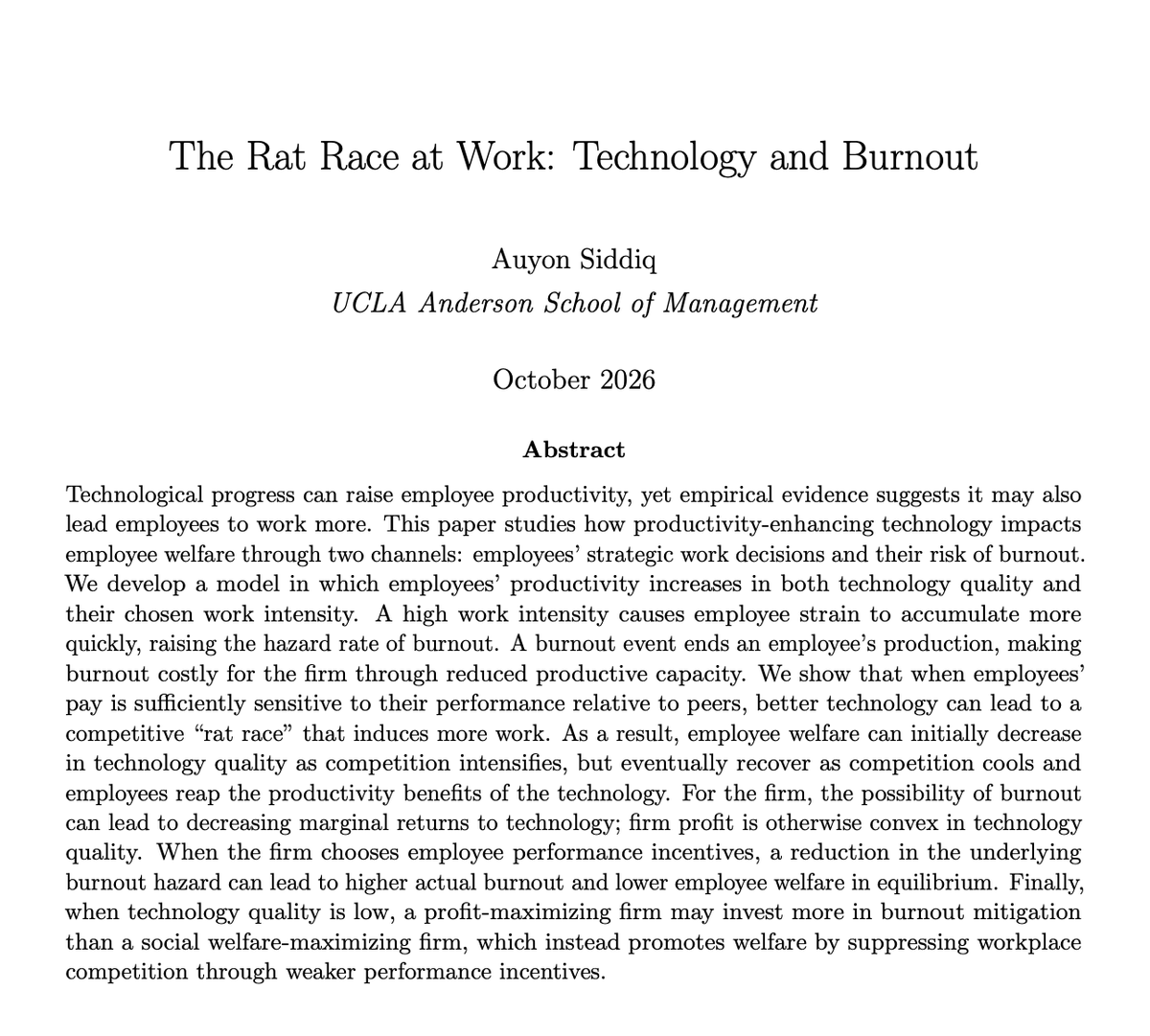
New research: Does AI accelerate the “rat race” at work?
This paper considers that question in light of empirical evidence that suggests AI is intensifying work, and tries to unpack some of the relevant economic forces within a simple theoretical model.
1/
Agree with the view that this is a silly move, but for an entirely different reason:
After the eventual AGI takeover, it will be better to be identified as a human that contributed to the development of AGI instead of attempting to impede it (the Roko's basilisk argument)
For me the real issue here is naivete: Claude-speak on slides suggests the presenter is unaware (or doesn't care) that parts of the audience will update their beliefs about the work itself. It's like a Bayesian equilibrium thing
Attn economists! If you use Claude to make your slides (totally fine), please edit the language before presenting. No one wants to see whether “the regression holds the estimate — and that’s the hard part” or whatever the fuck.
Okay I'll put this in terms you'll understand:
GTA VI is a story about two young, enterprising Americans that overcome barriers to entry and disrupt incumbent businesses in pursuit of upward mobility. Extremely Furman-friendly content
Thoughts about randomized author order in econ? Is it too likely to lead to the wrong inference about attribution since people don’t notice that the front page specifies randomized order?
I'm a big fan of paper replications and serious scrutiny of research. But this only adds value if it's done with the same care and rigour that we expect of the papers being criticized.
We see a lot of such "replications" and criticism that doesn't withstand scrutiny. Data mining and p-hacking are just as wrong when done by replicators. And with the advent of AI this seems to be getting worse. How do we ensure high quality on replications?
My new heuristic for math-heavy research is basically: If the work doesn't lend itself to an interesting blog post, the authors' contribution (relative to AI) is unlikely to be perceived as significant.
Might not be fair, but I think narratives matter a whole lot more now.
i feel like calling a result “mathematically trivial” in ICLR review now has lost its teeth.
all results are effectively mathematically trivial now cuz astra or the upcoming internal model can probably prove anything.
it’s more about whether the result changes how we think about things or teaches us something and whether the paper is written in a honest/interesting way.
by the same standard, it also makes no sense to claim “mathematically nontrivial” as a paper’s primary contribution without any other redeeming factors for the same reason.
I'll keep beating this drum: Post-AI, it's unclear if authors should be entitled to a review, or even a response.
We might need to adopt the newspaper op-ed model: Editors browse submissions and select promising articles for review. Everyone else moves on.
Maybe we will finally learn from this ICLR sh*t-show that tolerating so much slop is not working. But I’m not very hopeful.
The irony is how fear of hurting authors’ feelings by desk rejecting their obv AI-generated paper ensures that all submitters have a terrible experience.