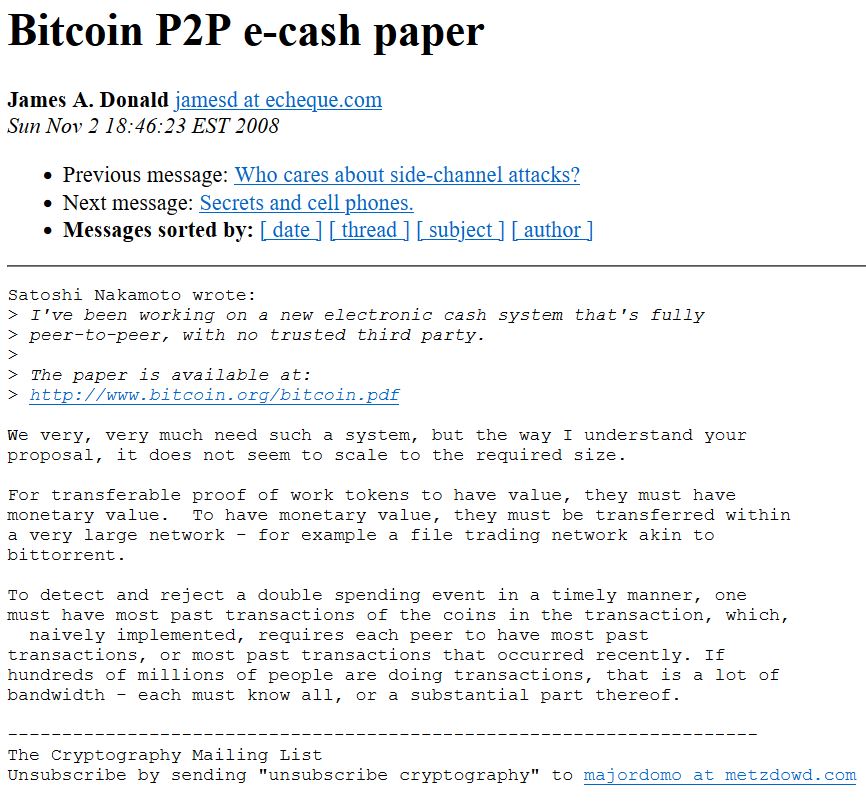
Below screenshot is the very first comment on, and criticism of, satoshi's p2p e-cash system: #Bitcoin.
14 years later the first solution to a secure cryptographic world-wide monetry system is on the table with #Kaspa / $KAS.
@crono_walker@coderofstuff_@emdin@IzioDev Beyond this there is a 2nd issue, two txids can have differing Input Scripts, so this would also require an architectural pivot towards indexing on the consensus side with tx hashes.
@crono_walker@coderofstuff_@emdin@IzioDev In the best case / end-game scenario (I.e. kaspa's throughput being saturated and entering a competitive fee market) we shouldn't actually expect many same txs in parallel blocks. I don't think it is worth optimizing for this. it also has other storage costs, such as more keys.
@emdin@IzioDev Get utxos by addresses could only ever get the payload on recent utxos that were added, or on archival nodes.. problem is that the payload is transient, and gets pruned. This would require a larger architectural overhaul, whereby payloads would be encoded on the utxo itself.
🚀 LIVE NOW! Witness the #HardFork#Crescendo – #KASPA TESTNET 10 unfold in real time! 🔥⚡️ Will this change the game? Join the chat and be part of history!
🎯 Tune in and join the discussion!
🔗 Watch now: https://t.co/VyzKooukxZ
#Kaspa#Bitcoin#Ethereum#Solana
Having been a Kaspa contributor since 2023,
@Max143672 (Maksim) is an experienced RUST and GoLang dev with 3 years of web3 related experience. Maksim's contributions are about performance optimizations; he also introduced the PSKT standard and basic multisig support to wallet framework. The next Sunday morning, Maskim will present overviews of the KIP-9 (Extended mass formula for mitigating state bloat) and KIP-10 (New Transaction Opcodes for Enhanced Script Functionality). KIP-10 is an extension of operations set to adopt/simplify micro-payments. Welcome Maksim and excited to see more join the Kaspa dev & contributor group!
Join us at the Kaspa Innovation Summit for an exclusive workshop, "Building Modern Multi-platform SDKs in Rust," led by @CryptoAspect , contributor and advisor to Kaspa and co-founder of Scaling Bitcoin with over 30 years of experience in systems engineering and 12 years in cryptocurrency,
Anton will explore Rust's essential features, WASM integrations, and the Rusty Kaspa framework.
Don't miss this chance to learn from a pioneer in high-performance systems architecture for the past quarter of the century!
Register now at https://t.co/hodOdjZGo4.
Kaspa in Enterprise event video.
Michael Sutton - A Masterclass in Scalability on Kaspa .
A must watch.
Also on YouTube https://t.co/hdTRtwaUrX
#kaspa $kas #kaspakii@KaspaCurrency@MichaelSuttonIL
@kdxdefi @KasperCoin KDX is the name of the Kaspa desktop p2p node application. Why did you name your project as one of the core applications in the Kaspa ecosystem? https://t.co/5ybLi1IN49
I am trying to figure out, is this ignorance, a scam or someone trying to capitalize on the name recognition?
As customary with Kaspa, in this problem as well you need to think differently than used to.
The reason being that miners kind of roll a biased dice instead of making deterministic max selection.
The reason that miners are incentivized to choose probabilistically is the high BPS -> existence of parallel miners, so if we all choose the same deterministic maximizing txs we all lose in expectation
It's actually a beautiful property and it comes from the informational gap between miners.
Same gap that can hopefully be used to mitigate MEV.
The probabilistic selection has a few interesting implications:
1. It eventually gives a chance also to medium fee values, even if the stream of higher-fees txs is larger than DAG capacity.
2. You can't just increase the fee by one sompi and win the race, you need a meaningful margin for being first with high probability. This derives the fee market more towards truthful fees
Kaspa fee market R&D update: after merging RBF a few days ago, now we're looking at fee estimation methods. We started by converging on the correct API with the thinking that implementation details can be improved over time. The following notebook contains the currently explored direction and describes some of its challenges and shortcomings https://t.co/HD6P4x4YTd
Briefly, Kaspa has uniqueness in the block template transaction selection algorithm where miners are incentivized to select transactions probabilistically in order to reduce collisions with parallel mined blocks (due to high BPS). We try and use this attribute for building a probabilistic method mapping from fee to expected inclusion time, and then use this method inversely for choosing the minimal fee for a given desired inclusion time.
Other approaches might rely on collecting empirical data of various fee groups and their average waiting time.
Interestingly, @hashdag pointed me out today towards Little's law (https://t.co/NBoKr4fDF9). Essentially in our case it means that the average waiting time for a fee group can be determined by the arrival rate and the number of waiting items in that group (thus perhaps inaccurate manual time tracking can be avoided, which is also preferred for performance reasons).
It’s been over a year since our first contributions to the rusty-kaspa repo @Max143672
https://t.co/DX19x8qFSZ
https://t.co/NWbQ3T5peI
Time sure flies when you’re having fun 🎉 #kaspa
It's a deep dive into a complex area of #Kaspa's code, yet a critical consensus component beautifully designed by @OriNewman, @hashdag, and others, and improved and implemented in the Rust codebase by myself. I have some self-criticism, but these sessions will improve over time
The Rust rewrite opened the door for new talent to join the Kaspa developer community. #Kaspa Core Devs are now in over 16 countries worldwide and growing!
"We are working very hard on decentralizing the development, and it is working." ~ @DesheShai
Join the community today - https://t.co/PJIPE7aDqI
#DAO #L1 #GlobalAdoption #GlobalCommunity
Potential BIG SCAM @XODEXnetwork - 🚨🚨🚨
Hello everyone,
Especially the people from @KaspaCurrency community. Please be aware that I might have found some malicious actors who recently join your community but it seems with not so good intentions. A thread 👇🧵
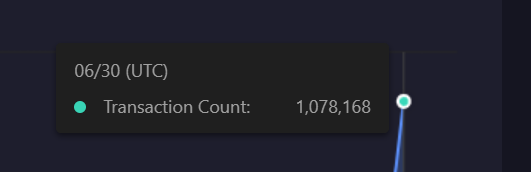
$ETH does about 1 million transactions per day.
$KAS just hit over 1 million transactions today on a poor launch of kasplex. Imagine when all the bugs are worked out.
Just got off a really pleasant Kas core dev meeting to kickoff the planing and effort towards mainnet high-bps. Agenda included things that must be perfected on TN11 (as prerequisite), KIPs that require implementation and design thoughts about gradual consensus forking logic