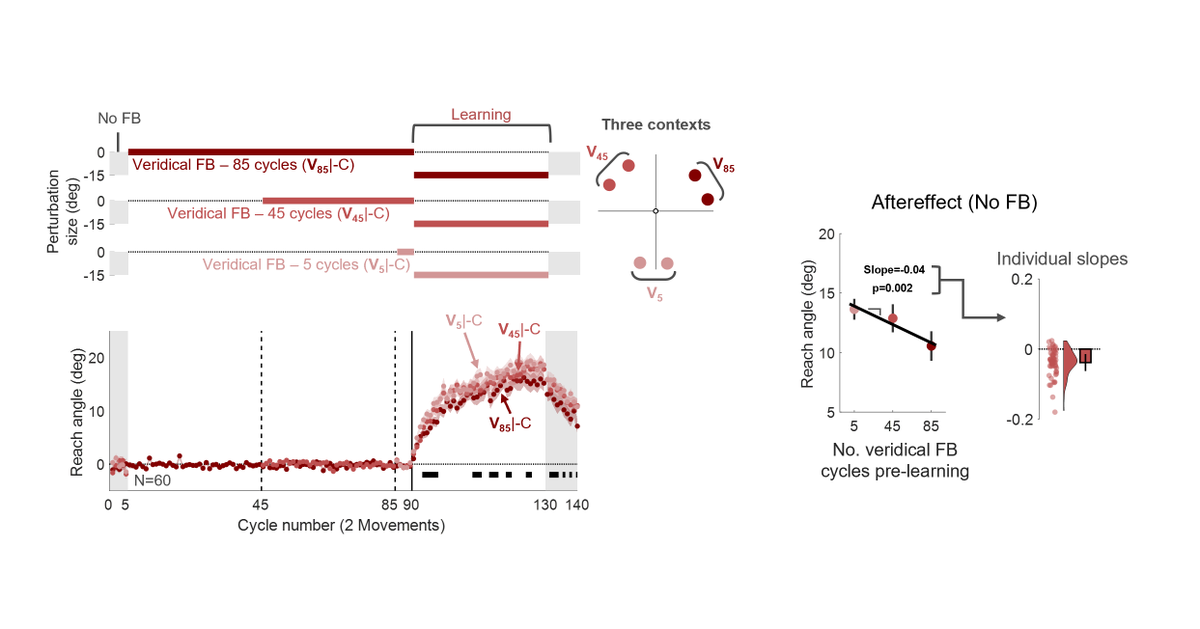
Is motor adaptation a form of associative learning?
In a new paper, now published in @eLife, we show that we can create associations between movement errors and arbitrary cues!
With @IPALab, @AssafBreska, @ivryrich and @smickdougle
https://t.co/1DlbdHdCQe
#tweeprint👇
Very glad to see our Review article out! It was a pleasure to collaborate with David Thura, Adrian Haith, and Julie Duque.
Link: https://t.co/35FWg9hjak
How do animals stay precise when their whole brain heats up or cools down? Larval zebrafish hunt accurately across a 10°C range. What enables such stability? What mechanism might support it? #zebrafish#neuroscience#temperature@STishbyTamari@ELSCbrain https://t.co/yO5BIKC4Aq
New preprint with Sritej, @reziliusReza , and Roberta Klatzky now on @biorxivpreprint!
Motor adaptation—our ability to correct errors using feedback—is attenuated in a Bayes-optimal manner when goals are uncertain.
Welcome any and all feedback! https://t.co/brOS9MxRFC
In Exp 5 we show that prolonged experience with baseline feedback produces attenuated adaptation. This is strikingly similar to latent inhibition, and consistent with our other evidence suggesting that motor adaptation is a form of associative learning.
https://t.co/1DlbdHdCQe
Happy to share that our study “Interference underlies attenuation upon relearning in sensorimotor adaptation” is now out in @SfNJournals#eNeuro!
https://t.co/Ymjj1JMHpp
@ivryrich, @ivrylab
Many thanks to the editor and reviewers for the wonderful feedback, and especially for recognizing that “the results of experiment 5 and the link to classical conditioning are what is most exciting in this paper”. We agree...
Happy to share our latest study led by @TantanBrainMan and our team @UCSF out today in Nature BME! Movement Responsive AI programmed BCI-aDBS improves naturalistic motion and reduces excessive movements at rest in PD.
https://t.co/4Yixe1y3xU
🚨 New preprint alert! Attention isn’t always helpful.
We found that dividing attention can boost implicit adaptation—if timed right. A twist on the idea that distraction always impairs performance.
w @benmillermills@TimCarroll_UQ
https://t.co/3e48xkihmq #biorxiv_neursci
1/5 Thrilled to share our Perspective in @NatureComms! Collaborating with @SolaimanShokur & @PTVassiliadis on this was such a rewarding experience. If you're into motor control and/or reward processing and/or neurotechnology, please take a look! Link: https://t.co/dUNheXN3UD
How does the motor system enable dexterous finger movement, and how does it recover after a stroke? Many questions remain, but in this ANN model designed to "mimic" physiological insights from humans and NHPs, we identified novel predictions:
https://t.co/BGmp6ljnBz
Our @TrendsNeuro review on task representational spaces in OFC/vmPFC and in deep RL models is now out! Had a great time working on it with @nir_moneta and @nico_schuck, check it out here: https://t.co/SWQ3CdUAOl
Thrilled to share this study on LFP physiomarkers of anxiety in PD. Humbled and honored to have worked on this transatlantic triple-cohort project with the most incredible team @littleneuro@LuciaRicciard10@colinwhoy @franci_morgante
I am happy to share my new preprint with David Whitney and Yifan Fang. We reveal two novel sequential effects in reaching movements and show that motor planning adheres to the principles of efficient coding.
https://t.co/7ZehM4hAox
Our latest paper is out! We looked at the roles and interplay of reinforcement and error feedback on exploration during reaching and gait for neurotypical individuals and those with Parkinson's disease.
https://t.co/seFQHytBPj
Excited to share our latest preprint on fronto-motor circuits and their connection to subclinical apathy and effort-based decision-making! Check it out!
https://t.co/5erWdUg15l