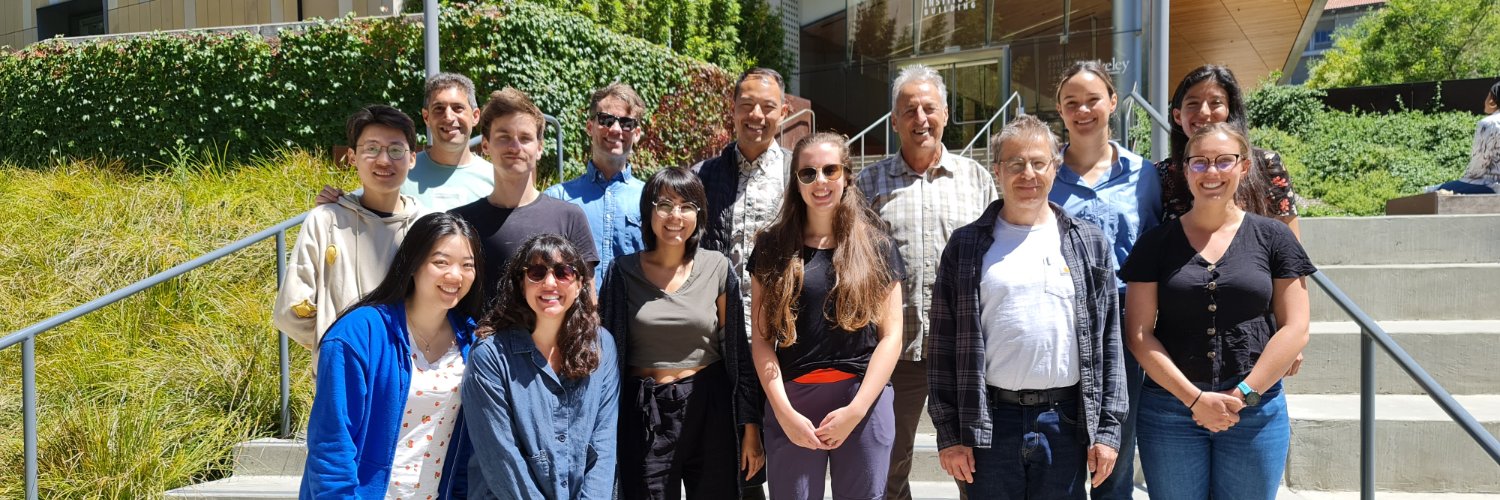
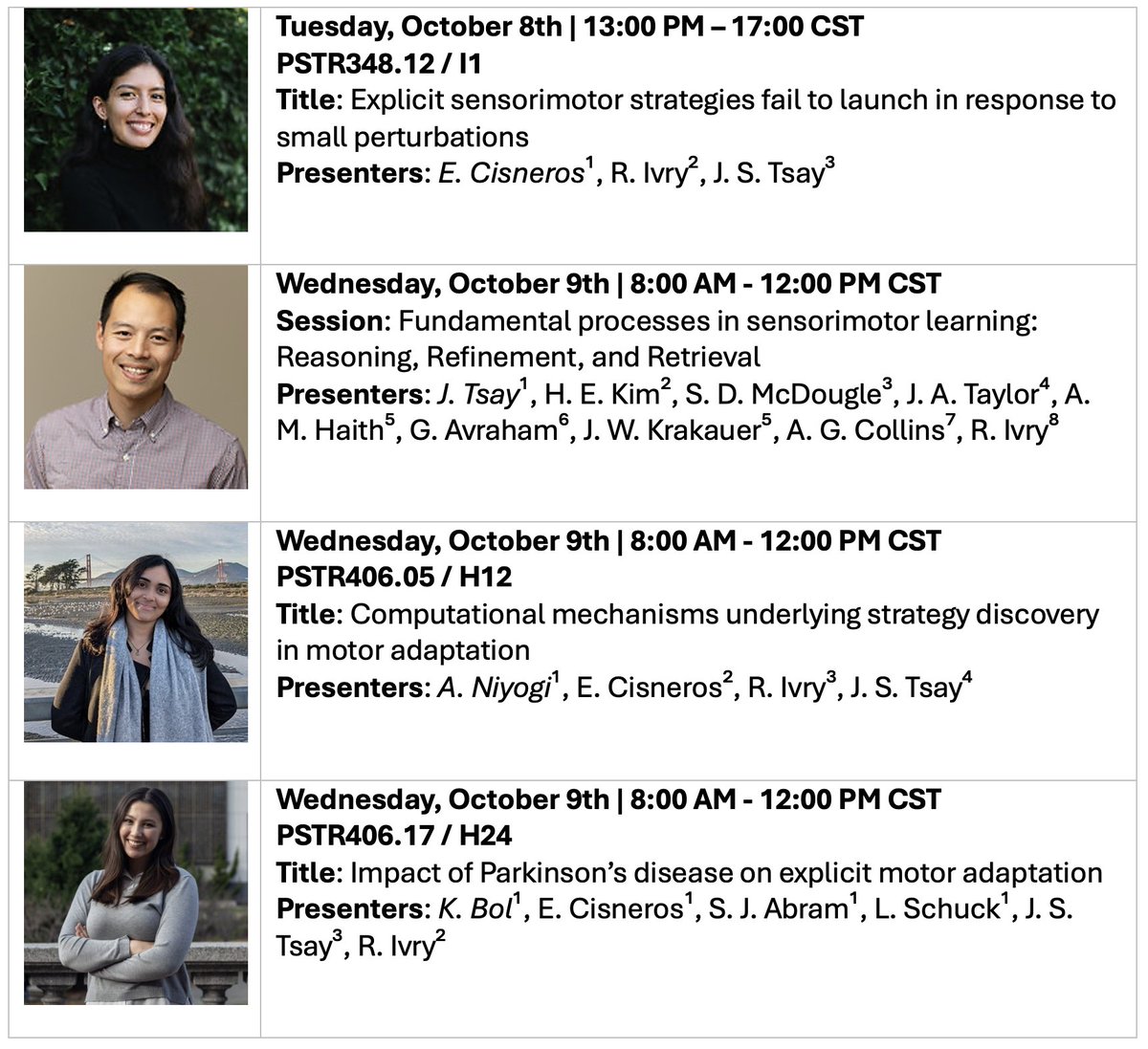
Excited to share our lab’s posters at @SfNtweets!
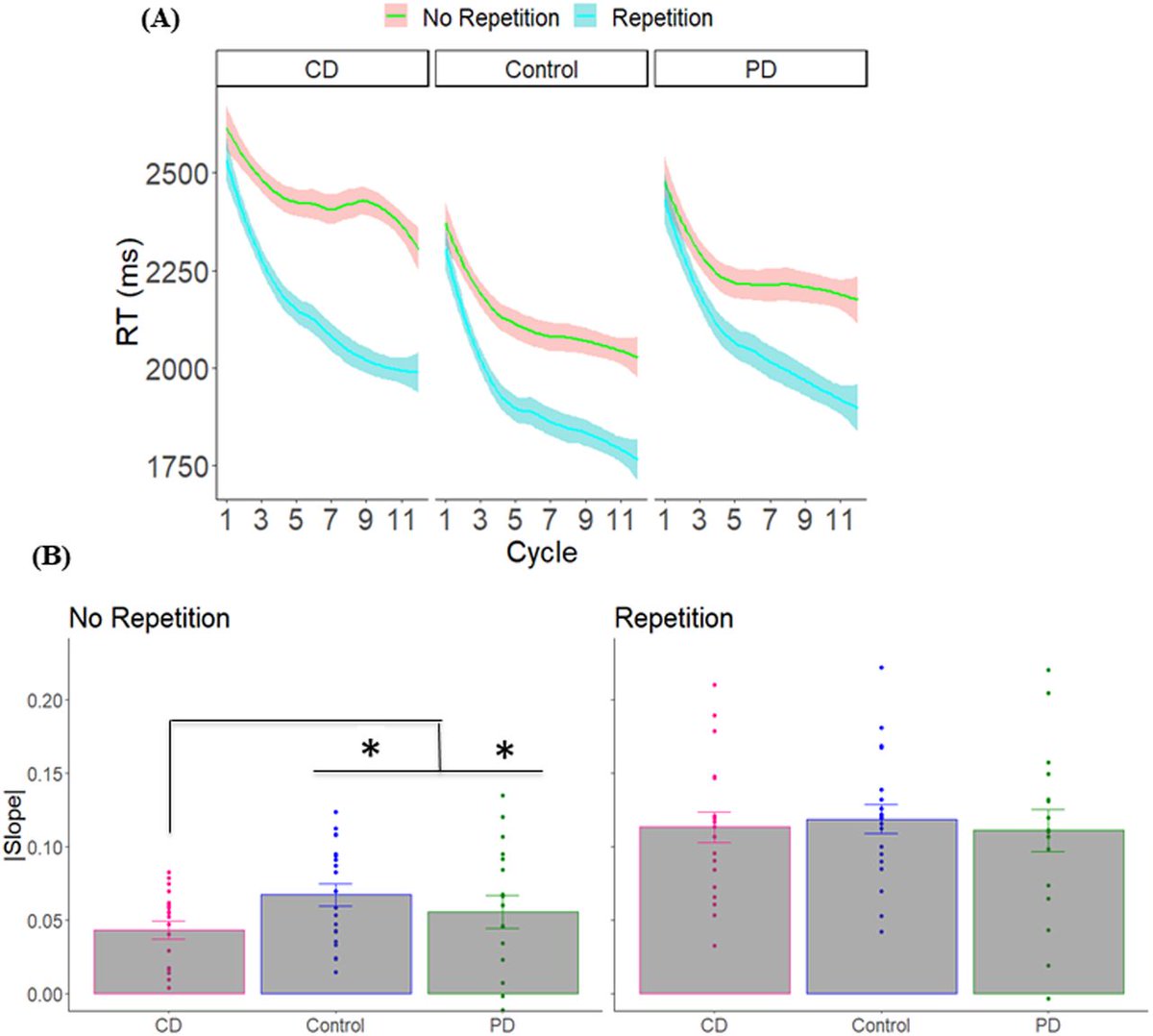
Come check them out—covering how explicit strategies handle small motor errors, fundamental sensorimotor processes, computational mechanisms behind motor strategies, and the impact of Parkinson’s disease on motor adaptation.
New preprint!!!
@TianHWang shows that attention influences sensorimotor adaption by defining the context for learning.
Check it out! 👇
https://t.co/o81N7hqVKC
🚨 New Preprint Alert! 🚨Here we've revealed a novel mechanism of how attention shapes sensorimotor learning across 8 experiments. Key findings:
https://t.co/01EPeM4FKG.
New review paper now published in @eLife!
@tsay_jonathan and colleagues propose a new framework for strategy use in motor learning.
Check it out! 👇
https://t.co/R7jaNVE8F8
Our paper on "Fundamental processes in sensorimotor learning: Reasoning, refinement, and retrieval" has been posted on @eLife.
https://t.co/Ph2vst2Ulg
I am thankful for our team/reviewers/editors for their feedback in refining our 3R framework. Let us know what you think!
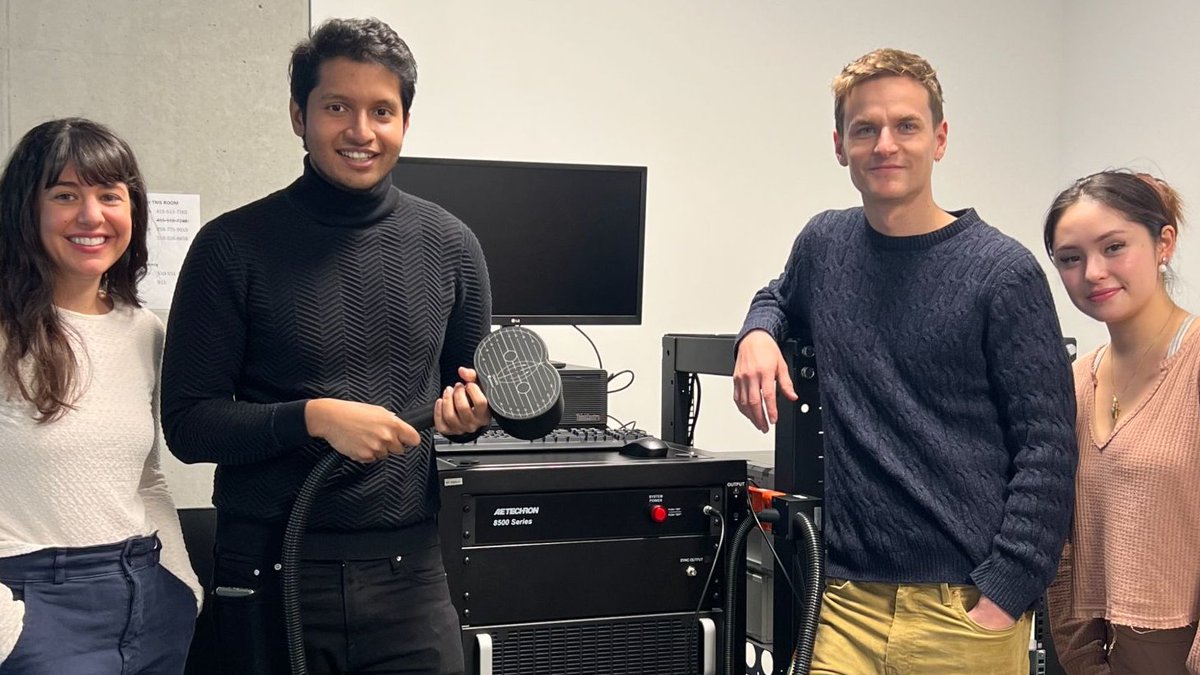
Excited to present our new NIBS method, #kTMP, in London this September!
⚡️ #kTMP combines the waveform flexibility of tES with the focality and potential amplitude range of TMS.
Can't wait to engage with this amazing NIBS community!
#Neurotech#BrainStimulation
New paper on the nature of post-error cognitive processing is out in Nature Communications!
"People are more error-prone after committing an error"
https://t.co/UCy7cTW0k0
w/ @adkinsty_ and @_HanZhang_
Read on for more!
Thrilled to welcome Dr. Avraham to the Magnetic Tides team!!
Previously Guy was a postdoctoral scholar at UC Berkeley and UCSF. Now he will leverage his expertise towards translational research with kTMP ⚡️
Second preprint this week, and no less exciting!!!
Elizabeth Cisneros and colleagues provide a comprehensive examination of aging and motor learning.
Check it out! 👇
https://t.co/ak8RaEs3x6
In a series of experiments involving over 400 human participants, we found that motor adaptation was reduced by symbolic compared to sensory feedback.
https://t.co/DQPEISzyfz 🧵
@yifeichen2023@sabrinabram@ivrylab
How should we interpret fMRI signal changes in the cerebellum? Learn about our new approach of how to better understand the relationship cerebellar and neocortical activity! @ivrylab@ladanshahani@MaedbhK@carobellum
https://t.co/rJwVRAxNZv @eLife
New preprint!!!
@avraham_guy & @ivryrich address the question of why implicit motor adaptation shows attenuation upon relearning (anti-savings).
https://t.co/2gV2dq7Agz
Check it out! 👇
In a new preprint, @ivryrich and I dive into the mechanism underlying attenuation upon relearning in sensorimotor adaptation.
TLDR: Interference. But you should read - there is a surprising twist 🙂...
https://t.co/a4wRooRJVY
Details 👇
1/13
New paper in @PLOSCompBiol!!!
Prevailing models of motor adaptation state that an increase in environmental (or perturbation) variability attenuates implicit learning.
@TianHWang and colleagues provide multiple lines of evidence challenging this view.
Check it out! 👇
Thrilled to share our latest paper published in @PLOSCompBiol! Our work challenges prevailing theories in motor learning. Through various sensorimotor experiments, the implicit system is NOT modulated by error consistency.
https://t.co/SIuR8EmTmE
New paper published in @JOCN_Journal!!!
@tsay_jonathan and colleagues examined how the relevance of the feedback in a motor task influences implicit changes in movements.
Check it out!
https://t.co/9GhMQ8CsXa
Question: Does the relevance of visual feedback influence how we subconsciously correct for errors in our movement?
Answer: Yes!
In our paper in @JOCN_Journal, we showed that *implicit* motor adaptation is modulated by the relevance of visual feedback.
https://t.co/2h2M9MIR4q
Where does the motor bias originate? In this new preprint with @tsay_jonathan@rmhead@ivrylab, we show motor biases arise from the transformation of eye-centered visual information (where is the target) into hand-centric proprioceptive space during motor planning.
Magnetic Tides is thrilled to announce that we have been awarded a Fyssen Foundation grant (https://t.co/2stgMyyaSC) to test the use of kTMP to improve speech comprehension.
This is a collaboration of Magnetic Tides, UCB and Prof. Benedikt Zoefel (https://t.co/k9OUO7Pw3y).
New paper in @CurrentBiology!!!
@TianHWang and colleagues identified the optimal timing of the feedback to drive motor adaptation, and it is not necessarily what you thought...
Check it out!
https://t.co/Gv1XHO8WCK
Check out our latest @CurrentBiology paper on how to optimize the feedback for motor learning! Providing participants with their hypothetical movement endpoint, before completing the action, boosts learning outcomes over traditional feedback.
https://t.co/P0WIhQwx10
Ever wonder how your brain does math?
Saban, @ppinheirochagas, Borra, & @ivrylab found the cerebellum & basal ganglia distinctively contribute to counting & chaining, two operations needed for solving math equations. #JNeurosci@TelAvivUni@BerkeleyPsych
https://t.co/WureEdJppG
New paper in @NatureHumBehav!!!
@tsay_jonathan et al. collected over 2,000(!) sessions of data on a visuomotor rotation task and revealed new demographic constraints associated with processes underlying motor learning.
Check it out! 👇
https://t.co/yax5tw4WRe
Our paper "Large-scale citizen science reveals predictors of sensorimotor adaptation" is now published in @NatureHumBehav!
Here's a thread on our 5-year journey (2019 - 2024) and findings. 🧵
https://t.co/F6aKb8lNyu
In this article, Tsay and colleagues (@tsay_jonathan@ivrylab and @itsnowforever) use a citizen science approach to replicate established findings and identify novel predictors of successful sensorimotor learning.
https://t.co/fHNLhBA6Rs