Brain, Learning, Animation, & Movement Lab: studying motor control, motor recovery, aesthetics of action, the cognitive-motor interface, & philosophy of science
🎧 Why Can't AI Laugh at a Joke?
w/ @blamlab & @adamsafron on John Krakauer's recent papers with David Krakauer and @MelMitchell1 of @sfiscience on how we might find genuine signs of emergence in LLMs, and @quiltydunn on "the deliberation taboo" in cognitive science.
Full show notes & MANY more deep discussions on tech, science, and philosophy @ https://t.co/otTKNWUKau
Chapters:
00:00 Teaser & Intro
08:28 Meet John Krakauer
10:53 Against Internal Models
13:01 Replay and RL Critique
16:37 Mental (Not Neural) Representation
20:55 What Counts as Evidence
24:03 Why Humans Deliberate
26:56 #AI Mirrors the Taboo
28:42 Deliberation Taboo Framework
32:04 Chain of Thought Confabulation
34:30 Slow #Science and Creativity
38:15 #Cognition vs #Consciousness History
43:57 Pain and Conscious Advantage
46:09 Illusionism and @danieldennett
49:12 Working Memory Bottleneck Debate
51:03 @maxsbennett on Simulation Limits
53:19 Defining Real Emergence
56:38 Inside LLM Representations
57:56 NeuroAI Chick Experiments
01:04:08 Efficiency And Evolutionary Pressure
01:07:00 Laughter, Feelings, Deliberation
01:13:53 Basal, Cortical, & Conscious Intelligence
01:19:57 #WorldModels vs World Policies
01:23:27 Language’s Role & The Meaning Gap
01:27:54 Tacit Learning & One-Shot Rules
01:30:18 Admitting The Deliberation Taboo
01:31:12 Explanatory Gaps And Coarse Graining
@EricTopol But there is no evidence here of a benefit or that even that the modulation effect has directionality with respect to a therapeutic enhancement of the response.
Most people favor one hand, and that hand tends to be the better one at writing, at throwing, at managing chopsticks. The long-standing view is that the dominant hand is “born” more capable, its skills rooted in a brain hemisphere specialized for motor control.
A new study in PNAS argues that this difference in skill is not innate at all. It is the consequence of a lifetime of practice, and it surfaces only when we pick up a tool. A reminder that even a trait as seemingly fixed as handedness can be emergent, arising from the interplay of biology, behaviour, and culture rather than from any single cause.
https://t.co/w4HzBSLnvx
🚨New preprint!
Using spinal cord stimulation, we demonstrate that non-monosynaptic corticospinal tract (CST) projections can be leveraged to enable dexterous recovery post-stroke, regardless of MEP status (a traditional measure of CST integrity).
https://t.co/VekbBlRsSV
SFI President David Krakauer joins The Generalist Podcast to talk about intelligence, the influence of AI on human thinking, and how to preserve creativity and understanding in a rapidly changing information landscape.
Watch the full interview: https://t.co/gcE3vaf3zw
"Moderate-high intensity aerobic or low-intensity flexibility exercise for 12 months in participants with aMCI may provide protection against decline relative to usual care" https://t.co/oOiRMrDG1h
In the cerebellum, neurons are placed in competition with one another, nulling the downstream effects of each other's spikes, in a well-organized subtractive process that produces a fast changing, precise output from a collection of slow, noisy neurons.
The internet has been progressively diluted with AI-generated slop. Are medical records headed for the same fate?
🧵 I just published a perspective in @NEJM with @AdamRodmanMD and Arjun Manrai on why rushing AI into medical documentation could be a mistake.
So many people confuse LLMs (or genAI, in general) for models of human cognition, language, learning, etc., so I thought it may be useful to share once more my brief comment, titled "Psychological models and their distractors". (open access link: https://t.co/U2T6Vsgl8H) 🧵
“The knowledge from this project could lead to new treatment approaches down the road for improving stroke recovery.”
Neuroscience research led by @UNC_SOM faculty @AdamHantman and @ShihYYI, along with @blamlab John W. Krakauer at @HopkinsMedicine, has the potential to improve outcomes for people with brain damage thanks to a $1.3 million grant from the W. M. Keck Foundation: https://t.co/JM0ulQxECn
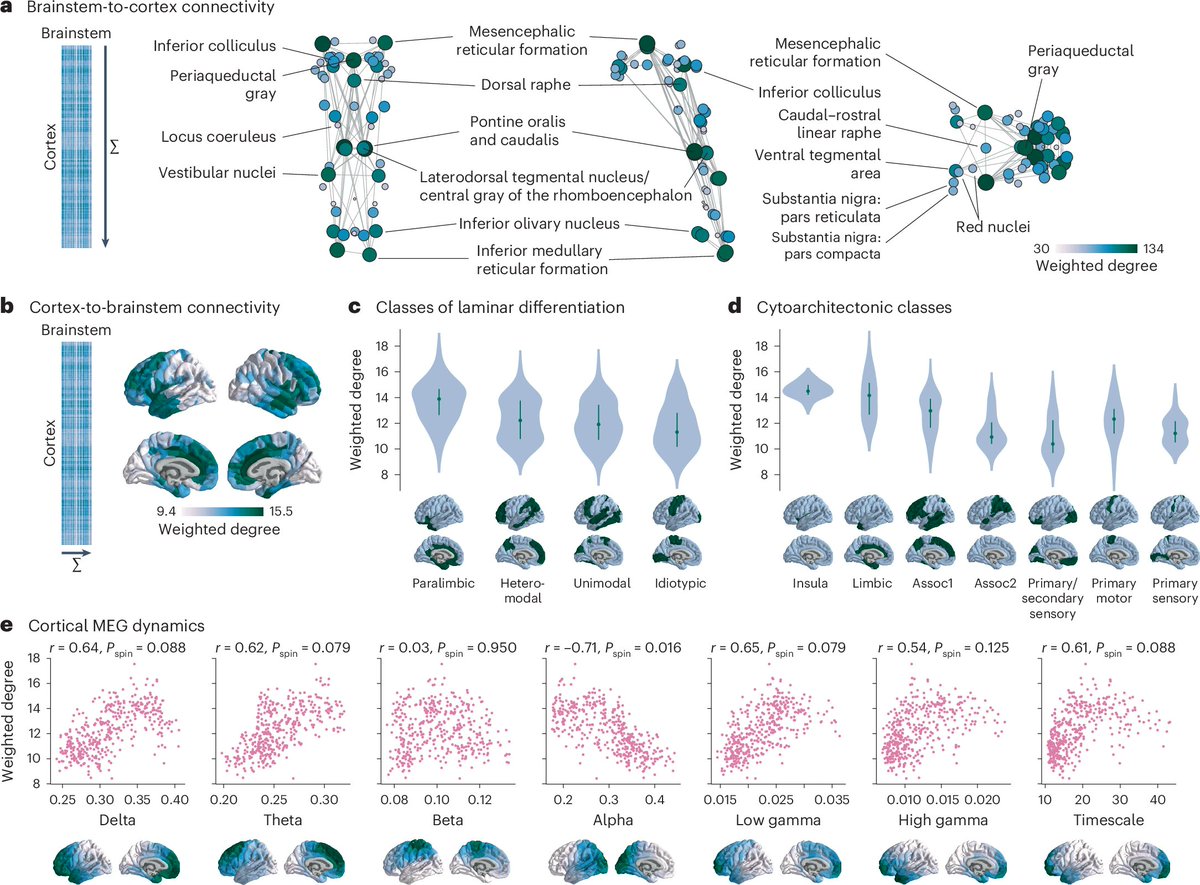
Integrating brainstem and cortical functional architectures | https://t.co/hmGC40nJq2
led by @JustineYHansen in @NatureNeuro
400 cortical regions + 58 brainstem nuclei. Lesgo 🤘🕶️⤵️
Propelled by tech money, the menace of race science is back – and it’s just as nonsensical as ever | Adam Rutherford | The Guardian https://t.co/TAvdNk6RAM
A recent study examining the kinematics of 3D arm movements in individuals in the sub-acute phase after #stroke found that both weakness and synergy intrusion contribute to motor deficits during the sub-acute period. https://t.co/UWVfaSi4aQ
#neurotwitter#neurorehabilitation