🚨 Grok Bot has a "rootkit" built in, and it's still unpatched since it was reported on Aug 24 by Profero.
One command in an agent can tell Docker to open a new container with no limits, and that gives full control of the machine your agents run on.
Every agent on your account shares one Linux user, and imported cookies sit in a plaintext file.
The sandbox's command service password is the word "local". It was reported to @spacexai and @cursor_ai over two months ago 👀
Avoid importing your browser cookies until it's patched!
This is actually insane 😡
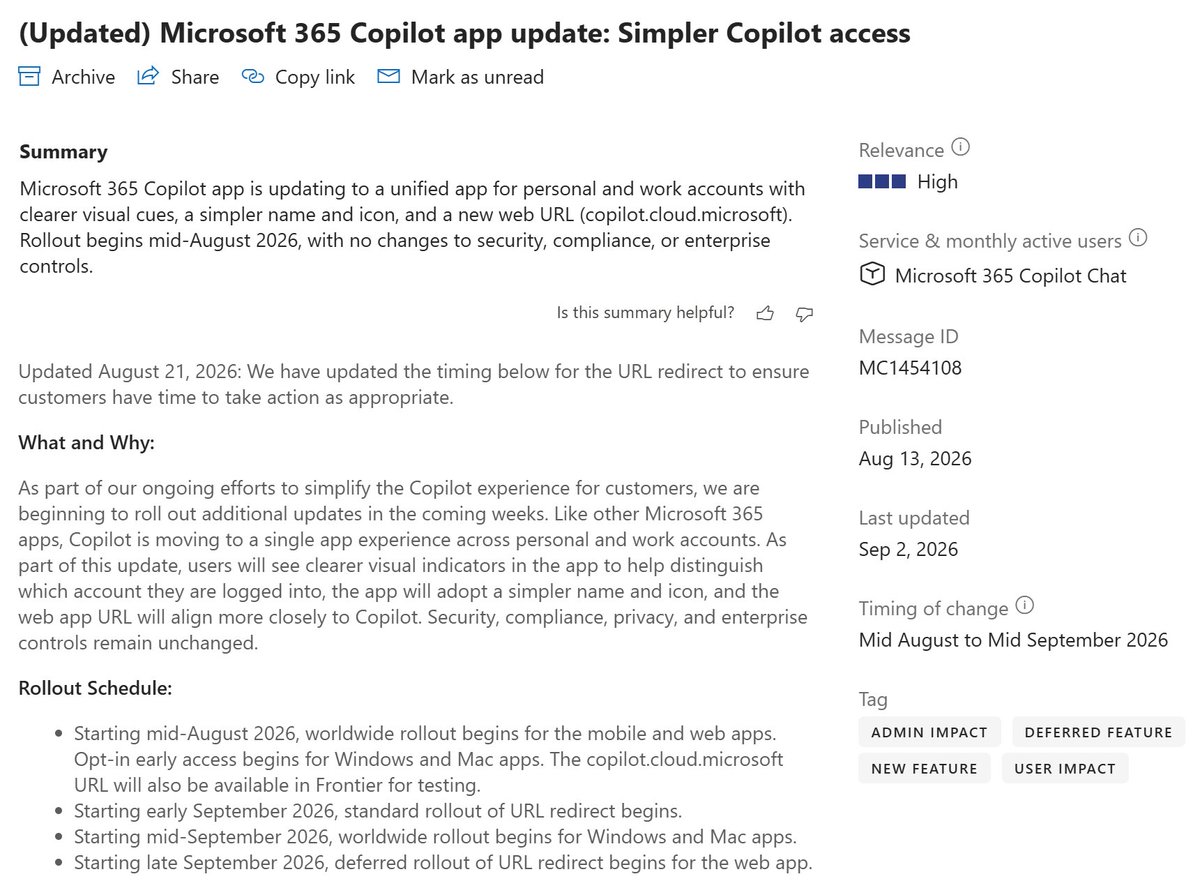
Instead of creating a client policy to disable personal account login to the new unified Copilot app, they are forcing orgs to roll out complex tenant restrictions that requires a proxy server or Global Secure Access.....
https://t.co/z8rB9tCwmG
Bonus rumination: UIs of any sort are losing stock at the fastest rate in software development history.
I don't want your dashboard - I want to ask my agent for the exact information, graph, or action that I need to take, and have it handle that for me.
I don't want your CLI, I'm going to ask my agent to do that, and while sure, it can use your CLI, it can also just hit the API directly. And your CLI is typically a thin wrapper over the API anyway.
Good quality APIs are the absolute most important thing to build out as a company right now. They are the foundation of your product's value. If you want to layer an SDK on top of that, or a CLI, or an MCP later, go for it. You need to meet your customers where they are.
But the API comes first - the rest sit on top. The biggest mistake you can make is to build out one of these higher abstractions first, and have your API be private or only intended to be a proxy for the higher level abstractions. You will end up paying the price for this.
I've come to the conclusion that you cannot use Astra and also be worried about maximizing your codex sub usage. These two things are inherently counter-productive.
And further, using multi-agent in an attempt to save codex usage while using Astra as the main agent is folly.
Here's why, and the solution if maxing usage is your main concern :
First of all, it is getting progressively more difficult to intuit which reasoning effort is cost/usage optimal and appropriate for a task.
From some recent research I was doing:
"A simple illustration using the published Codex standard rates is an Astra request reading 125,000 entirely cached input tokens costs approximately 3.125 credit equivalents for that input alone.
An additional 1,000 Astra output tokens, including reasoning, costs 1.25 equivalents. Thus, extra reasoning that avoids one such request could pay for itself before accounting for the avoided output, tool work, or rework.
There is also direct empirical evidence against assuming that higher effort always increases total task cost."
Practical consequence:
Do not optimize by minimizing thinking tokens or systematically choosing the lowest effort.
Optimize:
Total cost of producing an acceptable result, including the mistakes and extra actions associated with that effort. A stronger effort setting may cost more per response while costing less per completed implementation.
The second point is nearly impossible to know or predict.
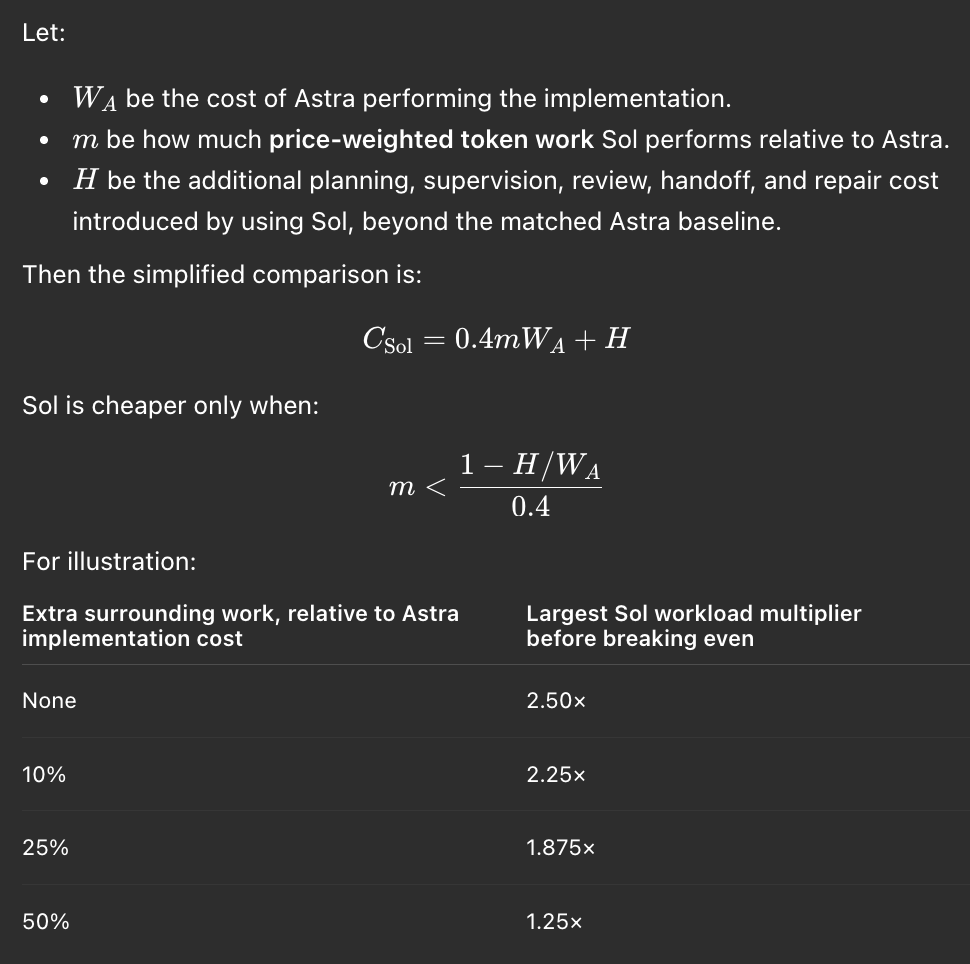
Under matched pricing conditions, Sol costs 40% as much as Astra for identical token workloads. But identical workloads are precisely what we cannot assume.
This exposes the central danger: a cheap implementer can lose its advantage through either additional internal work or additional expensive work elsewhere. Repeated Astra follow-ups consume the same economic margin as Sol’s own extra tokens.
Conversely, a cleanly bounded Sol assignment could still be worthwhile even when Sol uses more tokens, provided its surrounding costs stay low.
---
My own (possibly incorrect) conclusions/thoughts:
Astra's highest individual cost is output tokens ($50/M), followed by uncached input ($10/M), followed by repeated cached input reads ($1/M).
Over a session, total costs reorder those (based on a typical agentic development workload):
- repeated cached reads
- uncached input
- output
For other workloads 2 and 3 can flip.
Thus if there were a way to compress output and shell it out to the lowest-cost model that could faithfully produce it (eg, Luna high/max) it could (possibly) reduce those costs.
However, the repeated cached reads cannot be optimized or avoided but for Astra's ability to complete a task in as few turns as possible.
Optimizing uncached input into Astra is also another interesting aspect, but extremely difficult to decipher how this could be done since Astra needs to read any amount of potentially uncached input in order to properly complete a given task. I know there are tools (eg, RTK) which in the past have claimed to optimize input, but I have personally not had much luck with them, being able to confirm those claims. I believe this is a task better left up to OpenAI.
Shelling read/discovery tasks out to Luna subagents with compressed-result-only-input reaching Astra seems to be one obvious and most simply achievable route. For example, Astra should not be running unbounded commands and having that entire output reaching its context, unchecked.
The problem with delegation though, always comes back to the question of how much the overhead of delegation to a cheaper model by Astra actually eats into the potential savings of that delegation's prevention of unnecessary uncached input reaching Astra. Additionally, the cheaper model must be able to determine the optimal amount of information to return to Astra, which they are not always good at. This failure causes additional round trips and further eats into the proposed savings of such an orchestration system.
The bottom line: it is at this point, nearly impossible to design a multi-agent orchestration system that reliably reduces Astra costs. Thus, MA orchestration should concentrate on quality, not usage optimization, and under no circumstances will it be "cheaper" to use MAO than Astra alone. If you want Astra + highest possible quality (eg, independent reviewers), you'll have to eat both costs now.
Which ultimately means Astra should not be used for every task. 5.6 series of models should likely still remain your daily driver, using Astra as an advisor, if maximizing Codex usage is your primary concern.