Agentic AI adoption is on fire at @Uber, and it's changing the way we build, not just in engineering, but across the entire company.
Today, 99% of our engineers use AI tools. More than 70% of pull requests are attributed to local or cloud agents. And our engineers have built 2,500+ agent skills across the software development lifecycle.
Those numbers are exciting, but they led us to a much bigger question:
How do we bring agentic AI beyond engineering?
Finance. Legal. Operations. Marketing. Customer Support. HR. Procurement.
These functions run on complex workflows that are often manual, highly nuanced, and spread across dozens of systems. You can't automate them effectively by looking at process diagrams or documentation. You have to understand how the work actually gets done.
So we created something called Agentic Pods.
The idea is simple.
We handpicked ~30 of our most AI-proficient engineers (people with deep knowledge of Uber's systems) and paired each of them with a domain expert from a business function.
Then we gave every pod just two weeks.
• Days 1 – 2: Shadow the expert. Observe every step. Document workflows. Ask questions. Build intuition.
• Day 3: Prioritize opportunities based on scale, repetition, business impact, and data availability.
• Days 4 – 5: Build a working agent alongside the person doing the job.
• Days 6 – 9: Validate with several others performing the same work. Does it generalize? Does it actually make their job better?
• Day 10: Ship.
In just the past two months, we've run 16 Agentic Pods across 16 different business functions.
• Capital allocation across 150 cities: 15 hours → 30 minutes.
• Financial pacing reports: 2 days → 10 minutes.
• Marketing web quality assurance: 2 weeks → 50 minutes.
• Support workflow creation: 9,000 manual workflows → self-service automation.
The productivity gains are impressive, but what surprised us most wasn't the speed.
• It was how quickly engineers embedded in unfamiliar domains uncovered opportunities that had been hiding in plain sight.
• The biggest wins rarely come from automating one task. They come from rethinking an entire workflow. Once you redesign the workflow around AI, you often eliminate handoffs, remove unnecessary approvals, replace legacy tooling, reduce vendor spend, and dramatically accelerate decision-making.
• The workflow becomes the unit of automation - not the individual task.
• The most impactful agent skills cut across teams, orgs, functions, tools, and systems.
The biggest lesson? The best AI opportunities are rarely visible from the outside.
You discover them by sitting next to the people doing the work, understanding every friction point, and building with them, not for them.
We're now forming a dedicated team to scale this further and go deeper. They'll deeply understand the work, redesign it from the ground up, and use AI to fundamentally change how the business operates.
It's exciting times!
Introducing Native SDK
The toolkit for building native apps
→ Hot reload
→ Markup + Zig
→ Instant launch
→ macOS, Windows and Linux
→ GPU engine built from scratch
→ Built-in design system and themes
→ Custom components + design tokens
A workflow I'm enjoying: "Walk-driven development"
> go on a nice walk outside 🚶
> record a long audio note: ideas, goals, things to build 🎙️
> agent auto-creates docs/tasks, and kicks off cloud coding agents for me 🤖
Workers Cache — Your Cloudflare Worker now has its own tiered cache in front of it:
https://t.co/6rAJN8e71s
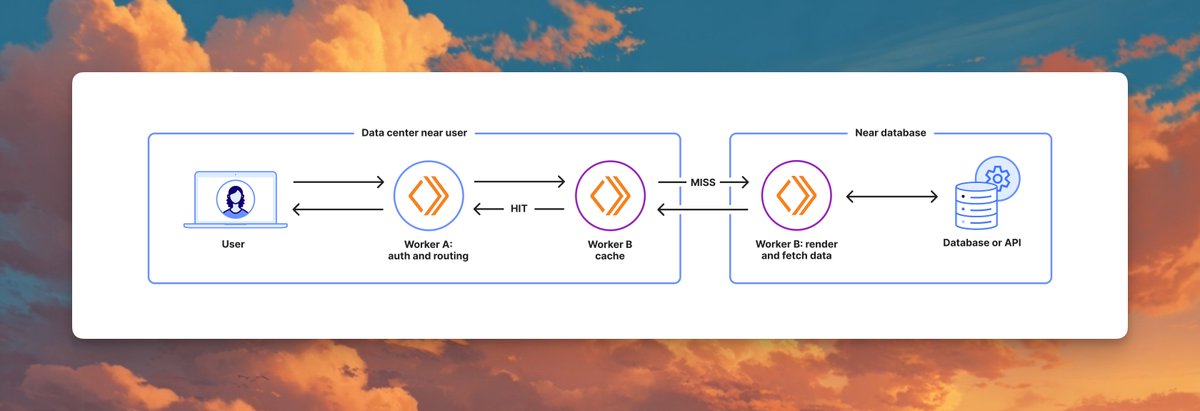
Workers Cache is a programmable tiered cache between Workers — even between code running in the same Worker
we’ve seen pretty much every approach to caching over the years from our customers, and Workers Cache is the direct result of everything we’ve learned
it takes all the workarounds and clever hacks we’ve seen to make sites and APIs fast, and simplifies them down to writing JavaScript and returning Cache-Control headers
you can use for so much — for us this is like shipping 12 different things on the same day
first up — you can use it to place your app near your database, cache its responses, and run code in front close to users:
Claude Sonnet 5 achieves 53 on the Artificial Analysis Intelligence Index, but without promotional pricing will cost more per task than Opus 4.8
We supported @AnthropicAI to evaluate Claude Sonnet 5 ahead of release: with max effort it improves 6 points over Sonnet 4.6 to achieve the same Intelligence Index as GPT-5.5 with high reasoning, but remains behind Opus 4.7 and 4.8
Key takeaways:
➤ Claude Sonnet 5 is the #5 model on the Artificial Analysis Intelligence Index, only 2-3 points behind GPT-5.5 (xhigh) and Opus 4.8 (max)
➤ With max effort, Sonnet 5 works harder than previous Anthropic models: it used ~40% more output tokens per Intelligence Index task than Sonnet 4.6, and ~3x the agentic turns for our knowledge work evaluations AA-Briefcase and GDPval-AA. This behavior scales well with the ‘effort’ setting, with the max effort using around 6x more turns than low effort on GDPval-AA
➤ Claude Sonnet 5 costs more per task than Opus 4.8 before accounting for promotional pricing: Claude Sonnet 5 costs $2.29 per task on the Intelligence Index, a ~2x increase compared to Sonnet 4.6 and ~15% more than Claude Opus 4.8. This is driven entirely by increased token usage. Sonnet 5 retains the same $3/$15 per 1M input/output token pricing as Sonnet 4.6 (compared to $5/$25 for Opus 4.8), however Anthropic is offering a one-third reduction to $2/$10 until September 1. Our results use standard $3/$15 pricing
➤ Sonnet 5 matches or outperforms Opus 4.8 on agentic knowledge work tasks: on both AA-Briefcase and GDPval-AA, Claude Sonnet 5 sits just ahead of Opus 4.8, trailing only Claude Fable 5 (which is not currently generally available). These benchmarks test the ability of models to produce accurate and well-presented professional outputs using our open source reference agent harness, Stirrup
➤ For reasoning and knowledge-heavy tasks, Sonnet still sits behind its larger siblings: despite substantial gains across many evaluations, heavy reasoning and knowledge benchmarks still show Opus 4.8 ahead of Sonnet 5. On CritPt, a frontier physics reasoning benchmark developed by researchers at Argonne and UIUC, Sonnet 5 scores 17% - this is 14 points higher than its predecessor, but behind GLM-5.2, Claude Opus and Fable, and GPT-5.5 (xhigh and Pro)
➤ Sonnet 5 also showed significant improvements over Sonnet 4.6 on Terminal-Bench v2.1 (+9 points), Humanity’s Last Exam (+10 points), and SciCode (+7 points), with relatively flat scores elsewhere
Other key model details:
➤ Context window of 1 million tokens (equivalent to Sonnet 4.6)
➤ Pricing of $3/$15 per 1M tokens of input/output (reduced to $2/$10 until September 1); cache pricing remains at a 25% premium for cache writes ($3.75 per million tokens) with 5-minute time to live, and 90% discount for cache hits ($0.3 per million tokens)
➤ Effort remains the recommended way of configuring model performance and latency. Sonnet 5 adds an additional ‘xhigh’ effort setting relative to Sonnet 4.6, matching the 5 effort levels available on Opus 4.8 (max, xhigh, high, medium, low)
Conventional model routing sucks. It passes benchmarks but fails to write code you'd actually merge.
Introducing Devin Fusion, a new hybrid-model harness for agentic coding.
In testing, it reduces the cost of Fable-level intelligence by 35% and still feels good to use.