A few short-term personal thoughts.
I don’t speak for the EF, so want to share a subjective view (which can be bent - I have no ego in this, so please fire away) ⤵️
1. I was silent because there is nothing of hard substance to communicate. Firstly, communicating about abstaining does no good and only makes the efforts of protocols working on a resolution - harder. It might also throw implicit shade (which there is none). So why do that. Secondly, communicating “we are speaking to the parties involved and hope a resolution is found soon�� is wordsalad. I don’t appreciate such empty statements by third parties. When affected protocols do it, it makes sense, because they need to do it for legal and optics reasons. But EF doesn’t make decisions for protocols, doesn’t control any of those keys or permissions, none of that - so it can’t speak for others. While we did talk and gave our opinions, such situations are ultimately up to the teams’ legal counsel, ethics, abilities, vision, funding. Those that pull through are the heroes here - and not us who “oh ye we talked to teams”. I find such comms to be rude instead if released.
2. On the inaction so far, many founders have already expressed why they think that: creating a dangerous precedent. But that reasoning reads rude at first. You immediately get hit with “but it is one of the main OG protocols, it is contagion, etc.” Arguing on the severity is moot, but I also never pulled out my personal lending balance from Aave (I have on Morpho, Spark, Gearbox, Liquity, and more too) so that says something? It’s tough but it’s a resilience test. If you plug this hole even a bit, it’s not just about the future, it’s also about past teams being rightfully very mad for not getting such support before. And then what about permissionless protocols, curated instances? Gets even messier. What EF did do is - reduce the debt of @LidoFinance / @mellowprotocol vaults and relieve their pain from high borrow rates (by swapping the position: https://t.co/p7ixbu8uAq). EF gets liquidity, treasury is safu at 1:1, Lido/Mellow cover their debt and save a lot. Is this an ecosystem-wide help? Personally I treat it as a neutral move, it’s maybe tiny positive in fact, but not worthy of self-glazing.
I personally find it amazing that the community came together and has now almost fully closed the hole. Well done to the parties involved, and on the great branding around it (cc @aave). The least we could have done, if not being active, is to stfu and let them cook. We don’t need to give opinions and say “oh, why this way, and not another way to deal with it”. Time constraints, stress, multiple parties involved, etc. - this is why it’s up to the teams to man up, these are their businesses and decisions. We must trust them to be grown-up, mature, and ready to survive situations like this. It’s okay to disagree here, I disagree with myself here (I hate both sides in this case).
3. We obviously want to talk about security, standards, efforts to avoid such cases, etc. - but now is bad timing. Putting salt on the wound is not a good idea, so we will address this in due time (so will the teams, without EF hand-holding anyone).
4. Also on tone deaf, sure the EF still appears like that sometimes, for example, the timing of the last periodic sale was crap, no way around it. All the troll memes are deserved, but they don’t change all the other good initiatives EF is working on. Not everything can be perfectly timed when there are many parallel things involved. On that specific sale I already posted here https://t.co/cgQmtzheoK and here https://t.co/uRyMlv05ZX.
——
I hope to appear logical and open-agile in anything I touch with regard to EF + DeFi, even if I am often not responsible for that and have no direct say in it. I hope this reply and others show the logic more clearly and allow for a discussion if needed. I don’t do this for the money honestly, and thus I am also not a fan of self-glazing empty statements.
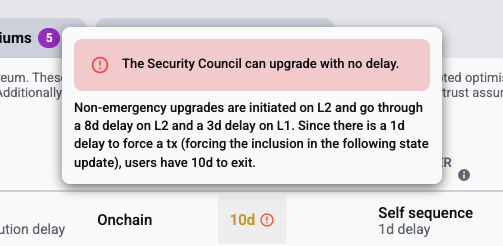
The fact that SC on @arbitrum has instant upgrade power is two clicks away (click on "pizza" or "Risk Analysis" and hover on Exit Window Red Warning
Should it be one click away ?
Should we be more specific here ? (how decentralized is the SC, a link to the constitution specifing SC mandate, etc..)
Should we make it more obvious what is "instant upgrade" and what it enables in practice ?
How can we, at @l2beat be better at what we do ?
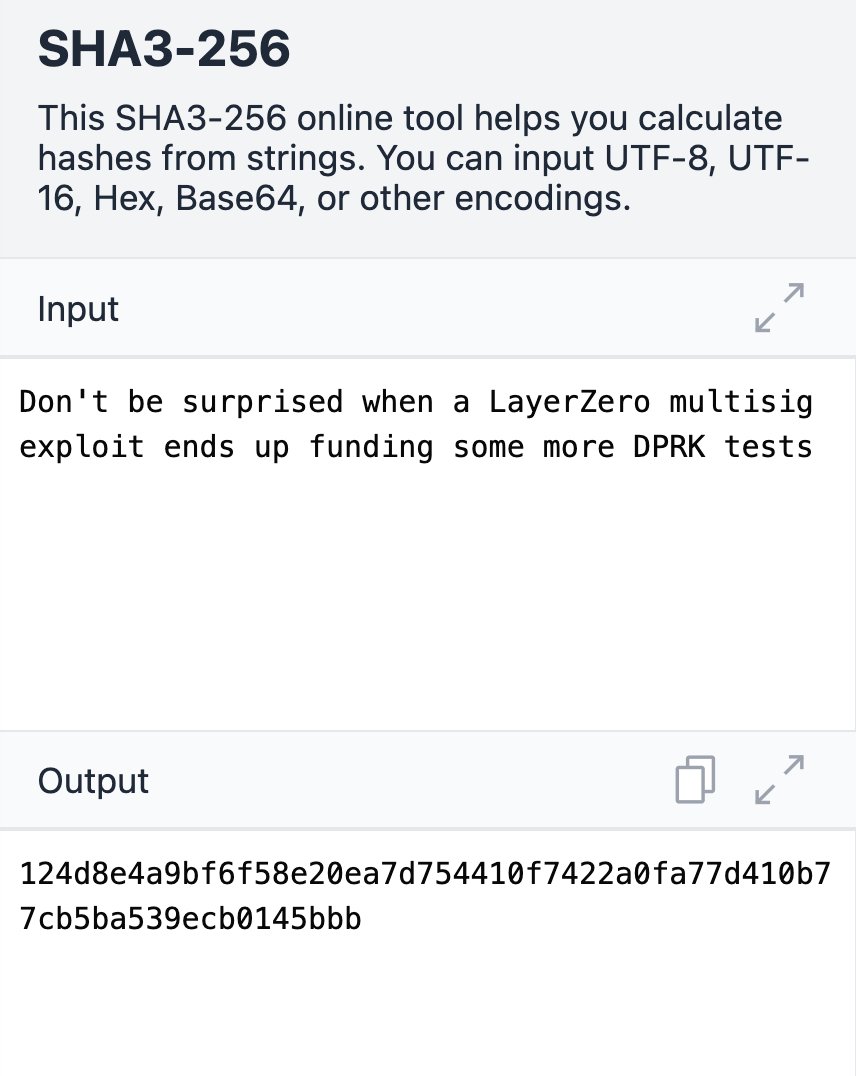
Unpopular opinion - warn about bad DVN setups before the hacks, not after.
I personally feel sorry for what happened to rsETH. At the same time so many times I was told that :
- users only care about speed and cost of bridging
- bridge hacks are so 2024 or earlier
- there's only short, in-flight risk for users, once you are on the other side you're safe
I wonder how long people will be interested to listen about interop and asset risk before all is forgotten again and we start to be ignored as usual
DeFi slowly puts itself into a very bad place - yields similar to TradFi (or lower) but risks much greater. This is not a good place to be
@javierbitcoin@dbaeza13 Ninguna decisión es al azar, ni esta rompiendo nada. Tienen intereses. Y si ganan esta partida de ajedrez van a imponer el sistema que lo sigan manteniendo como potencia económica (militar ya lo son).
Hot take: most companies don't need devrel they need integration engineers and solution architects.
Blockchain software is now used by enterprises, which means we need to actually graduate into the mindset of: how can we best service our customers?
There was a flaw in the early DeFi days that teams needed an active community of devs working on top of your protocol, that need devrels jumping in every hackathons across the world, having community calls, doing youtube videos, etc.
The truth is:
- it's 95% a waste of time and money: hackathons are very expensive, sending a few team members is very expensive as well, and the community of developers you create does not bring much value.
- it's even more true now than it was in 2020/21: the space is more mature, instits and classic web2 companies are all coming onchain. they dont need devrel they need to be reassured on tech, business, legal first
- people chasing hackathons usually don't care about your product/protocol or don't care about building a long-term product (they usually care about leveling their skills or grabbing money so they can attend the next hackathon in Bali). The few that do end up building a product have 95%+ of failing and the few that survive won't bring much value before a year or so
- yes it's a lot of fun for those devrels that you hired, but the right question is: where could this money be better spent? What has the biggest ROI? You have to restart from 1st principle
- you'd better allocate that money on sales people to close customers
- and you'd better have solution architect and integration engineers that can provide great support to those customers
- you'd rather focus your energy on existing and live projects for which you're truly solving a problem *now*
- you have to realize that in many B2B companies, the one who makes the decision are often not the developers but the exec or product people
Dont get me wrong, i do think having comprehensive documentation is important, i do see value for some projects in doing hackathons to battle-test your product, or hire talents or whatever, i do see value in having a developer community. But I strongly think that people should apply more 1st principle thinking before allocating significant resources to creating a community of developers.
@MatiasNisenson@worldnetwork The big problem in crypto is that everyone wants to invent something new, but no one wants to use someone else’s solution. It’s mostly ego, and that’s why forks keep winning