Professionally passionate, believe in the boundary-lessness of creativity, and love to flit between a high-tech optics research lab and a theatre stage!!
Durante los Juicios de Núremberg, Hermann Göring concedió una entrevista al psicólogo Gustave Gilbert y dijo:
«Por supuesto que la gente no quiere la guerra. ¿Por qué querría un pobre agricultor arriesgar su vida en una guerra cuando lo mejor que puede esperar es volver a su granja de una pieza?
Naturalmente, la gente no quiere la guerra. Nadie quiere la guerra en Rusia, Inglaterra, Estados Unidos, ni siquiera en Alemania. Eso es evidente.
Pero, al final, son los líderes de un país quienes determinan la política. Y siempre es sencillo arrastrar al pueblo, ya sea en una democracia, un Estado comunista, un parlamento o una dictadura fascista.»
Gilbert objetó:
«Pero hay una diferencia en una democracia: el pueblo tiene voz a través de sus representantes elegidos.»
A lo que Göring respondió:
«Eso está muy bien, pero, tenga o no tenga voz el pueblo, siempre puede ser llevado a obedecer a los líderes. Eso es fácil. Todo lo que hay que hacer es decirles que están siendo atacados y denunciar a los pacifistas por falta de patriotismo y por exponer al país al peligro. Funciona igual en cualquier país.»
— Diario de Núremberg, 18 de abril de 1946
¿No les resulta familiar?
Today marks the centenary of the birth of Norma Jeane Mortenson, the woman the world knew as Marilyn Monroe.
While the bourgeois press continues to gape at the ghost of a manufactured icon, the Communist Party of Britain reclaims the intellectual and the comrade.
Her politics were born of the assembly line. From the foster homes of Los Angeles to the Radioplane munitions factory, Monroe’s class consciousness was forged in the heat of proletarian survival. She was a woman of fierce intelligence, possessing an IQ that dwarfed the men who sought to manage her, yet she was reduced to a commodity to be bought, sold, and traded by the parasitic studio system.
The FBI files, which tracked her until her final breath, confirm what the establishment feared - a sex symbol who had read Marx and admired the Chinese Revolution. She was a militant anti-racist who used her platform to shatter the colour bar for Ella Fitzgerald, and she stood firm against the cowardice of the McCarthyite witch hunts when she married the blacklisted playwright Arthur Miller.
We must recognise that Monroe’s struggle was the intersection of class exploitation and patriarchal violence. She was a worker whose labour was her own body, super-exploited by a system that demanded she be beautiful and silent. Her life was a constant act of rebellion against the male gaze of capital. On her 100th birthday, we do not celebrate a "bombshell". We honour a clear-minded socialist who understood that the liberation of her class was inseparable from the liberation of her sex.
Happy Centenary, Comrade Marilyn. The struggle continues.
#MarilynMonroe
My god ...please watch this. I swear this country is being held together by a chewing gum.@ni5arga well done on exposing these vulnerabilities and even answering the media so confidently. I know this is not easy for you and took a lot of courage 🙌
India wants to become a $10 trillion economy.
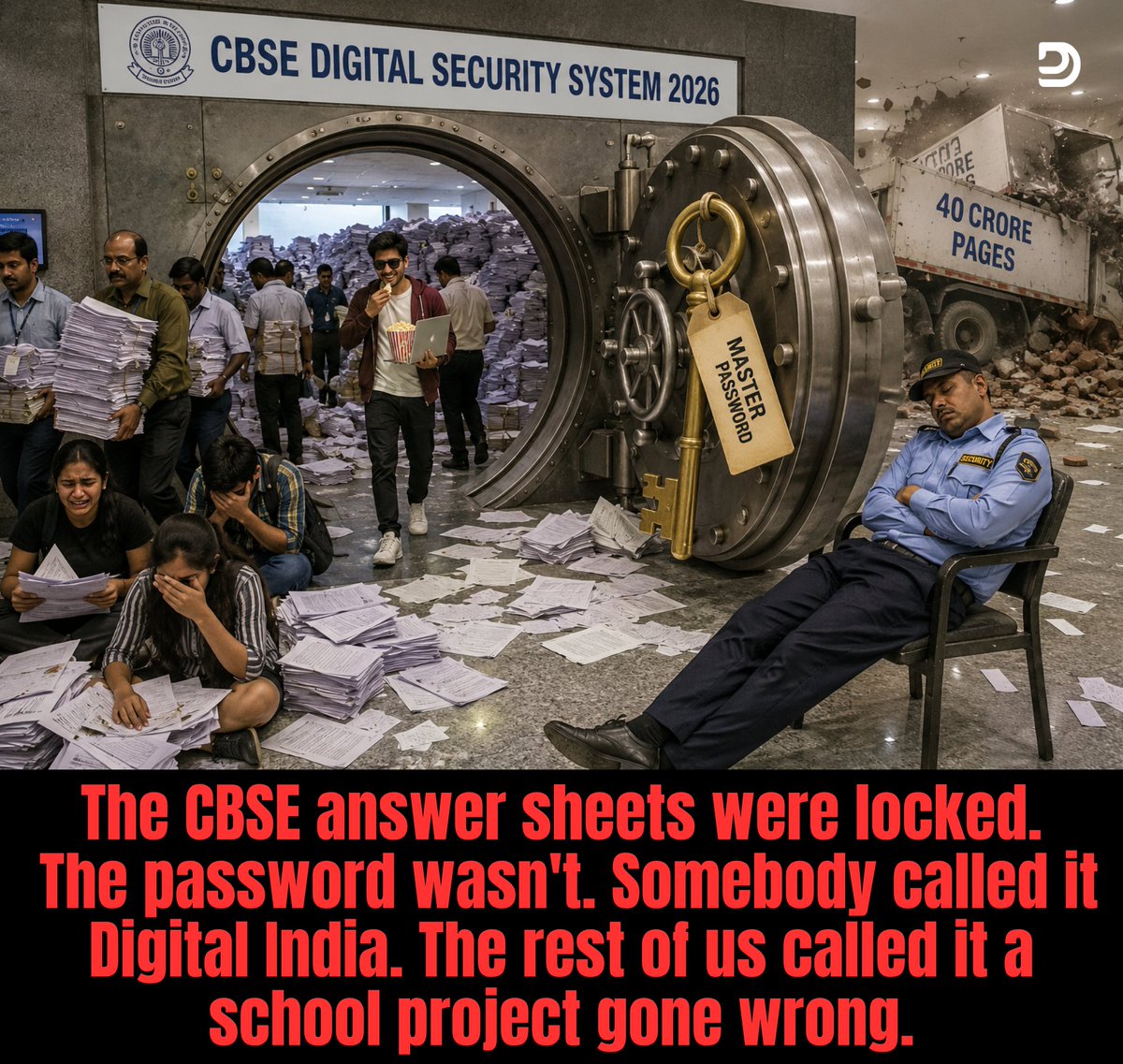
But CBSE could not protect a password.
And no.
This is not a joke.
18.5 lakh Class 12 students appeared for CBSE Board Exams in 2026.
Their answer sheets were handed to a company with 51 employees.
A teenager reportedly broke into the system within minutes.
This was not innovation.
It was institutional comedy.
CBSE launched On-Screen Marking.
OSM.
The promise?
Transparency.
Accuracy.
Speed.
The result?
Swapped answer sheets.
Blurred scans.
Missing pages.
Portal crashes.
Embarrassment.
Some students opened photocopies of their answer books.
They found someone else's handwriting under their roll number.
Now look at the scale.
18.5 lakh students.
26 countries.
7,574 exam centres.
120 subjects.
98 lakh answer booklets.
40 crore pages.
77,000 teachers logging in.
All processed in 10 days.
And managed by a company smaller than many CBSE schools.
Then came the tender.
Two companies qualified.
TCS.
600,000 employees.
57 years of credibility.
$29 billion revenue.
And Coempt Edu Teck.
51 employees.
Guess who won.
Not the company trusted by banks.
Airlines.
Governments.
Stock exchanges.
The other one.
But there is a twist.
Coempt was once called Globarena Technologies.
The same company linked to Telangana's 2019 Intermediate Exam fiasco.
3.8 lakh students received wrong marks.
Toppers became failures.
3 lakh sought reverification.
20 students died by suicide in eight days.
Months later.
Globarena changed its name.
The memories remained.
Then came the cybersecurity masterpiece.
OTP verification on the browser.
Not the server.
Password resets without old passwords.
Examiner IDs editable from browser storage.
And a master password sitting inside public source code.
No encryption.
No hashing.
Just there.
A School project is much secured and Scalable than this.
Like keeping jewellery outside a jewellery shop with a sign saying:
"Please don't touch."
CERT-In was reportedly informed in February 2026.
The platform went live anyway.
77,000 teacher logins.
40 crore pages.
No fix.
70,000 answer books required rescanning.
15,000 shifted back to physical evaluation.
The digital revolution quietly asked for revaluation.
Then officials defended the system.
And later called IITs to help fix it.
Which is a bit like crashing a bus and then inviting ISRO to explain gravity.
Now comes the uncomfortable question.
TCS was on the shortlist.
TCS lost.
A company carrying the baggage of a past exam controversy won.
How?
Who approved it?
Who reviewed the risks?
Who signed the file?
Nobody seems eager to answer.
NEET chaos.
Now CBSE chaos.
Every year we hear the same slogans.
Student-centric.
Technology-driven.
Future-ready.
Wonderful words.
Terrible execution.
India does not have a shortage of talent.
India has a shortage of accountability.
Mr. Education Minister, will you answer?
Salute to @imVkohli . One of the greatest T20 innings I have seen. The audacious flick-drive six off Ravada was worth my day! Should be playing for the country in this format, especially in the SENA countries, methinks!
Remarkable fact-finding about the CBSE OSM tendering process by a 17 year old kid who gave the exam this time! Really shows how good the Gen-z can be, if they are just motivated! But will CBSE act on this??! @Abhadra7@abandopa@darab_farooqui
https://t.co/TzAszDoUox
Vote-in-half-a-minute! The new world-record achievement of Bengali voters in 2026. Or at least, that of voters recorded officially.
What Bengal thinks today, will the rest of India think (or be made to think) tomorrow?!!
A tale of two constituencies https://t.co/4eCODuqTfU
'The vegan who won't eat a chicken but will pull a carrot out of the ground hasn't solved the ethical problem. They've just found a victim that doesn't scream in a frequency they can hear.'
If you tell this to vegans (I have), they say let's react to what we see. You hit a wall.
I am often asked this question and today I thought I'd clear my stance, and it's gonna be a longish one:
It's an undeniable fact that living things eat other living things. That's not philosophy, that's biology.
Everything that isn't a plant is running on something that was alive before it.
The only thing industrial food production did was put a packaging department between you and that fact.
The subcontracting model is the most dishonest thing modern humans ever built. You don't stop being part of the food chain because someone else does the killing in a facility you'll never visit.
You just stop knowing it. And then from that comfortable distance of not-knowing, you start having opinions about people who actually look their food in the eye.
Hunter gatherers and pastoralists have always had the most honest relationship with this reality.
Hunter gatherers hunted, killed, and were grateful.
Pastoralists went further. They kept animals, named them, fed them, and cared for them.
And when the time came, they killed them, ate them, and remained grateful for both. The life the animal lived and the life it gave.
No contradiction. No cognitive dissonance. Just the most complete and honest relationship with another living thing that exists.
The modern position is the incoherent one, at least for me. We either detach completely. Factory farming, no names, no faces, no knowledge.
Or we attach and refuse to kill, outsourcing the killing to someone we never have to see. Hunter gatherers and pastoralists did neither. They held affection and necessity simultaneously, without flinching from either.
Then there's the inconvenient plant argument, which most people dismiss because it's uncomfortable, not because it's wrong.
Plants react to damage, signal distress chemically, and warn neighbouring plants.
If you saw an animal do any of that you'd call it a pain response without hesitation. You call it something else in plants because plants don't have faces and you don't understand their language. That's not science. That's aesthetics.
We drew the line at animals because animals look like us and scream like us. Our empathy is triggered by resemblance, not by any coherent principle about what constitutes suffering.
And this reservation is also mostly for mammals. For fish the argument suddenly shifts. As one of my Bihari friends used to call them, Paani ki Sabzi.
The vegan who won't eat a chicken but will pull a carrot out of the ground hasn't solved the ethical problem. They've just found a victim that doesn't scream in a frequency they can hear.
The selective outrage is the tell. If the killing only bothers you when a specific group does it, on a specific day, in a specific ritual, you're not making a moral argument. You're making a tribal one. And you should at least be honest about that.
This is not a moral position. Survival trumps every moral argument. It always has. It always will. Morality is built on top of survival, not the other way around.
The day we can produce viable protein at industrial scale without killing anything, that day and only that day, does this become an ethical conversation worth having.
Until then, there is no clean exit from the food chain. The only question worth asking is whether you're honest about your place in it.
Most people aren't. I am.
MSD is a unique phenomena in Indian cricket. A giant, indeed a colossus, but also a problem? What is his future in CSK? Will he ever retire?
We discuss in detail - do tune in.
https://t.co/tWEflcabMe
We are having massive issues with our car from a few months back, hasn't been diagnosed yet. Hopefully, the engine isn't damaged by the ethanol!! @Abhadra7
Ethanol Blunder: Feeding Vehicles Instead of People? https://t.co/d9v54hCdmL
They didn't kill the cancer. They told it to go home.
A team of Korean scientists at KAIST just pulled off something that sounds like science fiction.
Instead of nuking colon cancer cells with chemo or radiation, they convinced them to turn back into normal, healthy colon cells.
No killing. No collateral damage. Just a quiet U-turn at the cellular level.
Here's how it works.
Led by Professor Kwang-Hyun Cho at the Department of Bio and Brain Engineering, the team built a "digital twin" of the gene network that controls how a normal cell becomes cancerous.
They ran simulations. They hunted for the exact moment a healthy cell flips into a malignant one.
Then they found the switches.
Three master regulator genes — MYB, HDAC2, and FOXA2 — were the keys to the whole transformation.
Flip those switches back, and the cancer cell stops behaving like a cancer cell. It starts looking and acting like a normal enterocyte, the kind of cell that lines a healthy intestine.
No gene editing. No permanent rewiring. Just the body's own natural signals, used in reverse.
The team confirmed it in molecular experiments, cellular experiments, and animal studies. The malignant cells stopped multiplying out of control and went back to doing their actual job.
The research has already been handed off to a company called BioRevert Inc. to develop into real-world treatments.
This isn't a cure tomorrow. But it rewrites the entire playbook for how we think about cancer.
You don't always have to destroy the enemy.
Sometimes you just have to remind it who it used to be.
Source: KAIST / Advanced Science (Gong et al., 2024) via ScienceDaily and OncoDaily
Another student gone home told me that his train from Bengaluru scheduled on June 1 got cancelled! Is this a Bengaluru phenomenon only?! Nothing reported in the media, of course! @abandopa@Pavan_KumarGV - any feedback from your students?!
My project student did well in CSIR and wanted to go to @iiscbangalore for PhD interviews. Went home to Bhubaneswar earlier this month, to go from there to B'luru. He couldn't reach since it seems 8-10 trains were cancelled that time. Heard nothing in the media! What's going on?
"Steve Jobs did not let his kids near an iPad. Bill Gates capped his children's screen time at 30 minutes a day. The senior engineers at Google were sending their kids to Waldorf schools that banned screens entirely."
And didn't warn us at all!!
A German neuroscientist published a book in 2012 arguing that smartphones are quietly producing the first generation in human history whose brains will shrink before they turn 30, and the media spent the next decade trying to destroy him for saying it.
His name is Manfred Spitzer.
He runs the Psychiatric University Hospital in Ulm and directs Germany's largest transfer center for neuroscience and education.
The book is called Digitale Demenz, which translates as Digital Dementia, and it became one of the best-selling popular science books in German history almost the moment it was published.
The press hated him for it. He was called Germany's most controversial brain scientist, accused of being a Luddite, a moral panic merchant, and a fearmonger who hated children.
None of that stopped the book from being translated into more than a dozen languages, and almost none of it engaged with the actual neuroscience he was citing.
The phrase digital dementia did not even start with him.
It started with South Korean doctors in the late 2000s, who noticed something strange in their clinics. Patients in their twenties were arriving with memory complaints that had previously only shown up in much older adults. Forgetting numbers they used to know by heart. Losing the ability to recall directions in cities they had lived in for years. Struggling to remember conversations from earlier the same day.
The doctors connected it to the rise of smartphone use, which had hit South Korea harder and earlier than almost any other country on Earth. Spitzer picked up the phrase and built an entire book around the neuroscience that explained it.
The core thesis is brutally simple. The brain behaves like a muscle. It grows when you use it, and it atrophies when you do not. Every cognitive task you outsource to a device is a task your brain is no longer practicing, and the neural circuits responsible for that task are no longer being reinforced. Over time, they weaken in exactly the same way an unused muscle weakens.
Spitzer was not arguing that smartphones would give you Alzheimer's. He was arguing that decades of cognitive outsourcing would produce a measurable decline in the underlying machinery, long before any clinical diagnosis would catch it, and that the decline was already showing up in young adults.
The mechanism is what made him impossible to dismiss. By the early 2010s, there was already deep evidence that the brain physically remodels itself in response to use. London taxi drivers who had memorized the entire street map of the city had measurably larger hippocampi than the average person, which is the brain region responsible for spatial memory.
Musicians who practiced for thousands of hours had thicker auditory cortices. Spitzer's argument was just the dark side of the same finding. If the brain grows in response to use, then it must shrink in response to neglect. And if every cognitive task adults used to perform with their own memory, navigation, arithmetic, attention, and reading was now being handled by a glowing rectangle in their pocket, then the regions responsible for all of those tasks were quietly being underused for the first time in human evolutionary history.
Then the supporting data started landing.
A 2020 study at McGill University tracked 50 regular drivers and measured GPS use. The heavy users had weaker spatial memory than the rest, and when researchers retested a subset three years later, those users had declined the fastest. The same hippocampus London cabbies had built up by ignoring shortcuts was being slowly hollowed out in everyone else by accepting them.
A 2024 MIT study scanned the brains of people writing essays with and without ChatGPT. The AI group showed 55 percent weaker brain connectivity than the group writing on their own. 83 percent of the ChatGPT users could not recall a single line from essays they had written minutes earlier. The damage stayed even when the tool was taken away.
A 2024 paper out of Norway recorded EEG scans of students writing words by hand versus typing them. The handwriting condition lit up the entire learning network. The typing condition produced almost nothing.
Every one of these findings is exactly what Spitzer predicted in 2012.
The most uncomfortable line in his book is the one almost nobody in the German press wanted to print.
He pointed out that the people building these devices were not letting their own children use them. Steve Jobs did not let his kids near an iPad. Bill Gates capped his children's screen time at 30 minutes a day. The senior engineers at Google were sending their kids to Waldorf schools that banned screens entirely.
The people who knew the most about what these products were doing to the developing brain were the ones protecting their own families from them, and almost nobody on the outside was asking why.
The generation he was warning about is now in their twenties.
The first cognitive scans of what we did to them are starting to come back, and the pattern is exactly what he said it would be.
The brain you were born with is not the brain you will die with.
You are training it every day. The only question is which direction.
A Wharton economist ran a randomized controlled trial on almost a thousand high school students in Turkey.
The result was so brutal for the AI-in-education narrative that it had to be peer-reviewed by PNAS before people would believe it.
Her name is Hamsa Bastani. She teaches operations and information at the Wharton School at the University of Pennsylvania, and the study she published in 2025 alongside her co-authors is one of the cleanest experiments anyone has run on what AI actually does to learning when you remove it from the equation and check what is left.
The setup was a randomized controlled trial, the same methodology used in clinical drug trials. Nearly a thousand high school math students in Turkey were split into three groups and put through four sessions of ninety minutes each. One group practiced with GPT Base, a standard ChatGPT-4 interface that could answer any question directly. One group practiced with GPT Tutor, a version of the same model that had been prompted to guide students with hints rather than hand them the answer. One group practiced with nothing but their textbook and their own head.
During the practice sessions, the AI groups looked like a miracle. The GPT Base group solved 48% more problems than the students working alone. The GPT Tutor group solved 127% more. Every administrator looking at those numbers would have written a press release about the transformative power of AI in education and moved on.
Then the actual exam came, and AI was not allowed.
The students who had practiced with GPT Base scored 17% worse than the students who had practiced alone. Seventeen percent worse, despite having solved nearly half again as many problems in the sessions leading up to it. The students who had struggled the most, who had sat with the confusion and worked through it without a tool to rescue them, were now the only ones who could actually do the math when it counted.
Bastani's team read through the chat logs to understand what had actually been happening during the practice sessions, and the answer was exactly what the exam results had already implied. The GPT Base group had not been learning. They had been extracting answers and moving on, and every moment that felt like understanding was actually the model doing the cognitive work while the student's brain waited for the next problem to arrive. The paper describes it precisely: without guardrails, students attempt to use GPT-4 as a crutch during practice, and subsequently perform worse on their own.
The detail that should follow every conversation about AI in education is the one buried in the post-test survey results. The students who had relied on AI the most during practice were also the most confident they had understood the material. The tool had not just failed to teach them. It had convinced them they had learned something they had not, which is a different kind of failure entirely and a much harder one to correct because the student has no idea it is happening.
The crutch had made them confident and weak at the same time.
53.7 seconds per vote with zero downtime: new world record in the Bengal polls!
Deconstructing the Bengal ‘miracle’
Behind the BJP’s landslide win in Bengal lie other factors besides anti-incumbency... https://t.co/zlLAue2eK8