been watching how y'all have been using @mobbin mcp for a month. if you think the no. 1 use is "generate ui", you'd be very surprised.
save this thread 🧵
(img credit @zygisSS22)
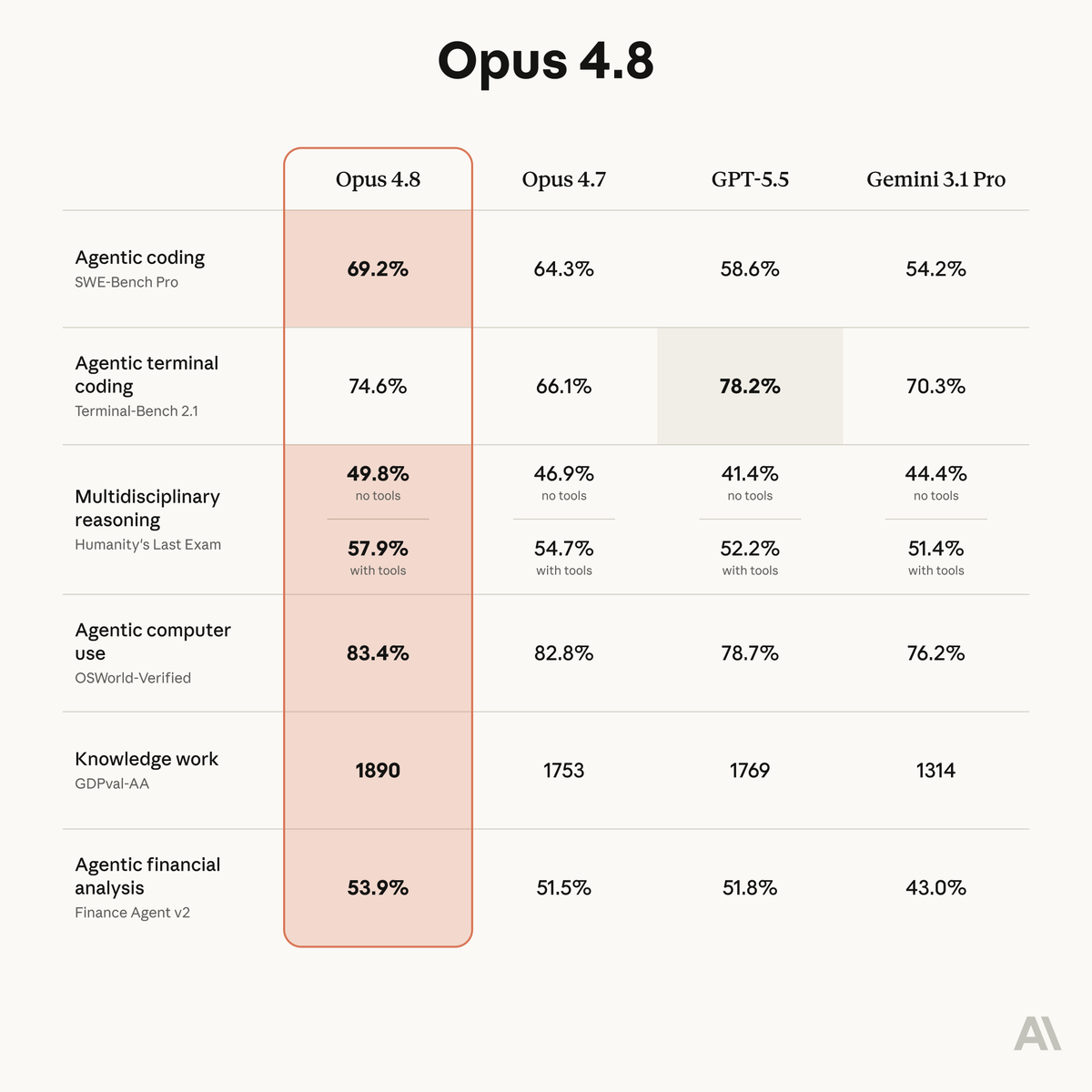
Introducing Claude Opus 4.8: it builds on Opus 4.7 with sharper judgment, more honesty about its own progress, and the ability to work independently for longer than its predecessors.
Available today at the same price.
Automation is a lie. CLIs are over. The SaaSpocalypse is dumb.
A year ago @danshipper came on the podcast to predict where AI was heading. He was remarkably right—including the call that everyone was sleeping on Claude Code.
Dan has a unique lens into where things are going because his team at @every is possibly the most AI-pilled group of people in tech. I always learn a ton talking to Dan.
So I brought him back for round two. We'll score these in exactly a year:
🔸 Every company will have one “super-agent” in Slack.
🔸 Codex and Claude Code will become the new operating system for knowledge work.
🔸 The AI job apocalypse is not happening.
🔸 PMs and designers will thrive.
🔸 We will read way more AI-generated writing and we will like it.
🔸 "I would buy SaaS stocks right now."
Listen now 👇
https://t.co/wzxQ5bz49h
@hexednobility@ryancarson Was just thinking the same thing. Surely markdown is more efficient from prompt/input/token perspective.
Plus you can define how you want your markdown displayed in a webpage via CSS.
HTML is great for displaying content but aren’t you passing html tag “noise”.
@ryancarson Does it read slowly? 😴
I use the built in mac accessibility feature loads. Select text, press shortcut and it reads it to you - the voice isn’t great but you can increase the speed. 🏃♂️💨
Really nice flow when combined with @superwhisper
https://t.co/i5pvzdI17c
what's happening inside Anthropic right now is genuinely fascinating:
DESIGNERS are now shipping production code
with no engineer in the loop at all
these are non-technical people with zero coding background.
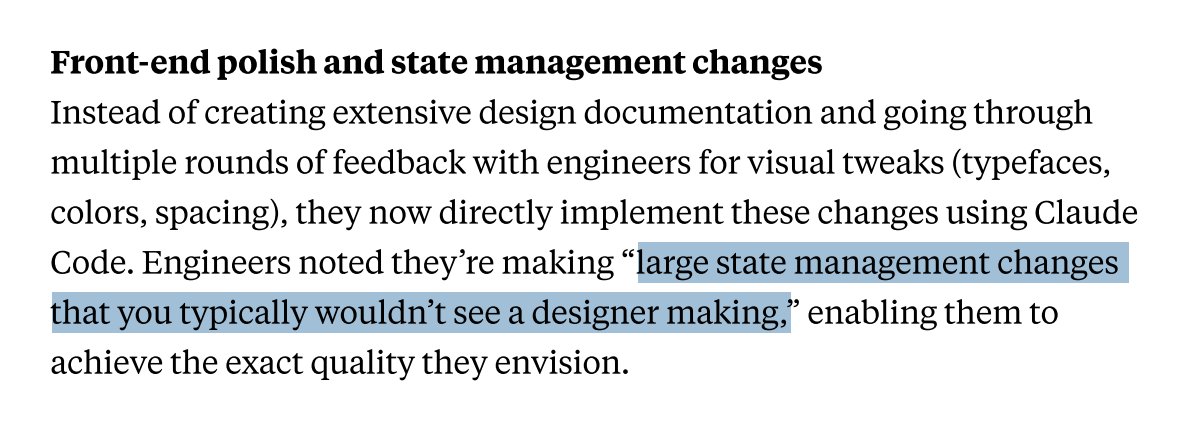
engineers on the team said designers are making "large state management changes you typically wouldn't see a designer making"
think about what that means for a second.
at every tech company in the world, designers and engineers are two separate roles.
designers make mockups, engineers write code. that's been the deal for decades.
at anthropic, that line is completely disappearing now.
here's what their designers actually do now:
it starts with a screenshot.
1) a designer takes their figma mockup and pastes the image directly into claude code.
2) claude looks at the image and generates a fully functional prototype from it.
working code that engineers can immediately build on.
this alone replaced the entire traditional cycle of:
make static design → write spec → hand to engineer → wait → review → give feedback → wait again → repeat.
but that's just prototyping.
from there, designers implement front-end changes themselves.
typefaces, colors, spacing, layout, etc directly in the codebase.
no ticket filed, no engineer pulled in.
and it goes further than visual polish.
designers are now making state management changes
(the code that controls how data moves through the app, even junior engineers find this tricky)
and for their ongoing backlog of polish and bug fixes, they don't even open claude code.
they just file a github issue (basically task description) describing what they want changed…
and claude automatically proposes a code solution.
then the designer reviews it and ships it.
so there's a persistent stream of improvements flowing into production without pulling a single engineer off their work.
they also use claude code to map out edge cases during the design phase.
the stuff that used to only get discovered later when engineers actually built the thing.
so now the designs are better
AND they ship faster because the edge cases are already handled before engineering starts.
one detail i love:
they set up a custom memory file that tells claude:
"you're working with a designer who has little coding experience. give detailed explanations. make smaller, incremental changes."
claude adapted its entire approach based on that one file.
here are some cool numbers, straight from the product design team:
• claude code is now open alongside figma 80% of the time
• 2-3x faster execution across the board.
the designers' reaction when it all clicked:
"holy crap, I'm a developer workflow"
the boundaries between roles are dissolving. quietly.
i think what's happening internally at anthropic is 2-3 years ahead of what will happen to the rest of the world
Design lead for Claude: The classic design process is dead.
Here's what's replacing it.
Jenny Wen (@jenny_wen) leads design for Claude at @AnthropicAI, was previously director of design at @Figma, and a designer at @Dropbox, @Square, and @Shopify.
In our in-depth conversation, we discuss:
🔸 Why the classic discovery → mock → iterate design process is becoming obsolete
🔸 What a day in the life of a designer at Anthropic looks like, including her AI tool stack
🔸 Whether AI will eventually surpass humans in taste and judgment
🔸 Why Jenny left a director role at Figma to return to IC work
🔸 The three archetypes Jenny is hiring for now
This conversation changed how I think about the future of design.
Listen now 👇
https://t.co/r4HICq4Ytn
Announcing a new Claude Code feature: Remote Control. It's rolling out now to Max users in research preview. Try it with /remote-control
Start local sessions from the terminal, then continue them from your phone. Take a walk, see the sun, walk your dog without losing your flow.
Figma just shipped the ability to bring UI work done in Claude Code straight into Figma as editable design frames.
Use this to explore new ideas in Figma, view multi-page flows on the canvas, or reimagine user experiences.
Introducing Claude Opus 4.6. Our smartest model got an upgrade.
Opus 4.6 plans more carefully, sustains agentic tasks for longer, operates reliably in massive codebases, and catches its own mistakes.
It’s also our first Opus-class model with 1M token context in beta.
@Shpigford Nice 👍🏻 love the logo
Any tips for defining a style that AI reuses instead of that awful multicoloured default UI.
I built couple “design system” pages with details of foundation styles, core components and pattern and include that in the prompt - setup too a bit of time tho.
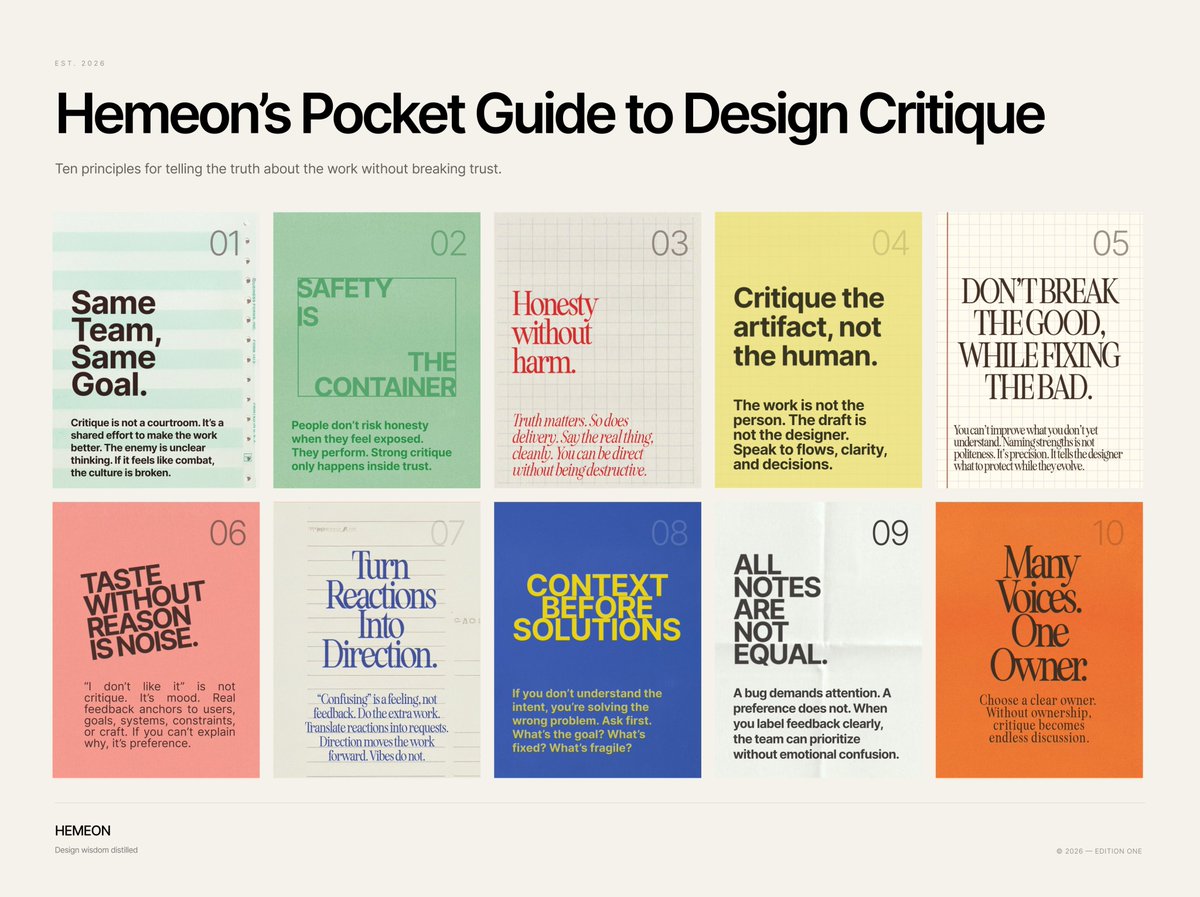
I'm back with a new pocket guide - 10 principles for better design critique.
I've sat in hundreds of design crits over 30+ years as a designer. These are tried and true.
Hemeon’s Pocket Guide to Design Critique
01 / Same Team, Same Goal
Critique is not a courtroom. It’s a shared effort to make the work better. The enemy is unclear thinking, weak craft, and lazy solutions. If it feels like combat, the culture is broken.
02 / Safety Is the Container
People don’t risk honesty when they feel exposed. They perform. They defend. They shrink. Strong critique only happens inside trust. Tend the room before you touch the work.
03 / Honesty Without Harm
Truth matters. So does delivery. Say the real thing, cleanly. You can be direct without being destructive. If people leave wounded instead of clearer, the moment failed.
04 / Critique the Artifact, Not the Human
The work is not the person. The draft is not the designer. Speak to flows, clarity, and decisions. The moment feedback touches identity, growth stops.
05 / Don’t Break the Good, While Fixing the Bad.
You can’t improve what you don’t yet understand. Naming strengths is not politeness. It’s precision. It tells the designer what to protect while they evolve.
06 / Taste Without Reason Is Noise
“I don’t like it” is not critique. It’s mood. Real feedback anchors to users, goals, systems, constraints, or craft. If you can’t explain why, it’s preference.
07 / Turn Reactions Into Direction
“Confusing” is a feeling, not feedback. Do the extra work. Translate reactions into requests. Direction moves the work forward. Vibes do not.
08 / Context Comes Before Solutions
If you don’t understand the intent, you’re solving the wrong problem. Ask first. What’s the goal? What’s fixed? What’s fragile? Critique without context is theater.
09 / All Notes Are not Equal.
A bug demands attention. A preference does not. When you label feedback clearly, the team can prioritize without emotional confusion.
10 / Many Voices, One Owner
Choose a clear owner. Without ownership, critique becomes endless discussion.
Thank you for reading. Drop a comment on the best tips you have for running a design crit. Would love to hear your ideas!
@Shpigford Haha! I say the same thing to my wife… then suddenly it’s 2am! 🤦🏼♂️ Feel like I could keep going but waking up for gym/work is starting to get pretty painful. 😴
Claude: "I've defined phase one of your project to be completed during weeks 1-4 and updated the spec."
Me: "Implement phase one now."
*5 minutes pass*
Claude: "Phase 1 is complete."