I’m doing this thread in response to the numerous posts that made rounds today regarding the sharp fall in Crude Oil prices below $0 per barrel.
I see a lot of misconceptions around this, so some clarity
Might be a lengthy thread, but I’ll try to simplify things. #Thread
RE: Nestle Nigeria’s Steep FX Losses
Many Nigerian companies reported significant FX losses in their 2023 fiscal year (that is no longer news), but three notable companies had their equity wiped out as a result. The interesting thing is that two out of the three names (MTNN and Nestle) rank very high among the blue-chip names on the Nigerian Exchange.
FX losses arise when entities hold dollar liabilities more than dollar assets and the exchange rate rises. In the head of finance people, holding dollar liabilities mean you are shorting the USD and exchange rate rising means that the USD has increased in value, thus translating to a loss for the entity who was short.
For consumer goods coys, they do not exactly short or long USD as a trader in the financial market would. Their dollar liabilities are often due to payables and loans that are denominated in USD or any other foreign currency (FCY). To manufacture products, these companies import raw materials from the global commodity market. It means they have to pay their suppliers in USD; hence payables sit on the balance sheet of these coys. Some companies even had Naira to repay their suppliers but were unable to pay because the CBN could not supply the dollars. Thus, those obligations had to remain on the balance sheet (consider this as a form of FX backlog). Guinness Nigeria experienced this problem.
In the case of USD loans, companies sometimes consider FCY loans because they are typically cheaper. But they become a pain when exchange rate rises because it means more Naira would be required to pay the same amount of dollar obligation. Companies who had dollar loans on their balance sheet took a hit.
Many of these coys will most likely say that while everyone saw a currency devaluation coming, the magnitude and sharpness of the movement was not anticipated. In all, these companies were victims of the Nigerian macro.
Nonetheless, I want to point at how Nestle brought problems to itself. Nestle is a very popular name among Nigerian investors. The track record of solid operating performance is there (see image below). Operating profits have been increasing every year except for 2020. The consistency of performance, spurred by its strong market leadership, management quality, and brand endears a lot of investors in this company. The company’s stock has also proven to be a very resilient one, especially in times of market downturns. Grandpas and Grandmas really love this stock (try to attend their AGMs and you’d see what I am talking about), and rightly so because the stock consistently delivered value.
What you have increased is “Cash”, not “Revenues”. And that cash is a liability because you have to pay it back.
Of course, you can then deploy the cash into productive activities to generate “Revenue”.
Lionel Messi on his plan: “I will train and play the last games with Inter Miami now to get to November games against Uruguay and Brazil well. Then I will enjoy my vacation in Argentina, It is the first time that I am going to have many more vacation days in December, during the holidays with peace of mind and with my people. Then in January I will return to training.” ☀️🇦🇷
@IbehOEmmanuel @bsleeves007@daviddapo@asemota For short-distance trips Lagos - Ibadan or Asaba to Aba for instance, you can complete these in 1-2 day cycles. This implies that you can sweat the truck on more trips, say 10-12 a month. Then consider the pricing, which then tells you which option is most viable.
@IbehOEmmanuel @bsleeves007@daviddapo@asemota Unfortunately, this is not an apples for apples comparison. I hinted that the condition for high-value trips is the distance. It is also why the cycles are typically ~ 1 week and maximum capacity utilization works out to about 3-4 trips a month.
@IbehOEmmanuel @bsleeves007@daviddapo@asemota Dampen your optimism is what I’m saying. You certainly will struggle to get 5 high-value trips (read: long distance) out of your truck in a month. 10 is virtually impossible. The cycle from pickup/loading to travel and return is ~ 1 week. So 3-4 still works out fine.
@bsleeves007 @IbehOEmmanuel @daviddapo@asemota I believe so too. He needs to start first 😀. When you do Lagos - Abuja or Ibadan - Benue 3-4 times in a month,
you’ve definitely had a good month.
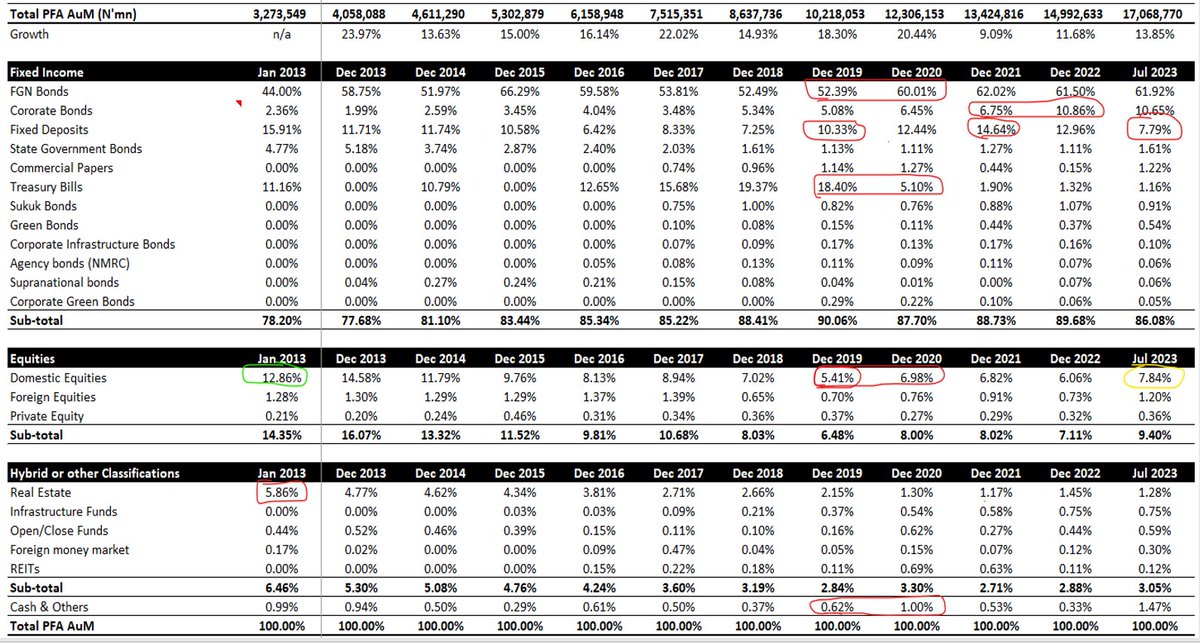
I did a quick look to see what our PFAs are investing our pension funds in. Very clearly, the pensions industry has continued to grow steadily, marking a 15% average annual growth over the past ten years. The highest growth happened in 2020 (although 2023 could beat the record).
Most humans have to save their entire working lives to get a large sum to make risk-free rates (3-12%) meaningful
To successfully do this, you need low, stable inflation; a currency that stores wealth, consistency & time
Ponzi schemes thrive cos Nigerians don’t have the above
Regular shoppers take mental shortcuts in purchasing products. Especially a product that is a household name.
I believe that is the goal of brands. They try to reduce the cognitive 1/x