Today we hit $100M ARR at @clay.
It took us six years to go from $0-1m, then two years to go from $1-100m.
I’m going to walk you through the 6 biggest GTM bets that got us here.
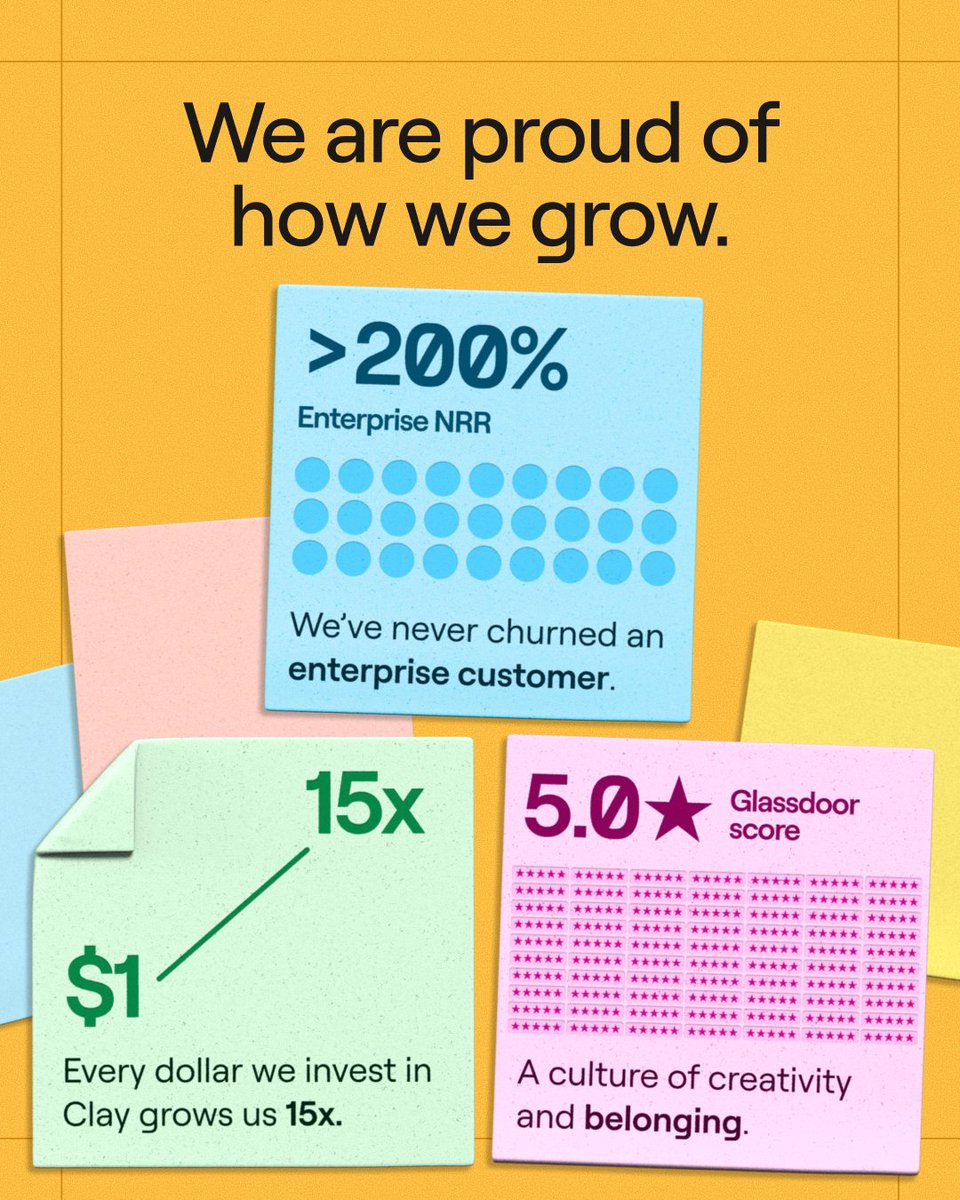
$100M ARR may be the headline, but I’m most proud of how we accomplished it: we’ve never churned an enterprise customer, have >200% enterprise NRR, every dollar we invest grows 15x (a ratio that has tripled in recent years), and we’ve created a culture of creativity and belonging (with a perfect Glassdoor score to match).
Note:
-We are a product-driven company. Without that foundation and a unique POV on the market, none of this would work.
-Our GTM approach is authentic to us. This isn't a plug-and-play framework. Greatness comes from doing what only you can do.
Here are the big bets that worked for us:
1. Building a self-serve motion through reverse demos
We originally had a product that nobody could use. It took us 8 calls to sell a $200/mo product! Reverse demos were key to bringing that to zero. Customers would share their screen, and we’d use Zoom annotations to solve their problem in 30mins. They accomplished something real, learned how to use Clay, and we got so much UI feedback that we immediately applied to the product.
2. An irrational investment in brand
Most B2B startups treat brand as a post-PMF investment. We flipped that. We bought Clay(.)com and hired a claymation artist before we had revenue. Our Head of Brand was employee #18. These choices felt irrational but they’re authentic to us and reflect our identity. Now it’s a moat.
3. Switching to usage-based pricing
We were the first GTM company to offer usage-based pricing. Our customers were shocked we didn't charge per seat and our investors thought we were leaving money on the table. But we're a product built for efficiency. Usage-based pricing helped us target more technical users and enabled our land-and-expand motion.
4. Building an agency motion to generate UGC on LinkedIn
Cold email agencies were our first customers. They posted about Clay organically to position themselves as experts and attract clients. We pounced on this and enabled them. This sparked a self-perpetuating cycle: new people discover Clay through that content, join, create their own, and earn recognition too.
5. Unconventional hiring
50% of our GTM and G&A teams are doing their job for the first time. This is how we bring creativity into our company and think differently. We’ve hired farmers, physicists, archaeologists, magicians in new roles. We look for product passion, customer empathy and technical curiosity, then teach the mechanics.
6. We created a new career path & economy: GTM Engineering
There are now thousands of open GTME jobs and hundreds of agencies built around it. Many first-time entrepreneurs have already built 7-figure businesses on top of Clay. Our community, with clubs in more than 70 cities, is our force multiplier, and tells us more about impact than any metric ever could.
-
All of these bets show we’re not racing anyone. We spent six years figuring out what and how we wanted to build. In an era of overnight successes and growth at all costs, it turns out that taking time to build something authentic can create a business with bigger impact & more growth than you'd think.
Our creativity remains our greatest alpha. That will continue to show up in how we do our work, who we hire, and in our boldest bets coming up next year.
sometimes feel my todo list is like a hydra...
check one off, and somehow two more get added
i definitely need a better task organization system, any suggestions?
claude code plan mode has seriously changed how i approach ai coding
instead of trying to get it to read my mind from the first prompt, i spend a few back and forth messages making sure we're aligned: installing the best packages, touching the right files, and proper error handling
that small bit of setup makes a huge difference. when i walk away for 5–10 minutes, it usually gets everything right in one go
@gregisenberg extracting data from unstructured sources is such a big problem in every industry. 70% of boring and manual tasks come down to some sort of data extraction and data movement between different systems
@shadcn this is a great overview - would be great if shadcn had more first class support and docs for theming though. every website that uses shadcn starts to look the exact same