Announcing three major scientific discoveries, one each in mathematics (harmonic analysis), computer science (complexity theory), and physics (quantum field theory).
AI starting to help us improve our understanding of the universe! https://t.co/VkfacopR2R
It’s kinda crazy to me that we melt sand down, clean it to 99.99999% purity, literal wizards have to draw it slowly into an ingot, we cut it, inscribe a hundred billion little on/off switches on it, and when you run electric current through it you can do basic arithmetic, which when you do enough of it can do any math on the planet, and which describes reality well enough that we can teach it the ontological meaning of words and their distance from each other on a high-dimensional space, and if you ask, it can tell you what word comes next and that apparently is powerful enough that if you do it a hundred billion times it’s the smartest thing to ever exist
oh yeah and we use this primarily for email
Last month, we demonstrated high-rate alchemy: turning mercury into real, stable gold, beating CERN’s record by a factor of 10.
Last week, we enriched isotopes in the world’s most powerful plasma centrifuge, beating the Soviet record that stood for 40 years.
Now, we’re building a fusion reactor in San Francisco to achieve record power density.
Ben Affleck reveals he writes Python, understands convolutional neural networks, worked extensively with GPUs, and used his celebrity status to get private looks at Google and OpenAI’s video models
“I’ve always been kind of into computers since I was young. Then, when film started to move from analog film to digital, I became more interested in that aspect of it. The visual-effects workflow for many years has included machine learning, so I can write pretty shitty Python scripts and stuff like that.
“With convolutional neural networks, which were the precursors to what the transformer can do, which is much more computation simultaneously, you would do things like look at what’s called a tensor. That’s the numerical translation of a visual image in numbers, like the batch number, the frame number and the red, green and blue values of each pixel in each frame. It’s just that simple. That numeric is called a tensor.
“You’d use a convolutional neural network to identify patterns that reveal what’s called edge detection or feature extraction, which is identifying patterns well enough to know, this is where the window ledge is, so we can more easily take the green-screen image out and replace it with something.
“That was familiar to me early on because, prior to Artists Equity, I had a small visual-effects company. I’ve worked with GPUs a lot too. The visual-effects guys said, ‘Hey, you should see. There are a couple: Google and this other company, OpenAI, are doing really interesting stuff with transformers in video.’
“I’ve learned that I can actually just call up and go, ‘Hey, it’s Ben Affleck. Can I come see what you’re doing?’ Sometimes people say yes, to my astonishment.”
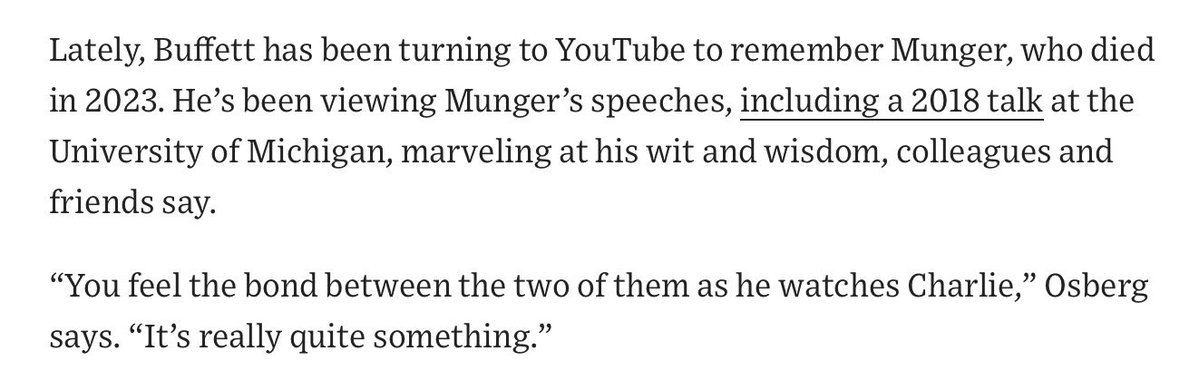
Warren Buffett, as it turns out, is a big YouTube watcher.
The WSJ has a great story today about his eclectic viewing habits. Buffett often ends up down the YouTube rabbit hole like we all do — and, recently, has been binging Charlie Munger clips and speeches.
$META IS TESTING HUMAN OPERATORS BEHIND SOME MUSE AI PHONE CALLS
The experiment began shortly after Meta launched Muse’s phone-calling feature, according to internal posts seen by Reuters.
Some employees have raised privacy concerns, warning that users could share sensitive information without realizing a call-center contractor is involved.
Meta says the test is internal for now and is being used to work through safety and privacy protections.
If the feature launches publicly, the company says it will include proper disclosures.
Source: Reuters