SFI-lärare och ämneslärarstudent /language teacher 📚🌹 🌈 litteratur, språk o kampen mot marknadsskolan o npm-samhället + för att ”planlöst studera humaniora”
När Lotta Edholm blev skolminister jobbade hon som välfärdslobbyist och satt i styrelsen för friskolekoncern, ägd av fd partikollega. Varje år betalar kommunerna ut 2.5 miljarder till skolor ägda av personerna bakom friskolereformen. Svensk borgerlighet älskar vänskapskorruption.
Students see no issue using AI to complete their assignment because they have been conditioned to treat schooling as a means to a capitalist end and not a tool for acquiring knowledge. The proliferation of AI is just making this very explicit for those who didn’t already know.
They scraped the internet for every last bit of data, stole information from books, articles, art etc. all created by HUMANS, and now want to sell it back to you at a premium because you all have convinced yourselves this is the future and it’s inevitable lmao
Last semester I had my students use their fav AI to write an essay on the causes of colonialism. I asked them to grade each other’s papers. I wanted them to see what we see when grading AI papers. They are all the same, same citations including from 1800s. Same voice. No nuance.
“You’re just jealous you didn’t have AI in college.” Rubbish. We’re angry because students deserve a real education. Because they’re cheating themselves if they skate through school without doing the reading. Because a world where no one knows anything will be very bleak indeed.
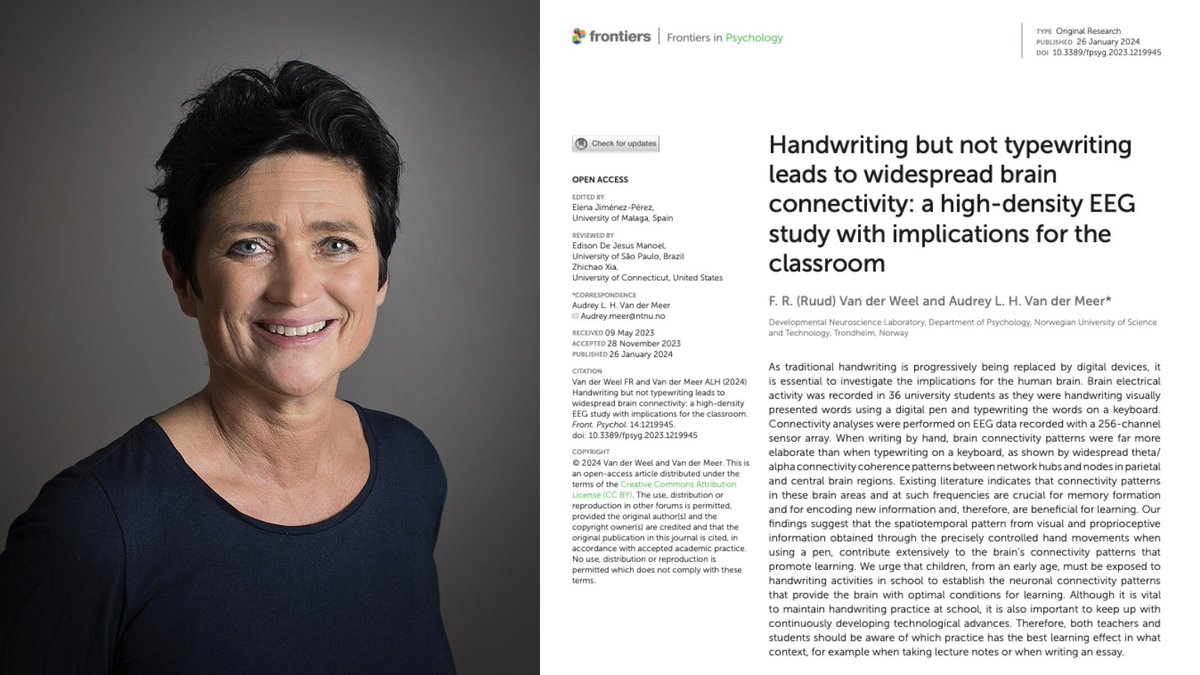
A Norwegian neuroscientist spent 20 years proving that the act of writing by hand changes the human brain in ways typing physically cannot, and almost nobody outside her field has read the paper.
Her name is Audrey van der Meer.
She runs a brain research lab in Trondheim, and the paper that closed the argument was published in 2024 in a journal called Frontiers in Psychology. The finding is brutal enough that it should have changed every classroom on Earth.
The experiment was simple. She recruited 36 university students and put each one in a cap with 256 sensors pressed against their scalp to record brain activity. Words flashed on a screen one at a time.
Sometimes the students wrote the word by hand on a touchscreen using a digital pen, and sometimes they typed the same word on a keyboard. Every neural response was recorded for the full five seconds the word stayed on screen.
Then her team looked at the part of the data most researchers had ignored for years, which is how different parts of the brain were communicating with each other during the task.
When the students wrote by hand, the brain lit up everywhere at once.
The regions responsible for memory, sensory integration, and the encoding of new information were all firing together in a coordinated pattern that spread across the entire cortex. The whole network was awake and connected.
When the same students typed the same word, that pattern collapsed almost completely.
Most of the brain went quiet, and the connections between regions that had been alive seconds earlier were nowhere to be found on the EEG.
Same word, same brain, same person, and two completely different neurological events.
The reason turned out to be something nobody had really paid attention to before her work. Writing by hand is not one motion but a sequence of thousands of tiny micro-movements coordinated with your eyes in real time, where each letter is a different shape that requires the brain to solve a slightly different spatial problem.
Your fingers, wrist, vision, and the parts of your brain that track position in space are all working together to produce one letter, then the next, then the next.
Typing throws all of that away. Every key on a keyboard requires the exact same finger motion regardless of which letter you are pressing, which means the brain has almost nothing to integrate and almost no problem to solve.
Van der Meer said it plainly in her interviews.
Pressing the same key with the same finger over and over does not stimulate the brain in any meaningful way, and she pointed out something that should scare every parent who handed their kid an iPad.
Children who learn to read and write on tablets often cannot tell letters like b and d apart, because they have never physically felt with their bodies what it takes to actually produce those letters on a page.
A decade before her, two researchers at Princeton ran the same fight using a completely different method and ended up at the same answer. Pam Mueller and Daniel Oppenheimer tested 327 students across three experiments, where half took notes on laptops with the internet disabled and half took notes by hand, before testing everyone on what they actually understood from the lectures they had watched.
The handwriting group won by a wide margin on every question that required real understanding rather than surface recall.
The reason was hiding in the transcripts of what the two groups had actually written down.
The laptop students typed almost word for word, capturing more total content but processing almost none of it as they went, while the handwriting students physically could not write fast enough to transcribe a lecture in real time, which forced them to listen carefully, decide what actually mattered, and put it in their own words on the page.
That single act of choosing what to keep was the learning itself, and the keyboard had quietly skipped the choosing and skipped the learning along with it.
Two studies. Two countries. Same answer.
Handwriting makes the brain work. Typing lets it coast.
Every note you have ever typed instead of written went into your brain through a thinner pipe. Every meeting, every book highlight, every idea you captured on your phone instead of on paper was processed at half depth.
You did not forget those things because your memory is bad. You forgot them because typing never woke the part of the brain that would have made them stick.
The fix is the thing your grandmother already knew.
Pick up a pen. Write the thing down. The slower road is the faster one.
Universities don't need to "teach students to use AI well." The whole point of AI is that it doesn't require any skill. Universities *should* teach students how to write and research on their own, and foster an ethic of shaming people who outsource their basic ability to think.
Re the idea that "universities need to embrace AI and you're doing students a disservice by not teaching them to use it" ⤵️ Maybe it's actually doing students a disservice to make them dependent upon using it
Especially in our new era of AI, this letter is everything. In 2006, students from Xavier High School in NYC asked the writer Kurt Vonnegut to visit their class. What he wrote back is one of the best (and most human) things ever:
Idag hade jag möjlighet att dela en undervisningsgrupp i två och hade blott 14 elever. Helt plötsligt kunde elever som aldrig lyssnar vid genomgångar eller läser kommentarer på prov få saker förklarade för sig.
Undrar hur många fler hade klarat skolan om klasserna var mindre.
I used to mark students down for using AI. Now I refuse to mark their papers at all & instead call them in to have a conversation about integrity. I give them a chance to redo their work properly with a grade reduction. It's time consuming, yes, but it's also our job as teachers.
- Vi måste göra *allt* i vår makt för att stoppa gängkriminaliteten!
- Ja!
- Sänk straffåldern till 13 år.
- Ja!
- Hårdare straff!
- Ja!
- Fler poliser!
- Ja!
- Fler fängelser!
- Ja!
- In med militären!
- Ja!
- Mer resurser till skolan!
- Vi har inte råd.
Jag tror inte folk har förstått hur dåligt det här är för skattebetalare/konsumenter.
Om elpriset sjunker, tex pga utbyggd elproduktion eller gynnsamma väderförhållanden, så behöver vi betala mellanskillnaden till företagen, eftersom Tidö lovat dem höga elpriser - för alltid.
Det är 1 juli och Tidö säkrar sin valförlust nästa år genom att:
- Göra det dyrare att behöva mediciner
- Göra det dyrare att vara ensamstående förälder
- Försämra svenskarnas boendestandard med lägre takhöjd och sovrum utan fönster
- Göra det billigare att vara höginkomsttagare
"ChatGPT users had the lowest brain engagement and 'consistently underperformed at neural, linguistic, and behavioral levels.' Over the course of several months, ChatGPT users got lazier with each subsequent essay, often resorting to copy-and-paste by the end of the study."