An Amercian member of congress is threatened by foreign terrorists carrying American rifles, backed by a foreign military paid for by American taxpayers, and the US ambassador to that country says not a word in defense of his own countryman, and instead uses his social media accounts to promote his own vapid cable news appearances, which amount to propaganda for that same foreign country. It’s too much, too insulting and humiliating to America. This is how revolutions start. For the sake our nation, Mike Huckabee should be removed from his post immediately.
Almost a year later and DOJ is pushing for a retrial. Sit with what that means: they’d rather set a precedent that criminalizes writing code than admit the case doesn’t hold. Every developer in this country inherits the risk - for decades - unless this is dismissed.
FreeRomanStorm and support the battle.
The internet might be over.
I am not talking about the corporate, ad-filled internet. I mean the real one. The one you use to talk with your friends, find niche communities, and freely share ideas. The way you access and interact with the digital world is about to change forever if we don't speak up right now.
The U.S. House of Representatives just passed the KIDS Act. Do not let the well-intentioned name fool you. This massive legislative package is a wolf in sheep’s clothing that could potentially cause an unfathomable amount of damage to the privacy, security, and free speech of every single citizen in the United States.
Major civil liberties and digital rights organizations, including the Electronic Frontier Foundation (EFF) and FIRE (Foundation for Individual Rights and Expression) are sounding the alarm. This bill is a massive over-reach of legislation designed to curtail your freedoms, everyones.
Under this bill, websites and apps will be pressured to verify the age of all users to avoid massive legal liability. This creates a de facto age-verification mandate, meaning you could soon be forced to upload government IDs, passports, or hand over biometric facial scans just to use standard apps or browse everyday websites. Forcing every corner of the web to collect and store these massive databases of citizen identity documents is an absolute cybersecurity nightmare waiting to happen, creating a golden target for hackers and data leaks.
The bill also takes direct aim at standard privacy features like disappearing or ephemeral messaging, treating basic digital privacy tools like dangerous design tricks rather than the digital equivalent of a private, real-world conversation. By weaponizing broad, vague definitions of "harmful content," the package pressures tech platforms to heavily over-censor completely lawful speech out of fear of massive government lawsuits. It risks sanitizing the internet and shutting down vital spaces for free expression and open communication.
This won't stop at signing up for websites, or chat apps. It will extend to artwork websites, multimedia hubs like Newgrounds, Music sites, even Reddit and 4chan will be subjected to this, and while you might think it's well deserved, you won't be saying that when they start asking users to verify their age on Mangadex or doujinshi sites, or on Itch io. Going to websites outside the US would be scrutinized if it doesn't follow the same criteria.
VPNs? Forget it, they'll try to outlaw those, too.
We all want children to be safe, but turning the entire internet into an Orwellian surveillance state where you have to show papers just to log on is a terrifying overreach. The bill has passed the House, which means the battleground is officially moving to the Senate. We cannot afford to sit this one out. This is a slippery slope and we must not give them this power over all of us.
Any member of Congress who votes yes today on the KIDS Act—empowering the government at parents’ expense and turning every American into a surveillance target—should be removed from office.
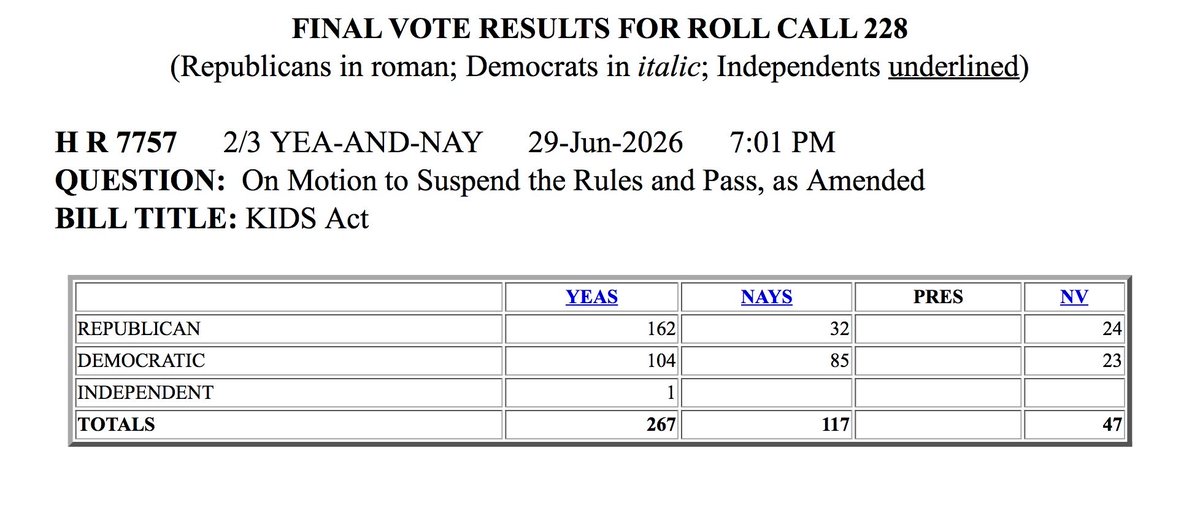
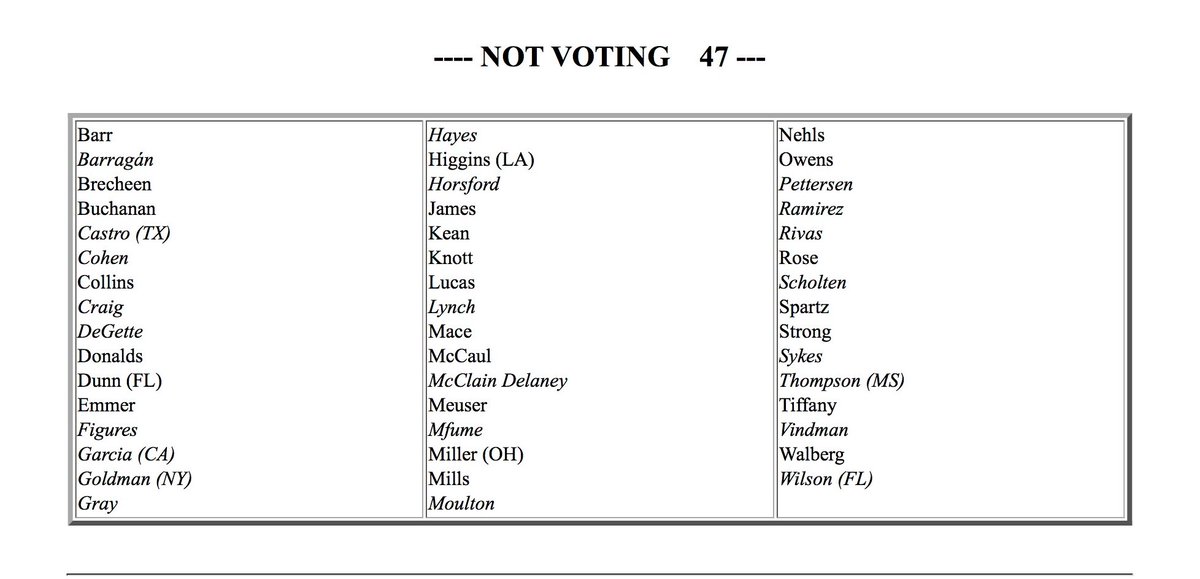
Forty-seven members of Congress skipped the vote on the KIDS Act, which establishes the infrastructure for mass surveillance of Americans online.
This bill needed a two-thirds majority to pass, so just 17 more no votes could have sunk it!
A couple members might have a legit excuse, but 47? No way. They bailed to avoid going on the record, even at the cost of furthering the surveillance state.
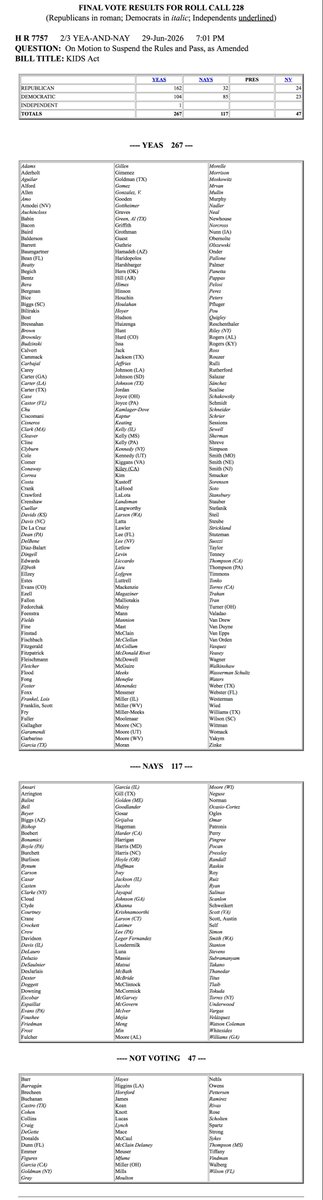
Here’s the roll call of members of Congress who betrayed the Constitution and the American people by voting yes on the KIDS Act.
The sickest part is that these people used “protecting kids” as an excuse to further insert government between parents and their children—all while establishing a surveillance infrastructure to monitor and control Americans of all ages.
This is a dangerous anti-privacy bill (identity verification) that the House of Representatives might try to pass by voice vote this afternoon before many of us are even in town. Senators Mike Lee, Rand Paul, and Ron Wyden voted against a similar bill in the Senate two years ago.
Warning! This is moving fast.
Congress is rushing the KIDS Act to expand the surveillance state under the guise of “protecting kids.”
Identity checks to use the internet.
Government monitoring and control of all Americans.
It’s coming if you don’t act now.
Tell Congress: No!
Congress is scrambling right now to pass online identity checks to use the internet—just like we’re seeing in places like the UK—before anyone realizes what they’re doing.
They’re using “protecting kids” as their excuse, but it’s really about spying on and controlling Americans!
Our statement on the UK government’s demand that all content on all devices sold or used in the country be scanned, on the presumption of nudity, using a dystopian combination of age verification and content scanning. This proposal will not safeguard children. It endangers us all.
https://t.co/VdWe9uhi8p
This is what these social media ID verification/age verification laws are really about, and you’re an idiot if u think any of this is about “protecting children.”
I have never seen so many people capitulating out of $ETH or crypto.
Some are writing blogs and essays explaining why it failed, mainly naming how other chains won the race, measured by fees taken in.
Some of my thoughts, in these hard times:
Time will tell, but I think many people are mistaken in treating $ETH like an end-stage $AMZN, as if the main question is already about mature margins, fees, and cash flows.
In reality, Ethereum is still very much earlier in its economies-of-scale phase, with nearly all metrics in the top right corner and growing at mid double digits to tripple.
Furthermore, most of the market is focused on the wrong battle: who can become the fastest and cheapest payment processor.
Lower fees, higher throughput, faster settlement. But that is likely a race to commoditization, similar to the payment processors crash over the last years.
If the only value proposition is speed and cost, then the moat gets thinner over time, easy disruptable. Someone can always be faster. Someone can always subsidize fees lower. Someone can always optimize one narrow use case.
The real value may not be in the transaction fee itself.
The real value is likely in the amount of economic activity secured by the network, the credibility of that security, the neutrality of the base layer, and the difficulty of replacing it once enough assets, applications, institutions, and users depend on it.
That is where Ethereum seems different to me and why so many institutions are choosing $ETH.
Most other projects still feel replaceable. They may have better performance in one area, better UX in another, or lower fees in the short term. But if their advantage is mainly technical efficiency, that advantage can be copied, competed away, or made irrelevant.
The newest hottest thing today is replacing the hottest thing from last quarter.
Ethereum’s bet appears to be much larger: become the most secure, decentralized, credibly neutral settlement layer for the internet economy.
Not the cheapest rail.
The hardest rail to replace.
In the end, the most valuable network may not be the one with the lowest transaction costs. It may be the one people trust most to secure the highest-value assets and applications over the longest period of time.
If $ETH can retain its market share while continuing to scale through upgrades that improve speed, throughput, and fees, its potential remains significant, especially if AI agents become truly crypto-native.
If it combines all of the above and earn the crown as the leading value-secured network, then $ETH could eventually be viewed as something like a truly decentralized, inflation-adjusting global bond: securing the world’s assets, free from political meddling, and deserving of a premium market cap because of the value it protects on top of the deflationary pressures create incentives to stake, get yield and trust the equivalent of buybacks and griwth in value secured to provide additional value.
Keep in mind over 1/3 of $ETH is now staked!
In that scenario, $ETH would not just be another asset to hold. It could become one of the only truly neutral and secure bonds for the digital economy.
... But sure, lets compare it to $SOL with 6% inflation, no moat, no security, massive outages, decreasing validator nodes and alike.
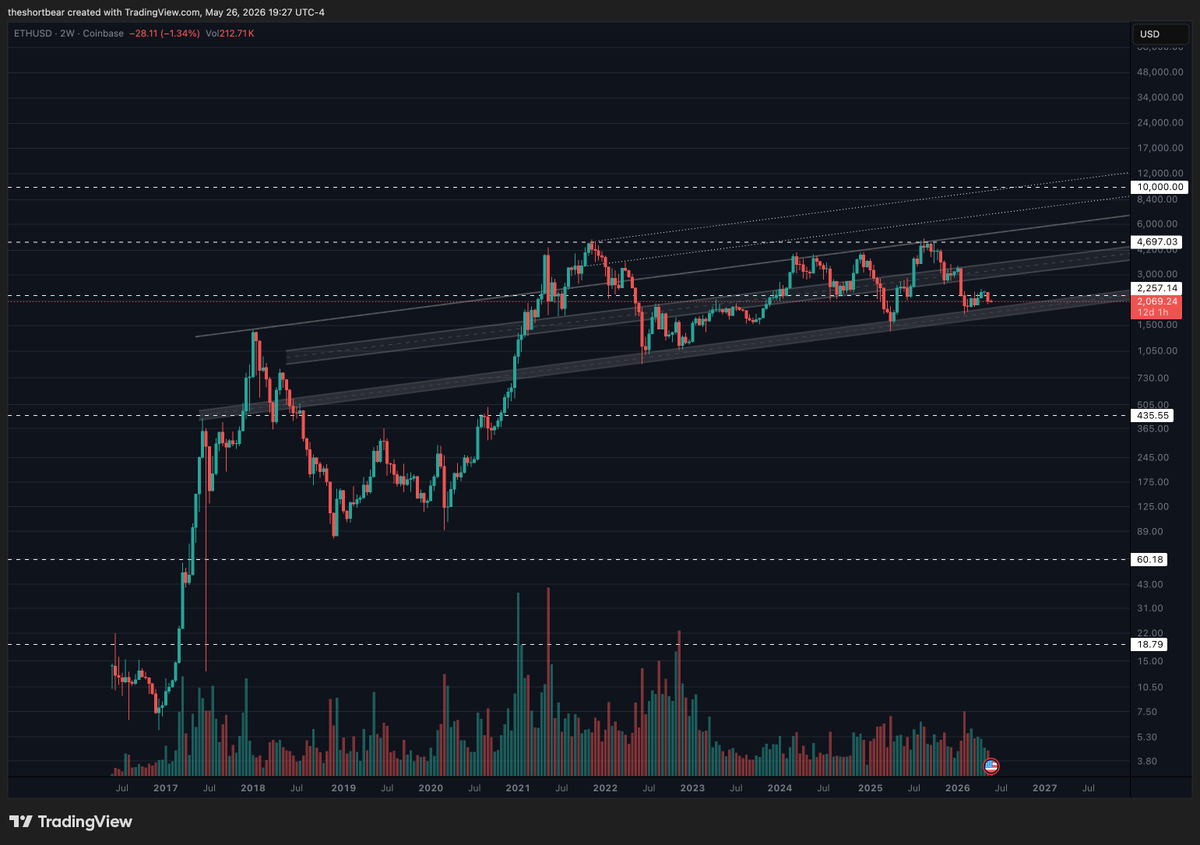
it just all feels like people are getting lost in short term fees and the easiest valuation attempt rather than what $ETH is actually built for, all while its testing its bottom range and players go full portfolio into AI.
Let me you a little secret.
This is a lie. This bill is called the Stop CSAM Act so that no one can look like a bad person by opposing it. But this bill does nothing for CSAM.
In fact, this is a bill to gut Section 230 completely.
Trojan horse of all trojan horses.
Ethereum is PERMISSIONLESS
Ethereum is OPEN SOURCE
Ethereum is ANTIFRAGILE
Ethereum is ENERGY-EFFICIENT
Ethereum is GLOBAL
Ethereum is BUDGET-SECURE
Ethereum is UNCESORABLE
Ethereum is a SOCIAL MOUVEMENT
Ethereum is HOPE
Ethereum is FREEDOM
ETHEREUM IS NOT A COMPANY