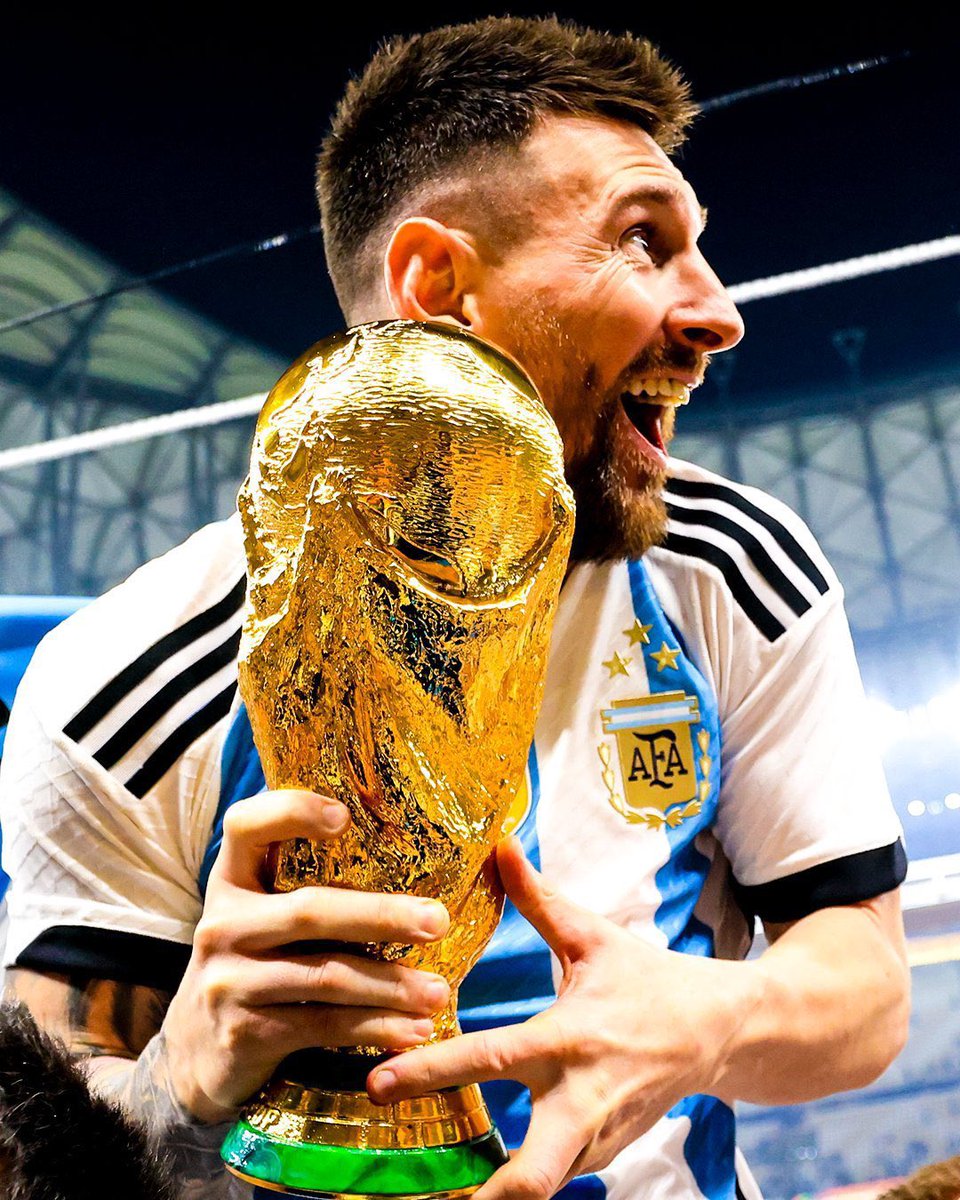
That’s my opinion. It remains so forever.
However, my opinion and that of history are unfortunately different. It’s the same reason every sane Messi fan knew it was done and dusted, that evening in Qatar.
We knew he was the greatest ever. We also knew history needed to be aligned on that. All aligned now. No contradiction.
Built in Nigeria. Growing across Africa.
What we're building goes beyond expansion into new markets. It's about connecting opportunities, strengthening capital flows across the continent and showing what's possible when African institutions scale across borders.
🧵
Many years ago, Taiwo Oyedele @taiwoyedele and I were colleagues at PwC.
Last week, we found ourselves discussing how to move Nigeria’s economy forward. We spoke about power, credit and growth.
Super proud of his journey and optimistic about his impact as HM of Finance
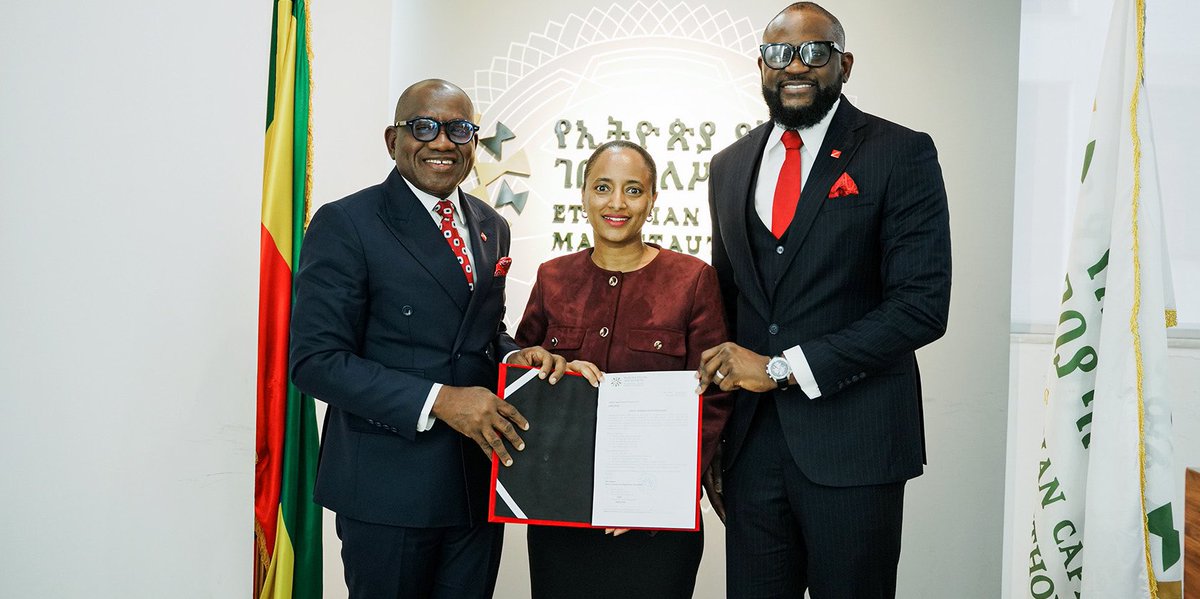
@UnitedCap has become the first foreign investment bank to secure an operating licence in Ethiopia. The group has also received approval to operate in Rwanda.
African institutions are increasingly leading, competing, and succeeding across the continent.
BOLD MOVES!
United Capital has secured operational licenses to expand into Rwanda and Ethiopia, becoming the first foreign investment bank to obtain an investment banking license in Ethiopia.
This marks another bold step in our mission to empower Africa’s economic growth!
United Capital just became the first foreign investment bank licensed in Ethiopia.
A few weeks ago, Rwanda.
That's not just expansion.
That's a bold bet on Africa's future.
Funny thing?
When the rewards come years later, people will call it luck.
Nobody ever sees the patience.
They only see the outcome.
Africa's next financial giants are being built in real time.
@UnitedCap
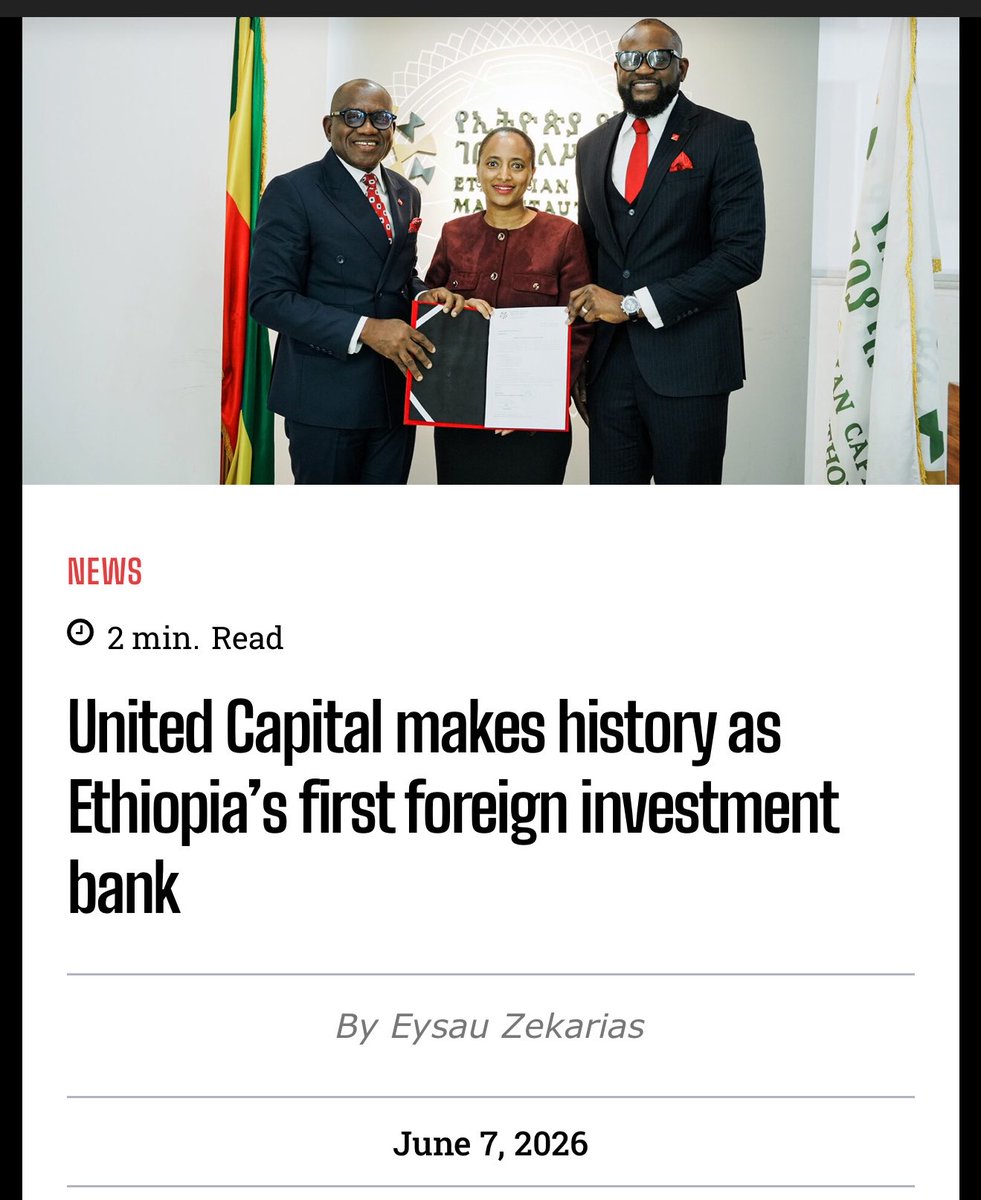
United Capital has become the first foreign investment bank licensed in Ethiopia.
The development follows the company's recent entry into Rwanda, marking a broader expansion into East Africa.
The approvals allow United Capital to broaden its Pan-African presence and provide investment banking, financial advisory, portfolio management, trusteeship and securities brokerage services in Rwanda and Ethiopia.
The move reflects growing momentum across East African capital markets as countries continue to attract investment, deepen market participation, and strengthen financial infrastructure.
For United Capital, it represents another bold step in its mission to power Africa's economic growth and unlock opportunities across the continent.
#CapitalMarket #InvestmentBanking #FeaturedPost
Massive news for United Capital! 🚀
UCAP has officially made history as the *first* foreign firm to bag an investment banking license in Ethiopia, expanding into a market of 120M+ people.
First-mover advantage locked in. 🇳🇬🤝🇪🇹
#Investing#NGX#UnitedCapital#TNI
I’ve spent the past couple of weeks building Looters: a public archive of Nigerian political corruption since the 1990s.
Governors, ministers, shell companies, Swiss accounts, the Jersey trusts, — one searchable graph.
You too can connect the dots: https://t.co/faIfzWfAIp
I do hope one day we will stop taking advice from banger boys and banger girls.
I remember someone on my team saying my job is easy. All I did was to “approve” when I told him to come and do my job for one day. He saw the decisions we make and ran away.
You think being a senior person is about making document edits lmao 🤣
We need more knowledge production for the sake of knowledge production in Nigeria.
Let people write the essays. Make the videos. Do the podcasts. Do the gatherings. Let people do everything.
We don't have nearly enough.
Turn churches into 7-days-a week community centres. Subsidize energy costs and operations through grants.
Have childcare facilities, sporting complexes, libraries, free food.
Watch as children make friends and break social media, gaming & substance addiction. They will read and learn. Pick up sports. Build social skills and self-confidence.
Observe as parents regain bandwith and time for intentional and present parenting.
Young people will observe the lives of mentors and learn to love and know Christ.
Collaborations will emerge. Loneliness will reduce as people find multi-generational friendships and families.
This is my vision of the modern church. A living breathing entity in the heart of urban communities.
One thing I have always known intuitively, and which writing longer pieces here has now confirmed, is that Nigerians do in fact read. They read attentively. They read passionately. They read in public, in fragments, in arguments, in long threads that turn into debates and sometimes into communities. What has changed is not the appetite for words, but the form in which those words arrive.
Publishing, however, remains stubbornly attached to a single mode of delivery, as though the printed book were not only the ideal form of literature, but the only legitimate one. Meanwhile, the ecology of attention has shifted completely. Information now moves in layers: excerpts, audio, performance, annotation, circulation. For better or worse, this is the world we are in.
Publishers complain that people are not buying books. They blame inflation, piracy, shrinking middle classes. All of this is true, and none of it is sufficient. Entire industries have faced similar pressures and survived by rethinking distribution rather than mourning a vanished past. Music did this. Film did this. Journalism—clumsily, imperfectly, but still—did this.
Music did not disappear because fewer people were buying CDs. It understood something crucial: people still wanted sound, presence, repetition, mood, identity. So the industry multiplied points of entry. Streaming. Live sessions. Licensing. Sync deals. Merch. Subscriptions. Fragments that lead back to the whole. Artists no longer earn from a single object, but from an ecosystem.
Publishing, by contrast, still behaves as though the book itself must carry the entire economic burden. This is not only unrealistic, it is creatively limiting. The result is an industry sustained largely by love of literature on one end, and financial precarity for writers on the other.
There is a vast, largely untapped space between those two realities. Loving literature is not enough. Publishing also requires people who understand markets, platforms, circulation, and contemporary habits of attention. The readers are already here, reading, commenting, arguing, debating. The failure is not theirs. It is structural.
High agency is your greatest asset when the odds are stacked against you.
Growing up with limited resources teaches you that waiting for perfect conditions means waiting forever. You learn that nobody's coming to save you, not because the world is cruel, but because everyone's fighting their own battles.
High agency means you stop asking "why me?" and start asking "what's next?" It's seeing every constraint as a puzzle to solve, not a wall to stop you. No connections? Build them. No capital? Start where you are. No mentors? Books, podcasts, and observation become your university.
The beautiful paradox: those who start with less often develop more agency. When you've never had a safety net, you learn to build wings on the way down. You become resourceful in ways that privilege can't teach.
Your background isn't your destiny, it's your training ground. Every obstacle you've overcome has been building your agency muscle. The hunger that comes from scarcity, when channeled right, becomes the drive that refuses to accept "that's just how things are."
The path isn't about forgetting where you came from. It's about using that perspective as fuel. You see opportunities others miss because you've learned to create value from nothing.
Agency isn't about denying systemic barriers exist, it's about refusing to let them have the final word on your story.
@LooseTalkGiants started this week's pod with @OsaGz saying 2 hours max and we're out. 🤣🤣
They ended up doing 3hrs30mins.
Wild!
I love these giants. We owe you guys big time!
@SteveDedee@AOT2
TOP 50 HANDLES of 2024-25 🍿
10. Jordan Clarkson
9. Kevin Porter Jr.
8. James Harden
7. Amen Thompson
6. Jalen Brunson
5. Shai Gilgeous-Alexander
4. Bub Carrington
3. Donovan Mitchell
2. Trae Young
1. Stephen Curry
"Those of us who are privileged to be educated, healthy, and with opportunity should not do easy things. The only way to justify our privilege is to do the hard things that society demands of us; solve tough problems and create opportunities for others". @FredSwaniker