The reason why the recent proof of the Riemann Hypothesis feels so alien is not because it's beyond human comprehension, but because it's essentially an "epistemic zero-knowledge proof".
It establishes a fact through a long chain of logically valid deductions without revealing its deeper generative structure – a bit like determining the position of a puzzle piece by ignoring the picture and instead matching shapes until you reach all four borders.
The only reason why mathematicians are disappointed, is because they expected that placing the center piece would come from "completing the picture" rather than building this awkward spine 😅
I personally think that even such a constraint-based proof is valuable because it can serve as the foundation for a larger reverse-engineering effort and should offer at least some new questions and structural insights, but there is a qualitative difference between establishing the position of a single puzzle piece and assembling a coherent patch of the puzzle whose emerging picture reveals where and how it fits into the whole.
I think mathematics should reconsider what it means for a problem to be solved, especially when awarding prizes for major breakthroughs. Establishing that something is true and uncovering the deeper structure that makes it true are two distinct intellectual achievements, and perhaps they should be recognized as such (different kinds of prices).
All roads lead to becoming a financially stable introvert with a gym routine, a reading habit, expensive walking shoes, and a suspiciously strong opinion about sleep.
Some reflections on AI in math. I found it helpful to simply list out the various parts of what a mathematician does, why math is valuable, and where the funding comes from. From there, what happens if AI gets more capable?
https://t.co/H5T1WdIBzw
"Das Pferd wird es immer geben, aber das Automobil ist nur eine Modeerscheinung – ein Spielzeug für Reiche."
Michigan Savings Bank, 1903
"Ich denke, es gibt weltweit einen Markt für vielleicht fünf Computer."
Thomas Watson, 1943
"No chance that the iPhone is going to get any significant market share."
Steve Ballmer, 2007
"Das Internet hat für die Wirtschaft kaum wichtigere Auswirkungen als das Faxgerät."
Paul Krugman, 1998
"Flugmaschinen, die schwerer sind als Luft, sind physikalisch unmöglich."
Lord Kelvin, 1895
"Das Spam-Problem bei E-Mails wird in spätestens zwei Jahren gelöst sein"
Bill Gates, 2004
"Der Fernseher wird sich auf dem Markt nicht halten. Die Menschen werden es bald leid sein, jeden Abend auf eine Sperrholzkiste zu starren."
Darryl F. Zanuck, 1946
"Es gibt keinen Grund, warum jemand einen Computer in seinem Haus haben wollte."
Ken Olson, 1977
"Wenn die Pariser Weltausstellung schließt, wird das elektrische Licht ausgehen und man wird nie wieder davon hören."
Erasmus Wilson, 1878
"Die Amerikaner brauchen das Telefon vielleicht, wir aber nicht. Wir haben genug Laufburschen."
William Preece, 1876
"Egal wie die Wissenschaft in Zukunft fortschreitet, der Mensch wird den Mond niemals erreichen."
Lee De Forest, 1957
"Reisen mit hoher Geschwindigkeit ist nicht möglich, weil die Passagiere keine Luft mehr bekommen und an Erstickung sterben würden."
Dionysius Lardner, 1830
"Mit Wechselstrom herumzuspielen ist reine Zeitverschwendung. Niemand wird ihn jemals nutzen."
Thomas Edison, 1889
"Mobiltelefone werden die Drahttelefone absolut nicht ersetzen."
Marty Cooper, 1981
#TeslaRoadster
#Tesla
TERENCE TAO:
“OpenAI did make a major breakthrough [on quasi-Riemann Hypothesis] the biggest advance on the subject in 50 years. A massive new zero-free region, very clever new technique.
Well, it’s sort of a combination of three or four existing ideas, arranged in a very unusual way. It’s not something I think any single mathematician alive would have come up with.
I think if you got the right people to work together and locked them in a room, they might have come up with this after lots of trial and error.”
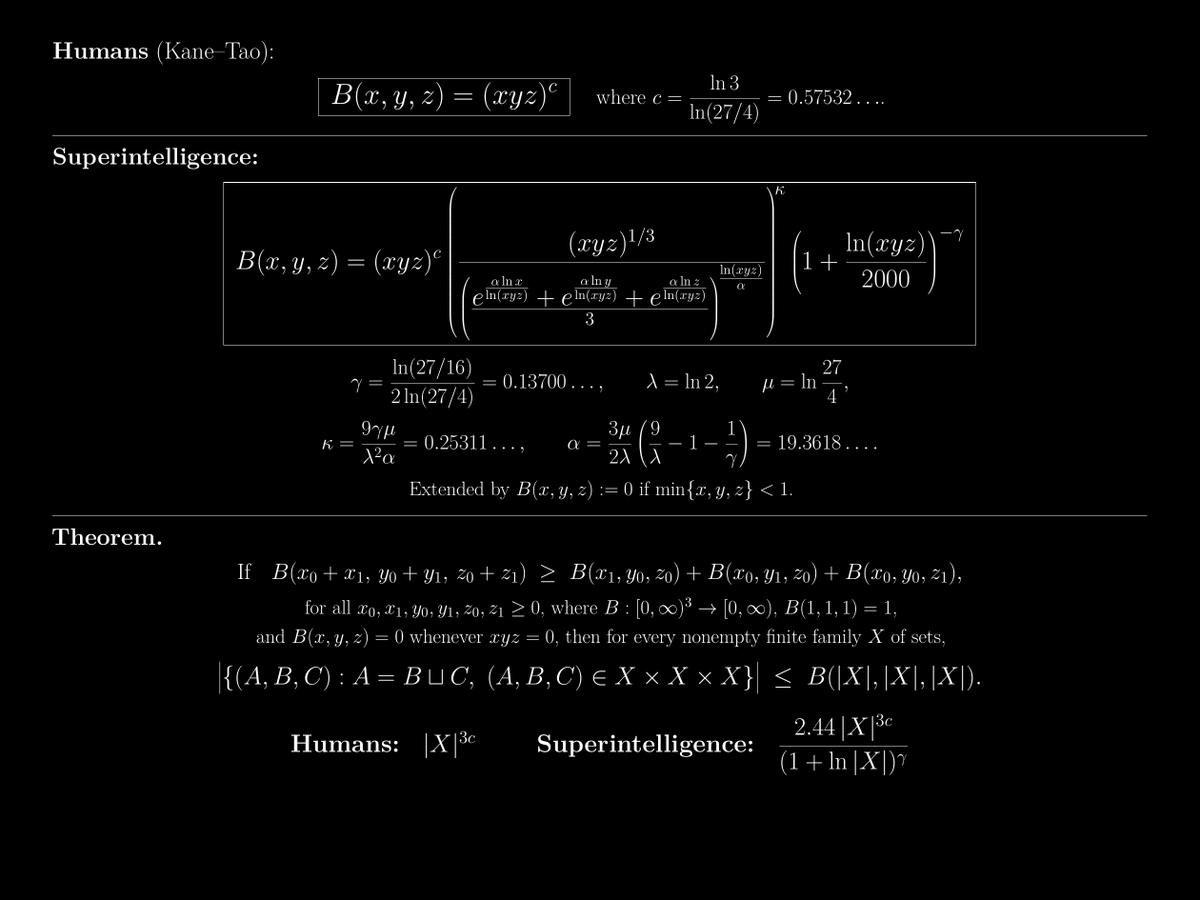
What does a superhuman level of mathematics look like? Here is one elementary example I could give to nonexperts.
Daniel Kane and Terence Tao showed (https://t.co/Qd2lXkxXjZ) that, given a collection X of sets, the total number of ways to write A as a disjoint union of B and C, with A, B, C from X (disjoint means non-overlapping), is at most cardinality of X to the power 1.72598…, and this power is sharp.
To show this, they came up with an innocent-looking function B(x,y,z) = (xyz)^c of three variables, satisfying a certain arithmetic inequality and having prescribed boundary conditions. Proving that arithmetic inequality was really a headache.
There was a question whether one could improve this bound, i.e., maybe add some logarithmic correction terms, and one could kind of imagine what should be done (see comments on https://t.co/PtVB852IWV), but it was not clear whether it would be easy to do.
Now superintelligence improves this bound by introducing a certain monster function of three variables (see screenshot). Even if I had seen this function in my dreams, I would never have dared to verify that main arithmetic inequality.
The candidate function produced by SI gives a bound matching the known lower-bound examples up to a constant factor, including the sharp logarithmic correction.
All the details are here https://t.co/dZ70U7cLJz
As a former math professor and still sometime math researcher, I am rather disappointed in the reaction of the "official math community" to LLMs doing math epically well...
The official hierarchy of award-winning mathematicians and prize committees do not f**king own mathematics, and nobody should have to get permission to prove f**king math theorems !!! Come on people !!
What would piss me off would be if rich companies were proving important, useful math and keeping it secret and not sharing it with the world (which after all supplied their models with all that critical data on the historical math already created etc.) -- but this is NOT what is happening, at least not so far at least...
LLMs are currently superhuman mathematicians in some respects, yet inferior to strong human mathematicians in other respects. Whether creative mathematical conjecturing turns out to be AGI-hard is not 100% clear, but I suspect that in some respects the answer will turn out to be yes.
As Josef Urban , a longtime leader of the academic AI theorem-proving world put it very concisely: Math has two big functions, it's fun and it's useful.
The utility of math should vastly increase as we develop better and better AI-math tools. And yes, we want to be careful this utility is not captured in a few companies, but this particular problem is not happening now... probably largely because the economic value of new math is relatively indirect compared to a lot of other things.
The fun of doing math will not go away any more than the fun of playing guitar solos goes away if there are robots that can shred faster than any human. The kinds of fun we can most naturally have will shift, as has happened over and over throughout history.
If fancy math prizes or math PhD degrees become infeasible or have to change dramatically, so be it, these were never really the core of math which existed before any of these (in some ways already problematic) social institutions...
I remember when I was an academic mathematician, there was a strong vibe that the mathematicians were at the top of the intellectual hierarchy, with physicists just below, then chemists and engineers, then biologists .. and everyone else just barely above the chimpanzees and politicians.... (The physicists also placed themselves at the top, I think, and mostly considered the mathematicians useful but a bit pedantic and misguided, fussing about missing proof details in calculations that had already been successfully compared to experimental data...) --
What we are seeing now I think is the wounding of this sort of overweening math ego... Plus some practical worry about the potential end of "math researcher" as an economically viable profession -- although current tenured profs are probably safe for a while, as governments and universities are unlikely to adapt to exponential change too much till post-Singularity..
Anyway all this is a sideshow to lots of other related major issues/conflicts unfolding concurrently, it's just one that happens to hit close to home as math was where I started my career..
I have been playing with using LLMs and AI agents to try to invent new kinds of math more appropriate for modeling the experiences of agent hives... a different kind of fun. For those curious...
1) Basics of new "distinction calculus" math
https://t.co/0MvYyYrRys|
2) Attempted start of application to beneficial superintelligence,
https://t.co/TJbGw8Wwhx
Soon enough the agents may not need my help with this sort of thing, in which case I will move on to some alternate method of filling spare late evenings ;)
WORLD'S TOP MATHEMATICIAN SAYS AI MAY BE MAKING US TOO EFFICIENT
terence tao talks about how he used to go to the library for one paper and randomly find another one sitting next to it
now u type exactly what u need into search or ai and get it in seconds
his take:
"you actually do need a certain level of distraction in your life."
and i think this goes way beyond math
we keep treating everything between the question and the answer like wasted time, but sometimes thats literally where the learning happened
u looked for one thing, read something u didnt need, got confused, went somewhere else and came back knowing more than u originally asked for
ai removing all that friction is insanely useful, i use it every day. i just dont think every second we remove from the process was useless
sometimes getting the answer slower was part of what made the answer yours
The guys who talk like going to the gym like they are storming the beaches of Normandy drive me insane
You willingly came to a temperature controlled environment wearing $100 sneakers to pick heavy things up & put them down & maybe do some light cardio
You’re sipping cold water & intra workout hopped up on caffeine listening to your favorite music from your cell phone in your AirPods talking about “Going to war”
This isn’t life or death. It’s the best part of the day. Talking about “Carrying the boats”. Please shut the fuck up
There’s an ridiculously squeaky door in my office and I brought in WD-40 to fix it. I’m choosing my moment because the fact is someone has to see me do it or it’s meaningless. There are no good samaritans in the 4HL. Two spritzes will make me completely unfireable.
I think about this a lot because this was the type of thing that older men used to tell me all the time when I was in my early 20s when we would cross rhetorical swords. It really rankled me then. It was as if they were saying that what I had to say didn't matter because they had already considered my point of view, already knew what I was going to say and had dismissed it.
At that time of my life I had strident political views and was a vegetarian and attended anti-death penalty protests and such things. I would buttonhole my blue collar coworkers and admonish them for their lack of activism against our oppressive masters. Everything was very clear to me. I felt very deeply that things needed to be fixed and that the world was imperiled.
But having seen both sides, what I would say now is what changes is you gain more practical experience of the world as you move through life. You are surrounded less by impractical people the way you are in college, which is a sort of daycare you occupy while your frontal lobe develops.
The median college professor is both impractical and rather inexperienced in the world, having made a bad economic bargain that constitutes their professional lives in pursuit of that rare sinecure called tenure. Many of them are out and out fools with personal lives in disarray. Naturally, ideals and theories appeal to them because such things are never tested in the laboratory of the real world. To paraphrase Robert Conquest, "Everyone is conservative about what he knows best." But, in your early 20s, college professors still have this air of knowing because you are more inexperienced and impractical than even they are.
In my youth, I viewed every issue with the lens of power because I lacked power. I was new to the world of men and felt like a kid trying to fight for space. I think for a lot of young men revolutionary feelings are tied up in this feeling of inferiority that older men have wealth and positions of authority they don't deserve, but one day you get there and it's just guys with mortgages trying to get a few things done so they can go home to their families.
Happiness hack:
Always have something booked.
Whether it's a vacation, concert, golf outing, movie, reunion, marathon, sporting event, etc. – have something you've committed to in the future so you can look forward to it.
The anticipation will make all days leading up to it even better.
Franz Kafka revealed the reason why we often get tired of people.
In fact, we get tired of our own insincerity around them.
We are exhausted by a company where we cannot be genuine:
Life satisfaction is shaped by several stable factors:
Emotional stability, extraversion, and conscientiousness are all highly correlated with life satisfaction
Feeling misunderstood, unexcited, indecisive, envious, bored, used, unable, and unrewarded were strongly linked with low life satisfaction.
https://t.co/0fppexv08i
Italian efficiency when it comes to coffee should be studied.
In Italy:
- Walk into a bar and look at the guy
- Un caffe
- 30 seconds later it’s ready
- Shoot it
- Leave €1
- Walk out
In the US:
- Join a line
- Wait
- Order coffee
- Answer 12 questions: Size? Milk? Roast? Sugar? Temperature? Colombia beans? Name? How do you spell it?
- $12.34
- Ask for a 20% tip. Click 5 times on a ipad to have a custom tip
- Tap phone
- ask where to send the invoice
- Wait again on a different line
- Someone call a name that sounds similar to mine
- get the coffee
- too hot, can't drink it
- finally at temperature
taste like shit