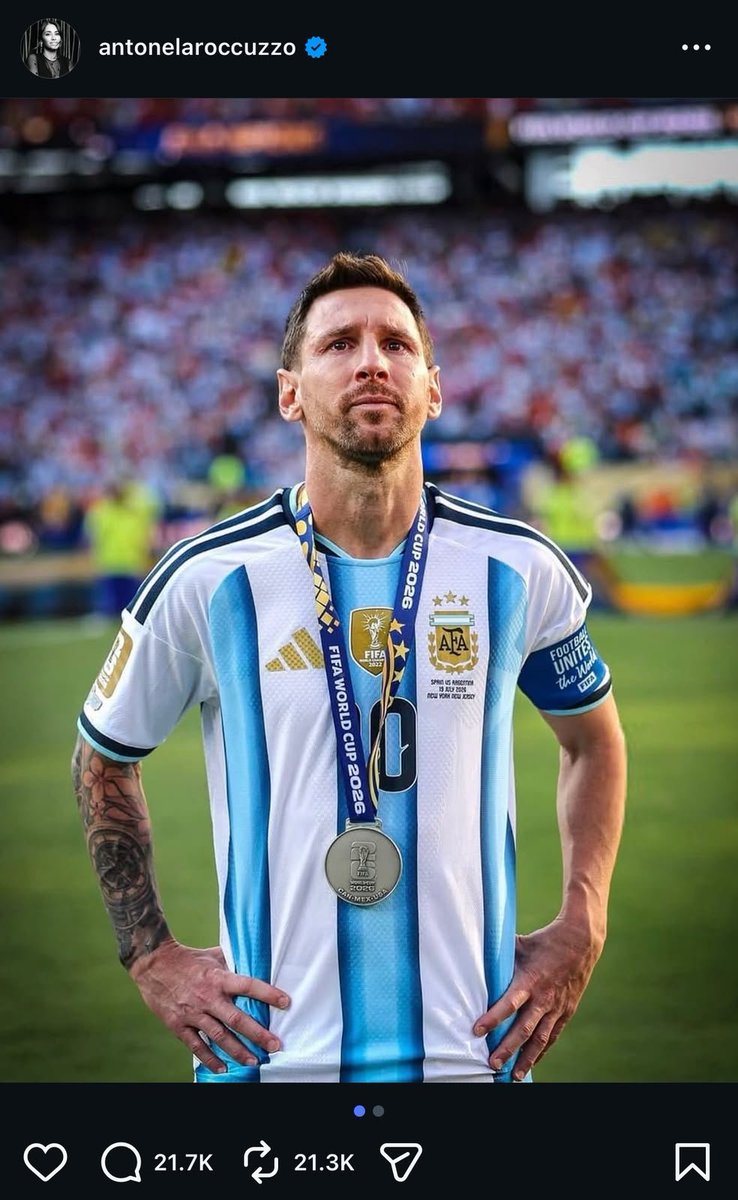
I’m going to take my time with this one. If you’re busy, save this post and read it later. Don’t miss this trust me.
I just want to put one final point on Messi’s story: football has never truly been an individual sport—except when it came to him.
Football is a team game. No matter how great you are, you still need the players around you to compete, even if the entire system is built to maximize your strengths.
Yet even with Messi, people kept repeating the same old narrative about Xavi, Iniesta, and Guardiola. The reality is that Messi only spent about four years playing with that historic generation, and even that team looked lost before Guardiola arrived. Messi contributed just as much to their greatness as they did to his.
When that generation left, Barcelona became almost entirely dependent on Messi for two years. Then Luis Enrique arrived, along with Suárez and Neymar, not to carry Messi, but to help share the burden.
After Neymar left, and with Suárez well past his best, Messi was once again carrying Barcelona almost entirely by himself, surrounded by average players. He was one game away from another historic treble, and once again, he was the team’s standout player.
Many people forget that in 2014, after Messi became La Liga’s all-time leading scorer with a hat-trick against Sevilla, Barcelona fans were handed flyers asking: “What if you woke up tomorrow and Messi was no longer at Barcelona?” Even then, some people still couldn’t bring themselves to give him the credit he deserved.
Messi even wanted to leave in 2020, and the situation nearly ended up in court. But he stayed because he didn’t want to fight the club he loved. In the end, he was still forced out in one of the saddest exits in football history.
Argentina was no different.
For years, Messi carried one of the worst-run national teams in modern football. In 2010, Maradona played Germany with four attackers because he believed more forwards meant more goals. Argentina lost 4–0.
Yet Messi was the one blamed.
He was called a failure, a choker, and a coward by people who ignored the reality that, without him, Argentina might not even have qualified for the 2014 World Cup. Every Copa América final they reached was because Messi got them there in the first place.
The difference was enormous: with Messi, Argentina reached finals; without him, they struggled even against much weaker opponents.
The 2022 World Cup wasn’t just about a great team—it was also about Messi bringing confidence, leadership, and belief to a group of players who followed him. He carried the responsibility while everyone else played their role.
Even in the latest World Cup, at 39 years old, Messi was covering huge areas of the pitch, playing 120 minutes repeatedly, and constantly finding new ways to win games almost by himself.
Most people will never care about these details or this context. Future generations will only look at trophies and short tournaments.
In the end, every argument people used against Messi eventually disappeared. They said he had no World Cup—he won it. They said he had no Copa América—he won it too.
To me, Messi is the most unfairly judged player in football history. No player has been blamed for more things beyond his control or had more false narratives attached to his name.
That’s Messi’s story—through logic, reality, and everything he had to endure.
Just think about these things for a moment. Was everything really normal?
1. Messi's family did not come to the stadium.
2. Argentina's President was expected to attend but never showed up.
3. Diego Simeone was seen in the stands during almost every Argentina match, yet he was absent from the final.
4. Lautaro Martínez was not even shown on screen for a single minute, let alone given any playing time.
5. Enzo received two yellow cards and was sent off
6. Lisandro Martínez's injury. He is the kind of player who has continued playing even while bleeding in ordinary matches, yet in a World Cup final he got injured without any apparent contact from an opponent.
7. Cristian Romero's injury.
8. Scaloni's strange substitutions.
9. Argentina failed to register a single shot on target in the first 90 minutes. Even after 120 minutes, they managed only two shots on target.
10. Spain completed nearly 800 passes, while Argentina completed fewer than 300. It is difficult to believe.
11. Argentina kept losing possession. Even when they managed to win the ball back, they often gave it straight back to Spain with their very next action. Time after time, they would bring the ball out from their own penalty area, reach midfield, and then immediately surrender possession.
12. Cristian Romero did not shake hands with Trump.
13. As of now, Messi, Julián Álvarez, De Paul, Lautaro Martínez, Enzo Fernández, and Lisandro Martínez have still not returned to Argentina.
14. Finally, Messi was not awarded the Golden Ball. By what statistical measure did Rodri deserve it over Messi?
All things considered, I have to say something happened here, just like what happened in the era of Maradona in 1990.
The Brazilian FIFA president back then simply snatched the World Cup away from Maradona. Maradona cried and said that Havelange (the then FIFA president) had taken the World Cup away from him.
Today, Infantino has perhaps done the exact same thing. Since false narratives like 'Messi, FIFA boy, rigged' were spreading throughout the entire World Cup, maybe they did this so that FIFA's image wouldn't be tarnished and the billion dollar business across Europe wouldn't be ruined.
I don't know what the truth is here, but sooner or later it will come to light. Until then, we wait....
And Ronaldo fans, listen
You guys spread anti-Messi agenda throughout the tournament. We will never forget you guys. Shame on you Loser FC.