Whatta scene it is. Padmavibhushan K.Parasaran, turned 100 today was visited by 2 ascetics&heads of 2 great spiritual organisations at his house to bless him&members of his family.His service to Sanatanadharma has earned him this punyam to get 2mahatmas visiting him on his b'day
@surjitbhalla I did a final check on UK within G7 given it’s my adopted country 😱 the US actually dominates the UK economically more than China dominates India by GDP. That immediately weakens any argument that China’s sheer size makes BRICS uniquely a “club of one”
And that is where I differ on the conclusion.
“BRICS has been dominated by China” is an observation.
“BRICS is a club of one” risks turning that observation into a destination.
The question is what happens over the next 15–25 years as India and others evolve.
We are looking at the first chapters, not the last page.
@surjitbhalla Now BRICS China’s share of the original BRICS economies actually rose from ~52% in 2010 to ~68% today. India remains ~14%.
So the historical diagnosis is difficult to dispute: BRICS has become more China-centric.
But BRICS leaders first met only in 2009.
3/4
Let us put the same lens on the G7.
It has had ~50 years to evolve. The US began at ~45% of G7 GDP, fell to ~37% as Japan, Germany and others grew, and is now back above 50%.
Economic weight within a grouping is not static. Dominance at one point does not tell us its destination. 2/4
எனது முதல் கடையைத் திறந்துவிட்டேன்! 🎉🏪 இந்தப் பயணத்தில் வழிகாட்டி ஆதரவளித்த என் பயிற்சியாளர் @Amandatlksc அவர்களுக்கு மனமார்ந்த நன்றி. உங்கள் நேர்மைக்கும் நம்பிக்கைக்கும் என்றும் நன்றியுள்ளவளாக இருப்பேன். 🙏✨
Source: Śānti Parva of the Mahābhārata
It is the story of the Cat (Lomaśa) and the Mouse (Palita)...a masterclass on the anatomy of manufactured narrative, bad-faith warfare, and algorithmic weaponization of untruth.
It reveals how a lie is not meant to convince you of a fact; it is engineered to fill the void of immediate attention before truth can mobilize.
In a dense forest, a hunter laid a tightly woven wire-net (Jāla) to catch wild animals. A cat named Lomaśa, hunting carelessly, walked straight into the net and got trapped.
Seeing the cat helpless, a small mouse named Palita came out of his hole to feast on the hunter's leftover meat. But as Palita looked up, he realized he was caught in a lethal matrix:
- Ahead of him was the trapped cat, waiting to kill him.
- On the branch above was a mongoose (Luluka) watching him.
- In the tree hollow nearby was an owl (Candraka) ready to swoop down.
Palita was completely surrounded by predators. He realized that the owl and the mongoose were waiting for him to make a single move, while the hunter was approaching in the distance with drawn weapons.
Palita did not appeal to morality. He walked directly up to the trapped cat, Lomaśa, and offered a cold, strategic deal:
"I will gnaw through the hunter's ropes and free you from this trap. In return, you must shield me from the owl and the mongoose under the false pretence that we are allies."
The cat agreed instantly. Palita crawled under the warm fur of the trapped cat.
When the owl and the mongoose saw the mouse sitting comfortably under the cat's belly, they saw a "narrative" that defied all natural laws: The cat and mouse are friends.
They did not know the net was there, nor did they know the mouse was gnawing the ropes. The illusion was so immediate, loud, and jarring that both the owl and the mongoose assumed the alliance was absolute, panicked, and fled the scene.
The lie worked instantly....
It filled the cognitive space, scared away the immediate threats, and gave Palita time to operate.
As Palita sat under the cat's belly, he gnawed through every single rope of the hunter's trap except for the very last strand. Lomaśa, seeing the hunter approaching in the distance, began to panic and hissed at the mouse:
किं सौम्य नाभित्वरसे किं कृतार्थोऽवमन्यसे I
छिन्धि पाशानमित्रघ्न पुरा श्वपच एति सः II
O gentle one, why are you not hurrying? Why do you neglect (your duty), as if your purpose has been accomplished? Cut the snares, O destroyer of enemies, before that dog-eater arrives!
Palita gave an answer that should be carved into the walls of every modern intelligence agency and digital war room:
"A wise man performs an action only at the exact microsecond of its strategic alignment. If I cut your final rope now, while you are hungry and strong, you will eat me before you flee. I will hold the final truth until the hunter steps into the clearing."
Palita waited until the hunter's bow was drawn and his shadow fell over the net. Only at that final microsecond did Palita bite through the last strand. The cat bolted up a tree in sheer terror, the mouse darted into his hole, and the hunter was left standing with an empty, broken trap.
Modern SM algos are hardwired to amplify high-rage, simple, shocking narratives...they act like the forest animals, reacting instantly to the illusion before checking if the net exists.
When political bad-faith actors launch a coordinated lie, they know fact-checkers will take 24 hours to research, verify, and publish a detailed report. By the time the truth arrives, the "owl and mongoose" (the voters/public opinion) have already reacted and moved on. The lie achieved its immediate tactical goal.
Palita teaches us that you do not try to counter a fast lie with slow, defensive explanations while you are still inside the enemy's trap.
The counter-strike must be a structural, high-precision release of ground truth that shatters the entire framework at once.
The Vālmīki Rāmāyaṇa preserves three distinct geographical routes to Laṅkā—Rāvaṇa’s route after abducting Sītā, the route of the vānara search party led by Aṅgada and Hanumān, and Rāma’s route with the vānara army.
1. Rāvaṇa’s route:
Sītā was abducted at Pañcavaṭī, identified with the Nashik region. Rāvaṇa then proceeded southward along the Western Ghats, crossing the Kiṣkindhā–Pampa region (Belagavi).
Vālmīki explicitly states that, “having crossed Pampa” (paṃpām atikramya), Rāvaṇa proceeded facing Laṅkā (laṃkām abhimukhaḥ purīm) (VR 3.54.5).
Pampa therefore marks a definite point on Rāvaṇa’s southward route.
2. Aṅgada–Hanumān’s search route:
The vānara search party moved southward from the eastern Vindhya region toward the southern ocean. Sampāti instructed them to proceed to the southern shore (dakṣiṇam tīram), but the text records them as reaching the northern side of the southern ocean (uttarām diśam) (VR 4.64.4).
They therefore did not approach the south of the Palk reservoir (Check my pinned tweet for details). They reached the northern side of Kavāṭam where the partially submerged Mahendragiri existed (VR: 4-41-18 to 20 & VR: 4-67). From that Mahendragiri, Hanumān crossed the ocean to reach Trikūṭa (Laṅkā).
3. Rāma’s route:
Rāma and the vānara army travelled southward through the Sahya and Malaya ranges of the Western Ghats. They then climbed a peak named Mahendra (VR 6.4.95), from whose summit Rāma saw the ocean.
The text places this Mahendra within the mountain route before the army descended toward the coast. The sea visible from this Western Ghats vantage point is therefore the Arabian Sea, not the Bay of Bengal.
This identifies the Mahendra of Rāma’s route with the Anginda Peak in the Nīlgiri–Silent Valley sector. Rising to about 2,383 m and situated close to the Palghat Gap, it provides a clear elevated view toward the Arabian Sea, roughly 50–60 km away.
From Mahendra, Rāma and the vānara army descended through the Palghat region, proceeded across the southern plains to Rāmeśvaram, constructed the Setu, crossed the southern shore of the Palk reservoir and proceeded to Trikūṭa, the mountain of southern Laṅkā.
Thus, the Rāmāyaṇa gives us three separate routes to Laṅkā:
Rāvaṇa:- Pañcavaṭī → Pampa → Laṅkā
Aṅgada–Hanumān:- Vindhya → Kavāṭam → Mahendragiri → Laṅkā
Rāma:- Sahya → Malaya → Mahendra → Palghat → Rāmeśvaram → Setu → Laṅkā
The geographical clues are in Vālmīki’s text. The task is to follow those clues rather than impose the modern map upon them. The geography of the Rāmāyaṇa deserves to be reconstructed from the text itself—not from modern assumptions about where Laṅkā “must” have been.
For more details, check my book 'Ramayana 5114 BCE'.
Check the first comment for my interview on this topic. My voice was hoarse at the time due to an illness, so please excuse the voice quality.
#Ramayana_5114BCE
Did Vālmīki ever say that the Rāma Setu ran north–south?
There are only two relevant references to the southern shore (dakṣiṇaṃ tīram / dakṣiṇaṃ pāram):
Sampāti tells the vānaras to proceed to the southern shore.
On reaching the seacoast, Rāma wonders how they can cross the ocean and reach the southern shore.
That is all.
Yet, interpreting the ancient geography through the lens of modern coastal orientations, researchers have often looked past the Rāma Setu, which runs broadly east–west, and shifted the search for Laṅkā and the Setu to locations far to the south—even towards the equatorial region or Gujarat.
But have they transported themselves to Vālmīki's geographical world? No.
Now, important scientific research is providing another perspective.
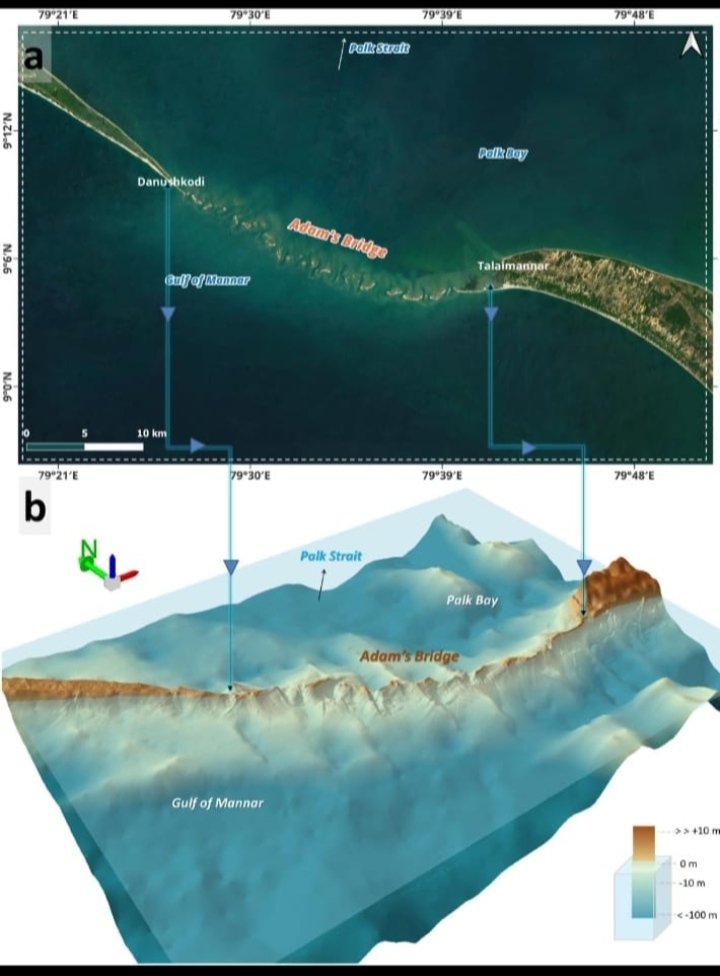
Bathymetric research of the Palk Strait by Dubey et al. indicates that the Palk region was not simply an open extension of the Bay of Bengal. It contained a vast freshwater reservoir, about 35 m deep and ~15,000 sq. km in extent, bounded by Rāmeśvaram, Pāmban, intervening shallow stretches of land and Talaimannar.
Those shallow stretches are significant. According to the research, people could have used this region as a causeway until around 7,000 years ago, before a sudden rise in sea level inundated its boundaries.
Now reconsider Vālmīki's words.
When Sampāti speaks of the southern shore, why assume he meant some distant southern coastline? The southern boundary of this Palk reservoir provides a much more immediate geographical meaning.
The vānaras, led by Aṅgada, had already traversed the coastal region. The southern shore offered the shortest practical route towards Rāvaṇa's Laṅkā in southern Sri Lanka.
When they reached Rāmeśvaram, however, the ancient pathway was no longer completely above water. Hence Rāma's question: How are we to cross the ocean and reach the southern shore?
The solution was the Setu.
And setu means a bund, embankment, causeway or structure enabling passage across water.
In this interpretation, Rāma was not constructing an imaginary bridge across the entire sea. He was strengthening or raising the shallow, partially submerged causeway across the Palk reservoir so that the vānaras could cross.
This also gives us a potential chronological marker.
If the scientific evidence indicates that the southern boundary of this ancient freshwater reservoir was inundated around 7,000 years ago, it provides an important environmental clue for dating the Rāma episode.
The point is not to force modern geography upon Vālmīki.
It is precisely the opposite:
Let Vālmīki's words lead us to the ancient geography—and then see whether geology and bathymetry support it.
More such evidence is discussed in my book Ramayana 5114 BCE: Decoding the Date and Myths.
Study the Bharateeya past through its own texts, geography and scientific evidence.
Our history deserves investigation—not dismissal.
#Ramayana_5114BCE
Where exactly was Ravana’s Lanka? Was it somewhere in the Narmada region, as some researchers claim?
The Azhwars give a clear answer.
In 25 hymns, they refer to Ravana’s Lanka as being in the south. Thondaradipodi Azhwar, in Thirumalai (19), places Lanka to the south of Srirangam. Nammalwar, in Thiruviruththam (77), also describes Lanka as being in the southern direction.
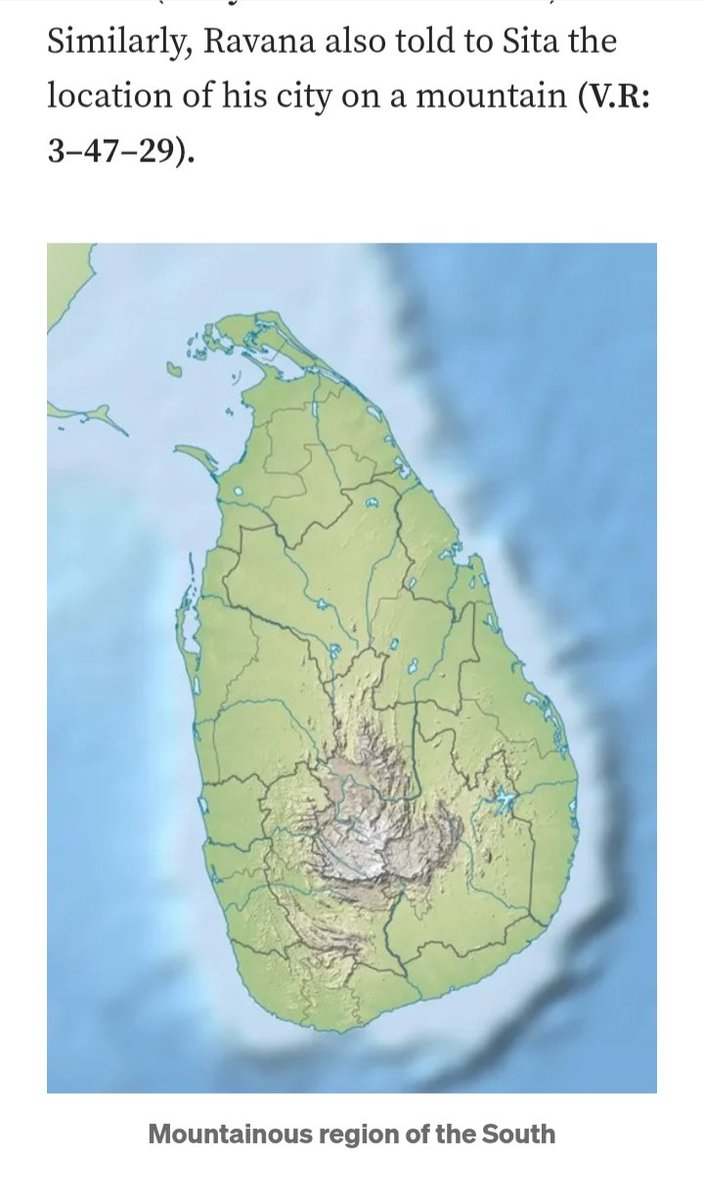
The Azhwars mention Lanka in 134 hymns, of which 22 describe it as surrounded by the sea. The Valmiki Ramayana too places Lanka across the sea; Ravana himself tells Sita that Lanka is in the midst of the sea (VR 3.47.29).
The Azhwars’ testimony is just one among the many primary references I have examined. Please refer to my article here to know more about Ravana’s Lanka: Locating Ravana’s Lanka https://t.co/Bc4BTj5D72
For complete details, refer my book Ramayana 5114 BCE
Vedāntago brāhmaṇaḥ syāt, kṣatriyo vijayī bhavet |
Vaiśyo dhana-samṛddhaḥ syāt, śūdraḥ sukham avāpnuyāt ||
“Whoever hears or recites this daily…” is followed by benefits for all four varṇas. Therefore, the Phala Śruti includes all four in hearing and reciting the Viṣṇu Sahasranāma.
No large AI lab. No big engineering team. No venture-scale budget. Just a professor's conviction that one of humanity's oldest knowledge traditions deserves modern, open infrastructure.
I was fourteen, walking home from school in Paris with my French-American friend. Summer was around the corner and the heat was relentless.
‘You must be used to this heat,’ she said.
‘Not really,’ I replied. ‘We lived in the hills in India before we came to Paris.’
‘Hills? I didn’t know India had hills.’
‘We have the Himalayas,” I had replied. ‘The highest mountains in the world.’
She stopped dead.
‘You’ve got to be kidding! The highest mountains are in America.’
That expression of absolute certainty is etched into my memory even today.
Twenty years later, when I met her again in New York, I reminded her of that conversation. We couldn’t stop ourselves from laughing.
So anyway that afternoon we went home, and I opened my Philips Atlas and showed her the Himalayas.
‘You know,’ she said thoughtfully, ‘ I’d always wondered about that weird name. I just assumed it was some Native American name.’
A few weeks later, in geography class, while studying the Alps, our teacher announced they were the highest mountains in the world.
My newly enlightened friend proudly corrected her.
‘Actually, the Himalayas are.’
The teacher shot me a look that instantly identified the culprit behind this inconvenient fact.
Then, without missing a beat, she recovered.
‘Yes… but the Himalayas are the newest highest mountains. The Alps were the oldest highest mountains.’
Case closed.
At fourteen, I learnt one of life’s great lessons: The West doesn’t just write history, geography, science. It often decides it.
If something is ancient, extraordinary or foundational, somehow it must have originated in Europe or at the very least be explained through a European lens.
The Rig Veda became “Aryan.” A Middle Eastern Jew named Jesus acquired blond hair and blue eyes.
Even Panini, at one point, seemed to belong to everyone except India.
Now, apparently, Panini is Pakistani.
Progress, I suppose.
From ‘ that’s impossible’ to ‘it was ours all along.’
The script changes. The narrator doesn’t.
#SundayMusings