I see only two major challenges for AI to fully replace humans in white-collar jobs.
1. Energy infrastructure
2. Token costs
Most of the other current limitations will improve over time, but these two will be difficult to overcome in near future. If the Energy infrastructure challenge is resolved, token costs may also go down.
"The hardest truth is that your greatest work may be seen by no one, and yet you must do it anyway for the one who watches is you."
— Friedrich Nietzsche
Out of 27 lakhs, not even 27 came forward and claimed that their name isn't present in the voter list.
So calm down, find something better to hide your tears.
The most underrated act of kindness is simply letting people be. Let them mispronounce a word, talk too much about a show they love, or get excited about something you don't quite understand. Everyone has something that lights them up, let them shine, even if it's not your thing.
Hedy Lamarr was the highest-paid actress in Hollywood.
In 1942, she filed a patent that became the foundation of WiFi, Bluetooth, and GPS.
The Navy seized it and told her to sell war bonds instead.
Here's the full story:
Allied torpedoes ran on one frequency. The Nazis jammed them every time.
Lamarr teamed up with composer George Antheil. Together they hopped between 88 radio frequencies. Same number as piano keys.
The Navy classified her as "an alien with ties to a foreign adversarial power."
Twenty years later, the Navy quietly used her tech in the Cuban Missile Crisis. Today her concept is worth $30 billion.
In 1997, Lamarr won the EFF Pioneer Award. She was 83. Her reply: "It's about time."
She died three years later.
Hollywood saw a face. The Navy saw a foreigner. Neither saw an engineer.
The people who decide what counts as genius are rarely the ones producing it.
What idea have you seen dismissed because of who proposed it?
One lens: when an institution rejects an idea then later adopts it, the rejection was never about the idea.
I made a free toolkit breaking down 100+ mental models used by history's greatest thinkers.
5,000+ downloads. 113 five-star reviews.
Grab your free copy here: https://t.co/u2q1uUm9vD
If you're new here, @GeniusGTX is a gallery for the greatest minds in economics, psychology, and history. Follow along for more similar content.
— National WWII Museum, https://t.co/gEtHifqMHR | Data: US Patent #2,292,387, EFF
There's a forest in Utah where every single tree is actually the same tree. 47,000 trunks growing out of one giant root system, all clones of the same parent. The whole thing weighs about 13 million pounds, around 40 blue whales worth. It's called Pando, and it's been alive for around 80,000 years. Humans hadn't even started painting in caves yet when this thing took root. It's the heaviest living thing on Earth.
Trees do some properly weird stuff. When a giraffe starts eating an acacia tree in Africa, the tree releases a warning smell into the air within minutes. Other acacia trees nearby pick up that smell and immediately start pumping bitter chemicals into their own leaves, before the giraffe even gets there. Giraffes have actually figured this out and learned to walk upwind, so they can get a few bites in before the trees notice them.
In 1997, a Canadian scientist named Suzanne Simard found that trees in a forest are connected to each other underground, through a giant web of tiny fungus threads that link them all together. Her experiments showed that one tree can send food and chemical messages to another tree through this fungus network. The press nicknamed it "the wood wide web." Some of the bigger claims about trees being one happy family are still being argued over by scientists, but the basic idea, that trees pass signals to each other underground, is now solid science.
And some live for thousands of years. There's a tree in California called Methuselah, a kind of pine, that is almost 4,860 years old. It was already 200 years old when the first Egyptian pyramid was built. There's another one growing nearby that scientists think is over 5,000 years old. Both were already ancient when Stonehenge went up.
Trees also do something to your body when you're around them. A Japanese researcher named Qing Li ran an experiment. He had people spend a few days walking in forests, then took their blood. The cells in their immune system that fight off viruses and tumors had jumped sharply, and the boost lasted for over a week after they got home. He had another group take the same kind of trip but to a city instead. They got nothing. The trees were releasing some kind of compound into the air that the city didn't have.
The tallest tree in the world is in California too, a coast redwood named Hyperion. 381 feet tall (taller than the Statue of Liberty), around 700 years old. A single trunk holds 550 million leaves. You're sharing the planet with all of this.
Singapore has more than 20 semiconductor fabs on a 720 sq km island.
Not one of them is owned by a Singaporean company. Every single fab belongs to a foreign multinational. That's the strategy.
But it's the wrong strategy for India. 🧵
Two MBA graduates tried to export one container of rice. The government portal asked them to re-upload a document. There was no field to do it.
The workaround was an email address listed nowhere on the site. Without knowing someone, their first export would have died there. 🧵
Exceptional people are rare. When you find someone wonderful, invest in them.
-When you find a great employee, pay them well.
-When you find a great friend, prioritize the relationship.
-When you find a great spouse, out-love them each day.
Relationships are probably the most important part of life. Take care of the great ones.
In 1942, the Japanese rounded up all Chinese men in Singapore.
They were filtering out the healthy young ones to execute.
Lee Kuan Yew was 18. A guard pointed at him and said: "Go to that lorry."
He knew what that meant. The lorry went to the beaches. The beaches meant machine guns.
He asked: "Can I collect my other things?"
They said yes.
He walked away, found his family's gardener, and hid in his quarters for two days.
When they changed the screening inspectors, he tried again. This time, he got through.
The ones sent to that lorry were taken to the beaches and shot. Somewhere between 50,000 and 100,000 didn't survive.
60 years later, he sat down at Harvard to explain how he built Singapore from a tiny island into one of the wealthiest nations on Earth:
On what the war did to him:
"We lived in happy, placid colonial Singapore in the 1920s and 30s. The British Empire would have lasted another thousand years, so we thought."
Then the Japanese came. In less than one and a half months, the British collapsed.
"Three and a half years of hell. Butchery. Brutality. Many didn't survive. I was fortunate. I did."
"But it changed us."
"What right did they have to do this to us? Why did the British let us down so badly?"
When the war ended, Lee went to Cambridge to study law. But he was watching with different eyes.
"Can they govern me better than I can govern myself? Because they scooted when the Japanese came in. And why shouldn't I be running the place?"
On learning languages to lead:
Lee was the best speaker in English. But only 20% of Singapore spoke English.
The masses spoke Hokkien, Mandarin, and Malay.
"So every day at lunchtime, instead of having lunch, I would sit down with a Hokkien teacher and laboriously and painfully learn to convert my Mandarin into Hokkien."
"Had I not mastered that, the battle would be lost by default."
His first speech in Hokkien, the kids laughed at him.
"I said, please don't laugh. Help me. I'm trying to get you to understanding."
By 6 months, he could get his ideas across. By 2 years, he was fluent.
"Believe it or not, at the end of two years I could speak better than most of them."
"That came respect."
It showed two things: how determined he was, and how sincere. Here was a man doing all these other things and still learning their language just to talk to them.
On fighting the Communists:
The Communists had been organizing since 1923. The year Lee was born.
"Here we were in the 1950s trying to beat them. And they are professionals at organization."
They had elimination squads. Guerrillas in the jungle. Killer squads in the towns.
Lee stood up and said no.
"They denied that they were Communists. 'We're just left-wing socialists.' So I did a series of 12 broadcasts to set the scene. And I made it in three languages."
English. Malay. Mandarin. 20 minutes each.
"When I finished each broadcast, the director of the station couldn't see me. Went into the room and found me lying on the floor trying to recover my breath."
"But it was a fight for survival. Life or death."
On where trust comes from:
"It's difficult to establish trust in times of calm. You just say, 'Well, it's an argument, therefore I'm a better guy than you.'"
"But when the chips are down and you can get eliminated in a very unpleasant way and you show that you're prepared for it and you'll fight for them, it makes a difference."
"Without that trust, we could not have built Singapore."
On IQ vs EQ:
Harvard asked him: would you prefer high IQ or high EQ in a leader?
"IQ, you can get beautiful paper done. Complex formulas worked out. Elegant solutions."
"But when you've got to get a team to work and put that formula into practice, you're dealing with human beings."
"If you're not good at EQ, you can't sense that A doesn't get on with B, and you put them in the same team. It's no good."
He rated his own EQ as 7 or 8 out of 10. His IQ as "maybe 120."
But he had colleagues who could sense a person instantly.
"He shook hands with the man and said, 'I recoiled when I felt his palm. Evil man.' And he was. How does he know? I don't know."
"So I learned whenever I had to do interviews to choose people, I would get people who are very good at seeing through a candidate."
On corruption:
Singapore in the 1950s was full of deals, bribes, and organized crime.
"When we took over, we decided that this was the critical factor. If we did not make it so that every dollar put in at the top reaches the ground as one dollar, we're not going to succeed."
"We came in and made a symbolic act. We dressed in white shirts, white trousers, and said we will be what we represent."
He put the anti-corruption bureau under his personal portfolio.
"I gave the director the authority to investigate everybody and everything. All ministers. Including myself."
One of his own colleagues took half a million in bribes. When the investigation started, he asked to see Lee.
"I said, if I see you then I'll be a witness in court. So best not see me. Better see your lawyer."
The man committed suicide. Left a note saying: "As an oriental gentleman who believes in honor, I have to pay the supreme price."
"It's a heavy price. But it reminds every minister that there are no exceptions."
On consistency:
Lee had three journalists analyze 40 years of his speeches.
He asked them: what was the dominant theme?
All three said the same thing: consistency.
"What I said at the beginning, throughout all that period, the theme stayed loud and clear."
"That made it simple. Because you know where you stand with me. And you know what I want to do."
On delivering results:
"We deliver the homes, the schools, the jobs, the hospitals."
"Today, 98% of our people own their own homes. The smallest would be about $100,000 US. The biggest about $300,000."
"Once you own that amount of assets, you are not in favor of risking it with a crazy government. Your assets will go down in value."
"But that was planned."
Why? Because Singapore is small. Everyone does national service. If you're going to fight, you better be fighting for something you own.
"So we give everybody a stake."
On changing culture slowly:
Lee wanted Singapore to speak English. But he couldn't force it.
"Had I passed a law and said you will all learn English, we would have had mayhem. Riots."
Instead, he let parents watch who got the best jobs. The jobs were already there, from the multinationals and banks. They all used English.
"They watched and saw who got the best jobs. And they switched."
It took 16 years.
"I did not want to have said 16 years. Because in those 16 years I lost 20,000 Chinese graduates who had poor jobs. I wanted to make it shorter. I couldn't. I would have run into flack."
On whether leadership can be taught:
Lee quoted Isaac Singer, the Nobel Prize winner for Yiddish literature.
Someone asked Singer: "Can you make a writer write great literature?"
He paused. Then said: "If he has the writer in him, I will make him a good writer in a shorter time."
Lee's version:
"Can you make a leader of anybody? I don't think so."
"He must have some of the ingredients. He must have that high energy level. He must have the ability to project himself, his ideas. He must have the desire, almost instinctively, to say 'let's do something better.' Of wanting to do something for his fellow men and not just for himself and his family."
"You can't teach those things. He's either got it or he hasn't got it."
"But if he's got that, then you can save him a lot of trouble."
On sustaining yourself:
Harvard asked how he managed despair over decades of leadership.
"If your message is one of despair, then you should not be a leader. You must give people hope."
"But there are moments when you feel very down. Either because you're physically down, or emotionally down, or because the world has turned adverse against you."
"When you are in that condition, the first thing you do is get a good night's sleep. Then get a swim or chase a ball. Get the cobwebs out of your mind."
"If you're not fit, you're going to make mistakes. Physically fit. You must stay physically and mentally fit."
In his later years, he learned to meditate.
"At the end of 20 minutes to half an hour, my pulse rate can go down from 100 to about 60. You can feel yourself subside. You still your mind. You empty your mind."
"Then when you are rested, you resume quietly. You still got the same problems. Maybe you sleep on it. Come back. Look at it for a few days. Then decide."
This 2 hour Harvard interview will teach you more about leadership than every business book you've read combined.
Bookmark & give it 2 hours this weekend, no matter what.
Your body replaces 98% of its atoms every year. Within five years, every single one is swapped out. The you from 2021 is physically gone. Not "mostly gone." Gone. The atoms that used to be your face are now part of the air, the ocean, somebody else's lunch.
Oak Ridge National Laboratory proved this in 1953. Your skin right now is about a month old. Your liver, six weeks. Your stomach lining regrows every five days. Your skeleton is completely different from ten years ago. A few atoms do stick around for life, buried in some brain cells, in parts of your heart, and in your tooth enamel. Scientists at the Karolinska Institute in Sweden tracked them using leftover radiation from 1950s nuclear bomb tests. The oldest surviving piece of "you" lives in your brain, your heart, and your teeth.
Your brain is also erasing you. On purpose. A neuroscientist named Ron Davis at Scripps Research found that the brain has cells that release dopamine, the same chemical you feel after a good meal or a win, and use it to dissolve memories. When his team shut these cells off in test animals, they remembered twice as much. The chemical behind your best feelings is the same one shredding your past, and it never stops running.
Ebbinghaus proved this back in 1885. You lose about half of everything you learn within one hour. A 2020 study from Baycrest's Rotman Research Institute had people live through a real experience and then checked how much they kept. At best, about a quarter. 75% of the details of your own life are being actively wiped by the organ that is supposed to be keeping track of it all.
The universe is 13.8 billion years old. Squeeze all of it into one calendar year, with the Big Bang on January 1st, and humans show up at 11:52 PM on New Year's Eve. Your whole life, every birthday and breakup and boring Tuesday, lasts 0.17 seconds on that calendar. Not even long enough to blink.
Stars will keep burning for about a hundred trillion more years, then the fuel runs out and the lights go off everywhere. The last things left will be black holes, places where gravity is so strong not even light can escape. Even those slowly leak away over a number of years so large you would need a hundred zeros to write it. After the last one is gone, nothing is left. No light, no warmth, nothing bumping into anything else, ever again. The universe reaches total stillness and stays there. Forever.
Brian Cox once described the window where life can even exist as one-thousandth of a billion billion billionth, billion billion billionth, billion billion billionth of a percent of the universe's total run time. You are in that window right now. Built from borrowed atoms, running on a brain shredding its own records, here for a fifth of a second on a cosmic calendar that ends in permanent silence. Anyway, hope your Tuesday is going alright.
That's Ahmedabad for you.
When the traffic signal was red, a chana chor garam (an Indian snack) vendor was passing by where one of the strings broke and all of it fell down on the road.
This felt personal to people around this.
People helped him out to put his stuff back, asked about the damage and contributed to give him ₹2000 instantly.
All of this happened within ~ 130 seconds.
Such stories must be appreciated.
Well done Amdavad..!!
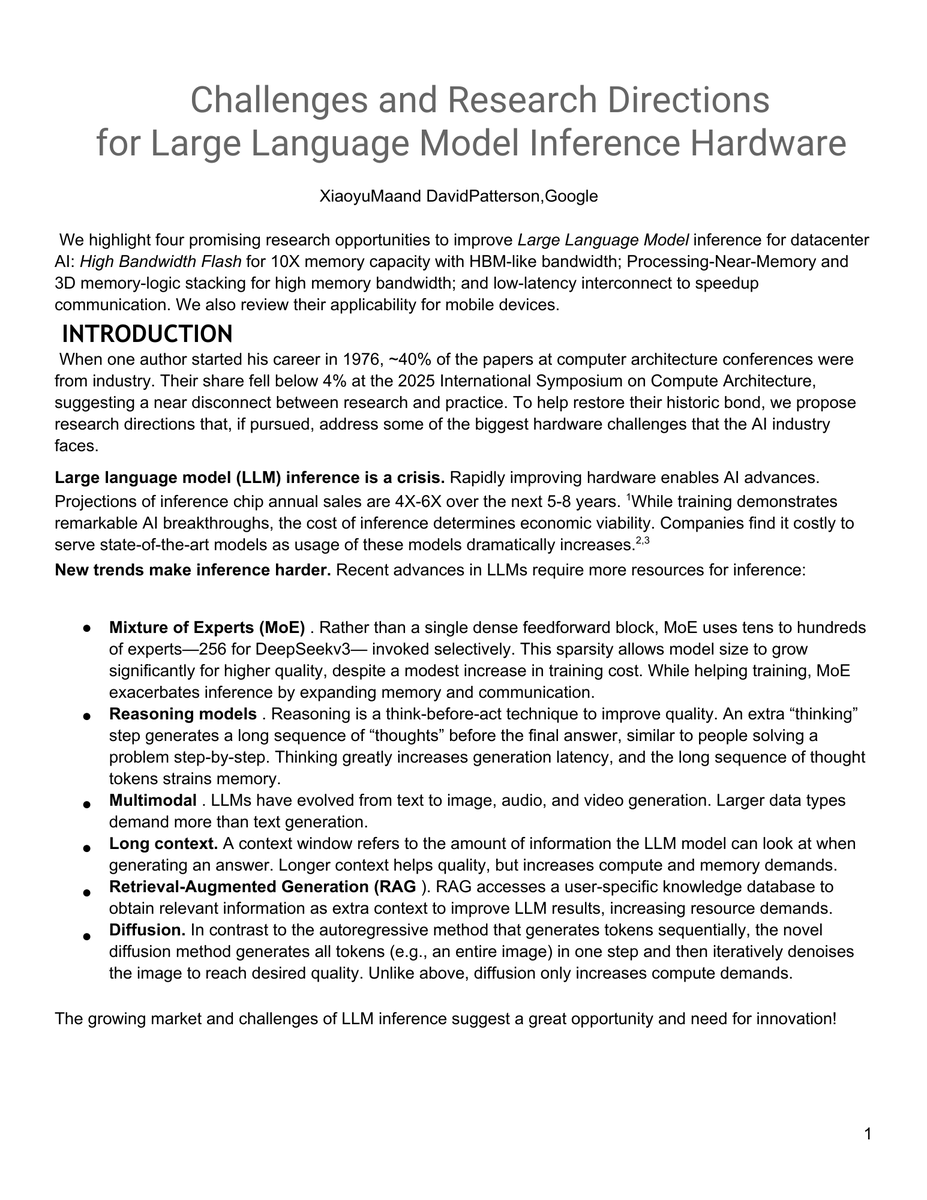
🚨 BREAKING: A Google researcher and a Turing Award winner just published a paper that exposes the real crisis in AI.
It's not training. It's inference. And the hardware we're using was never designed for it.
The paper is by Xiaoyu Ma and David Patterson. Accepted by IEEE Computer, 2026.
No hype. No product launch. Just a cold breakdown of why serving LLMs is fundamentally broken at the hardware level.
The core argument is brutal:
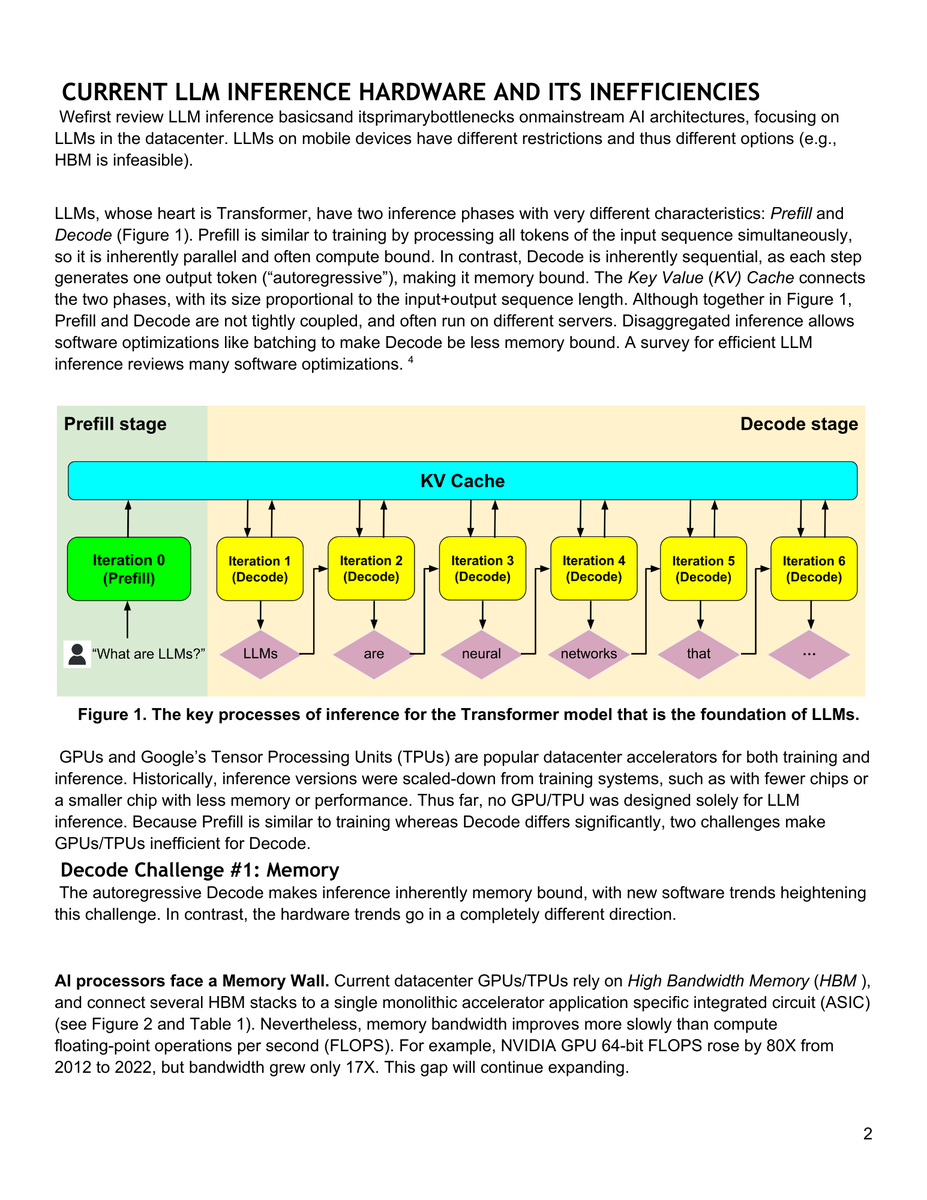
→ GPU FLOPS grew 80X from 2012 to 2022
→ Memory bandwidth grew only 17X in that same period
→ HBM costs per GB are going UP, not down
→ The Decode phase is memory-bound, not compute-bound
→ We're building inference on chips designed for training
Here's the wildest part:
OpenAI lost roughly $5B on $3.7B in revenue. The bottleneck isn't model quality. It's the cost of serving every single token to every single user. Inference is bleeding these companies dry.
And five trends are making it worse simultaneously:
→ MoE models like DeepSeek-V3 with 256 experts exploding memory
→ Reasoning models generating massive thought chains before answering
→ Multimodal inputs (image, audio, video) dwarfing text
→ Long-context windows straining KV caches
→ RAG pipelines injecting more context per request
Their four proposed hardware shifts:
→ High Bandwidth Flash: 512GB stacks at HBM-level bandwidth, 10X more memory per node
→ Processing-Near-Memory: logic dies placed next to memory, not on the same chip
→ 3D Memory-Logic Stacking: vertical connections delivering 2-3X lower power than HBM
→ Low-Latency Interconnect: fewer hops, in-network compute, SRAM packet buffers
Companies that tried SRAM-only chips like Cerebras and Groq already failed and had to add DRAM back.
This paper doesn't sell a product. It maps the entire hardware bottleneck and says: the industry is solving the wrong problem.
Paper dropped January 2026. Link in the first comment 👇