Teach AI your way of thinking.
Introducing Amazon SageMaker AI's new serverless model customization capability with AI agent guided workflow in preview that can transform months of development into days. Customize AI models to match your exact requirements.
🚨 In and Out of Possession Formations 🚨
In #FM26, you'll choose two formations rather than one. Unlocking a world of new possibilities for your team's shape with and without the ball.
Discover Tactics upgrades 📖
🚨 Every player role coming to #FM26 appears to have been accidentally revealed via a file on SI's FMDB website.
🧐 See the pics with roles for 3 positions.
✅ Full assessment (40+ new or renamed roles), plus role comparisons & spicy combos to try.
➡️ https://t.co/ljUPPnVLO2
Veri bilimi bugünün modası. Ancak unutmamak gerekir ki Ekonometri zaten yüzyıldır bu işi yapıyor!
Ekonometri, modern veri biliminin sessiz kahramanıdır.
Aşağıdaki makale de bunu oldukça iyi bir şekilde ele alıyor…
🔗 https://t.co/O6KDULbNTz
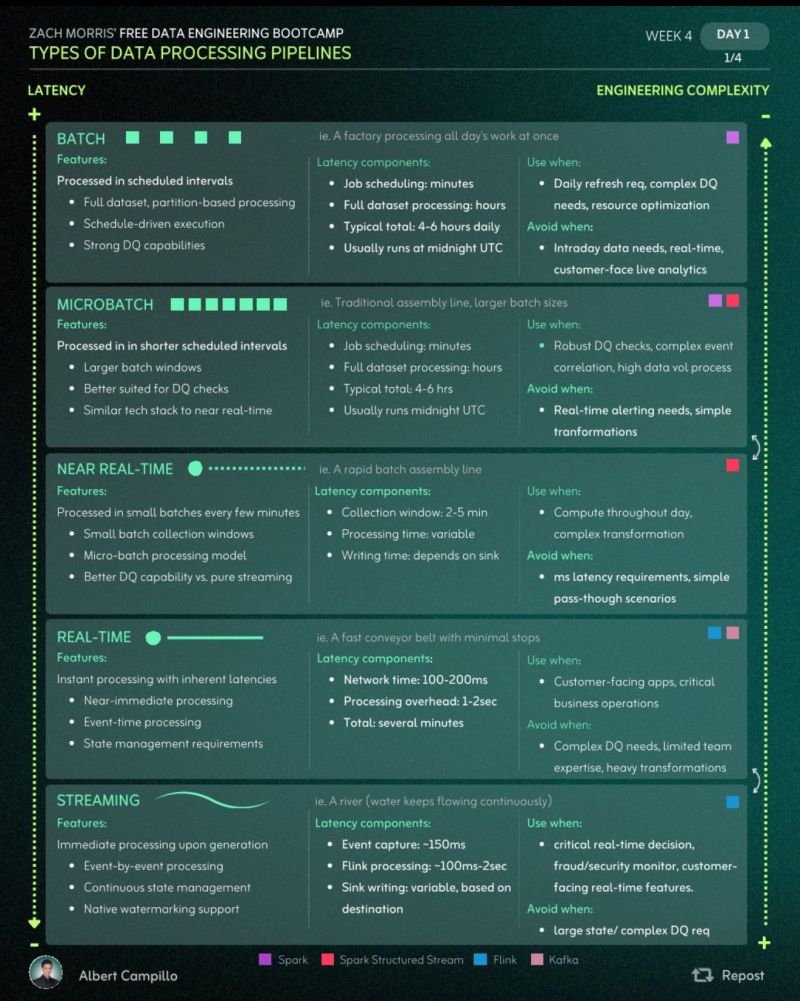
Stop building streaming pipelines when your stakeholders request “real time” data!
When they ask for realtime, always ask for acceptable latency:
If the acceptable latency is >=1 hour, please just use batch!
If the acceptable latency is between 10 minutes and 1 hour, use microbatch!
If the acceptable latency is between 1 minute and 10 minutes, use near real time!
Only if the acceptable latency is in the seconds or milliseconds should you be busting out streaming pipelines!
Join the free boot camp here: https://t.co/y5SbRHdTED
Today we launched a new product called ChatGPT Agent.
Agent represents a new level of capability for AI systems and can accomplish some remarkable, complex tasks for you using its own computer. It combines the spirit of Deep Research and Operator, but is more powerful than that may sound—it can think for a long time, use some tools, think some more, take some actions, think some more, etc. For example, we showed a demo in our launch of preparing for a friend’s wedding: buying an outfit, booking travel, choosing a gift, etc. We also showed an example of analyzing data and creating a presentation for work.
Although the utility is significant, so are the potential risks.
We have built a lot of safeguards and warnings into it, and broader mitigations than we’ve ever developed before from robust training to system safeguards to user controls, but we can’t anticipate everything. In the spirit of iterative deployment, we are going to warn users heavily and give users freedom to take actions carefully if they want to.
I would explain this to my own family as cutting edge and experimental; a chance to try the future, but not something I’d yet use for high-stakes uses or with a lot of personal information until we have a chance to study and improve it in the wild.
We don’t know exactly what the impacts are going to be, but bad actors may try to “trick” users’ AI agents into giving private information they shouldn’t and take actions they shouldn’t, in ways we can’t predict. We recommend giving agents the minimum access required to complete a task to reduce privacy and security risks.
For example, I can give Agent access to my calendar to find a time that works for a group dinner. But I don’t need to give it any access if I’m just asking it to buy me some clothes.
There is more risk in tasks like “Look at my emails that came in overnight and do whatever you need to do to address them, don’t ask any follow up questions”. This could lead to untrusted content from a malicious email tricking the model into leaking your data.
We think it’s important to begin learning from contact with reality, and that people adopt these tools carefully and slowly as we better quantify and mitigate the potential risks involved. As with other new levels of capability, society, the technology, and the risk mitigation strategy will need to co-evolve.
Introducing Kiro, an all-new agentic IDE that has a chance to transform how developers build software.
Let me highlight three key innovations that make Kiro special:
1 - Kiro introduces spec-driven development, helping developers express their intent clearly through natural language specifications and architecture diagrams for complex features. This comprehensive context helps Kiro’s AI agents deliver better results with fewer iterations.
2 - Kiro features intelligent agent hooks that automatically handle critical but time-consuming tasks like generating documentation, writing tests, and optimizing performance. These hooks work in the background, triggered by events like saving files or making commits. It’s like having an experienced developer constantly reviewing your work and handling the maintenance tasks that often get delayed.
3 - Kiro provides a purpose-built interface that adapts to how developers work. Whether you prefer chat interactions or working with specifications, Kiro supports your workflow while keeping you in control of the development process.
Kiro is really good at "vibe coding" but goes well beyond that. While other AI coding assistants might help you prototype quickly, Kiro helps you take those prototypes all the way to production by following a mature, structured development process out of the box. This means developers can spend less time on boilerplate code and more time where it matters most – innovating and building solutions that customers will love.
Starting today, Kiro is available for free during preview and supports most popular programming languages.
Here’s how to get started with @kirodotdev today: https://t.co/Ne5m2Nh4wC
Excited to see how developers use Kiro, and to work with the developer community to continue to shape Kiro moving forward.