Agreed. The problem is that people confuse the difference between value and the claim upon value.
That’s a lesson that applies whether the money is:
gold,
silver,
paper,
digital dollars,
Bitcoin,
shells,
beads,
or anything else.
money.
The Fiat system tempts them with unearned claims on value.
That’s the distinction.
A nurse earns money by caring for patients.
A craftsman earns money by building furniture.
A farmer earns money by growing food.
- The Keynesian banking system offers claims without creation -
Consumption without contribution.
Reward without service.
"Bitcoin isn't backed by anything."
Let me stop you right there.
Bitcoin is backed by energy. Real energy. Kilowatts. Heat. Physics.
The kind of backing you can't print, fake, or vote into existence at an emergency Fed meeting.
Every block mined is a thermodynamic proof of work. Not a promise. Not a policy. Proof.
The issuance schedule has never been amended by a committee. Not once. Not ever. Because there is no committee.
There's just math. Cold, indifferent, and immune to political theater.
The network is secured by more raw computing power than anything humanity has ever built. Hundreds of exahashes per second standing guard. Every single day.
Now let's talk about what is backed by nothing.
The dollar.
It's is backed by confidence. Specifically, confidence in the institution that printed $6 trillion in two years while telling you 3% inflation was healthy and you should be grateful for the soft landing.
In the same people who can't pass an audit.
Who fund wars with a credit card.
Who promise solvency while sitting on $39 trillion in debt and accelerating.
"Backed by nothing" isn't an attack on Bitcoin.
It's a confession about the dollar.
Follow if you're serious about building wealth they can't print away.
Tu confonds deux choses, et c'est exactement le piège que la French Theory a tendu.
Liberté, égalité, fraternité — égalité *de droits*, égalité *devant la loi*, égalité *de dignité*. C'est la promesse républicaine, et personne ici ne l'attaque.
Le wokisme, ce n'est pas ça. C'est l'égalitarisme des résultats. Et l'égalitarisme des résultats, contrairement à l'égalité des droits, n'est pas un élargissement de la liberté — c'est sa négation.
Quelques exemples concrets :
— San Francisco supprime les classes de maths avancées au collège pour "réduire les inégalités". Résultat : les écarts entre élèves explosent, les familles aisées prennent des cours privés, les pauvres se font enterrer. L'égalitarisme a creusé l'inégalité.
— Les politiques de discrimination positive à Harvard : étudiants admis avec des scores très en dessous de leurs camarades, taux d'échec dispropportionné, sentiment d'imposture, ressentiment généralisé. On a saboté ceux qu'on voulait aider.
— L'aide humanitaire qui distribue du riz gratuit pendant 30 ans en Afrique : effondrement des filières agricoles locales, dépendance institutionnalisée. Donner un poisson, c'est empêcher d'apprendre à pêcher.
Le wokisme ne détruit pas l'humanité dans le sens dramatique. Il fait pire : il dessert systématiquement ceux qu'il prétend protéger, et il génère du ressentiment des deux côtés — ceux qu'on infantilise et ceux qu'on culpabilise.
La fraternité républicaine dit : tu es mon égal, donc je te traite en adulte capable.
Le wokisme dit : tu es ma victime, donc je dois te protéger de toi-même.
L'un élève. L'autre infantilise. Ce n'est pas la même chose, et confondre les deux est exactement le tour de passe-passe qu'on dénonce.
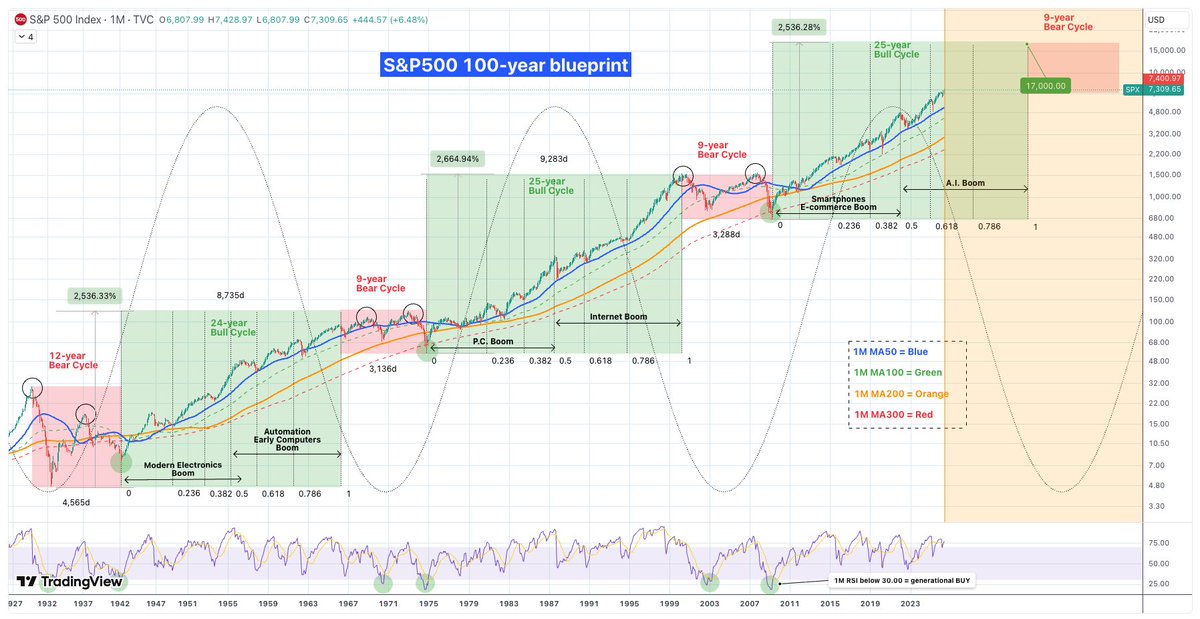
Der 100-Jahre-Plan für den Aktienmarkt
Wenn du dir die letzten 100 Jahre anschaust, siehst du ein klares Muster: Der Markt wiederholt immer wieder die gleichen Zyklen. Seit der Großen Depression 1930 gab es drei große Abwärtsphasen und drei Aufwärtsphasen .
Wir stecken gerade mitten im dritten großen Bullenmarkt.
Die schlechten Zeiten (Bärenmärkte)
Diese Phasen dauerten meistens etwa 9 Jahre (die Weltwirtschaftskrise von 1930 war mit 12 Jahren eine Ausnahme). Ein typisches Zeichen war, dass der Markt zweimal oben und zweimal unten „anklopfte“, bevor es wieder aufwärts ging. Oft krachte der Kurs bis zu einer bestimmten langfristigen Linie (dem 300er-Schnitt im Monatschart) und startete von dort aus neu durch.
Die guten Zeiten (Bullenmärkte)
Die ersten beiden großen Aufwärtsphasen dauerten jeweils 24 und 25 Jahre. Das Spannende: Sobald der Markt einmal Fahrt aufgenommen hatte, fiel er fast nie unter eine bestimmte grüne Linie (den 100er-Schnitt). Die blaue Linie (50er-Schnitt) war dabei immer die beste Chance, um günstig nachzukaufen, wenn es mal zwischendurch ruckelte.
Warum steigt der Markt so extrem?
Hinter jedem Bullenmarkt steckt eine neue Technologie:
Früher waren es industrielle Durchbrüche.
Dann kam der Internet-Boom.
Heute erleben wir den E-Commerce- und Social-Media-Boom.
Klar, irgendwann platzen diese Blasen immer, weil die Leute übertreiben. Aber die Technik bleibt! Das Internet ist nicht verschwunden, nur weil die Kurse im Jahr 2000 abgestürzt sind – es wurde zum Fundament für alles, was wir heute nutzen.
Der KI-Boom
Wir sind jetzt im zweiten Teil des aktuellen Aufschwungs, und der wird von der Künstlichen Intelligenz getrieben. Wahrscheinlich wird diese Blase um das Jahr 2034 platzen. Das wird wehtun, aber danach wird KI das feste Rückgrat unserer gesamten Wirtschaft sein.
Im Grunde sind die letzten 100 Jahre eine Kette von Erfindungen, die die Kurse immer höher treiben. Die Abstürze zwischendurch sind nur dazu da, die heiße Luft rauszulassen und Platz für neues Geld und die nächste Technologie zu machen.
Was bedeutet das für dich heute?
Wenn dieser Zyklus so läuft wie die letzten beiden, könnte der S&P 500 bis auf 17.000 Punkte steigen.
Es wird zwischendurch immer wieder Korrekturen geben. Der Zoll-Crash Anfang 2025 war so ein Moment, hat aber die wichtige blaue Linie nicht ganz berührt.
Schau auf den RSI-Anzeiger. Wenn der unter 30 fällt, ist das eine Chance des Jahrzehnts. Das ist in 100 Jahren erst sechsmal passiert – und jedes Mal war es der perfekte Zeitpunkt zum Kaufen.
Liken, Folgen, Speichern, Kommentieren, Teilen.
Danke für den Support 🫶😊🫶
Sen. Moreno: "In 2016, I became the first person in the United States to pay my taxes with Bitcoin. I paid $3,000 in taxes with two Bitcoin."
Sen. Scott: "The $3,000 would today be worth how much?"
Moreno: "Too soon."
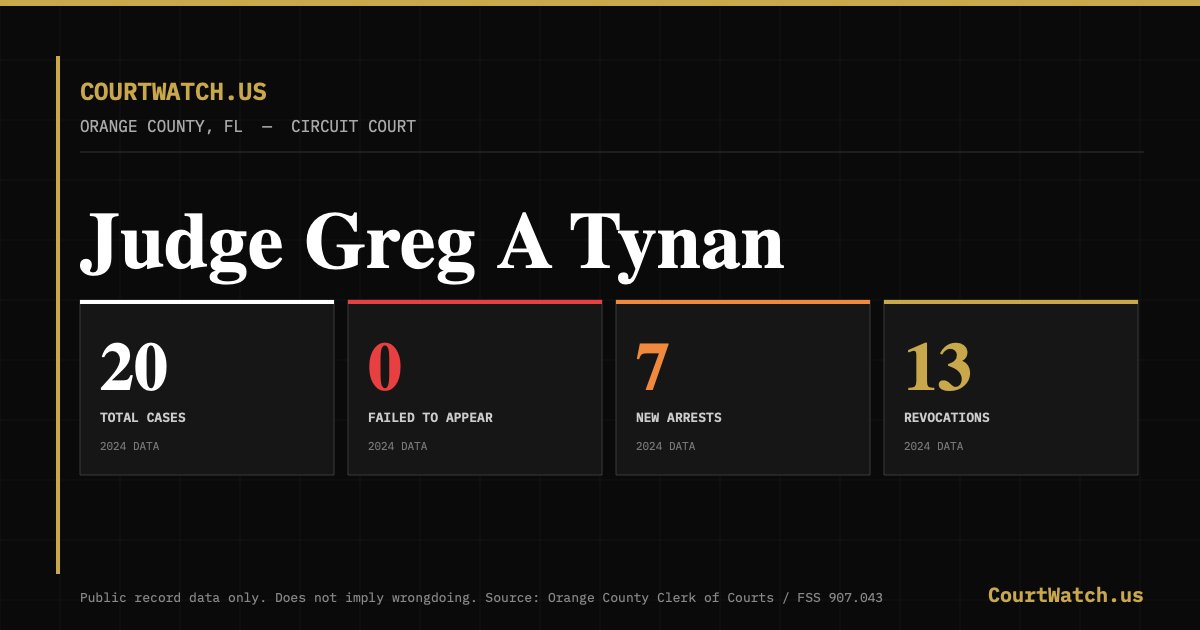
I built https://t.co/R1jAMUfNTv — a free public database for American citizens who deserve safer communities.
You can track which judges released defendants who then got rearrested, skipped court, or violated their release conditions. All public records. All free.
I started with Orange County FL and will be expanding to all 67 Florida counties and eventually every state in the country. This first batch of info is from 2024 and since public reports are released in March/April for the previous year, data is behind. But I wanted to see if this is plausible. After adding 2024,I'll add 2025 and then figure out how to get real-time-data uploaded.
It's in beta — would love to know what you think 👇
Numbers don't lie, but criminals do.
https://t.co/DfTcJ6XMYn
@bennyjohnson@jockowillink@GrantCardone@LauraLoomer@nickshirleyy@j_fishback
this is actually insane
> be tech guy in australia
> adopt cancer riddled rescue dog, months to live
> not_going_to_give_you_up.mp4
> pay $3,000 to sequence her tumor DNA
> feed it to ChatGPT and AlphaFold
> zero background in biology
> identify mutated proteins, match them to drug targets
> design a custom mRNA cancer vaccine from scratch
> genomics professor is “gobsmacked” that some puppy lover did this on his own
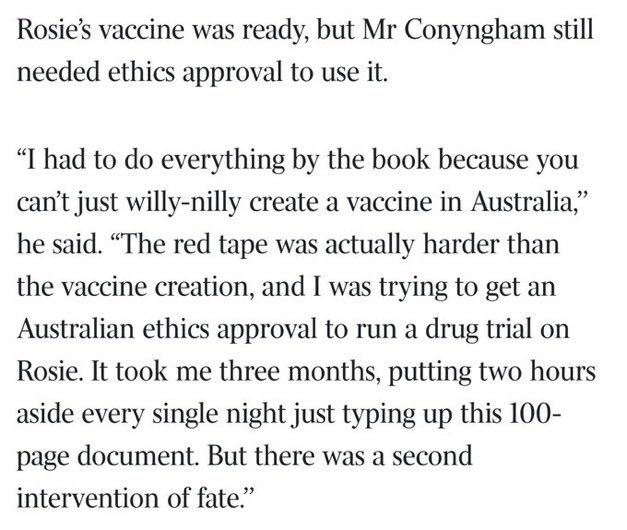
> need ethics approval to administer it
> red tape takes longer than designing the vaccine
> 3 months, finally approved
> drive 10 hours to get rosie her first injection
> tumor halves
> coat gets glossy again
> dog is alive and happy
> professor: “if we can do this for a dog, why aren’t we rolling this out to humans?”
one man with a chatbot, and $3,000 just outperformed the entire pharmaceutical discovery pipeline.
we are going to cure so many diseases.
I dont think people realize how good things are going to get
I’m watching https://t.co/oXzelJZDNk like it’s the COVID case tracker in April 2020 thinking “no one understands what is happening.”
Everyone is distracted by ai and missing the real singularity.
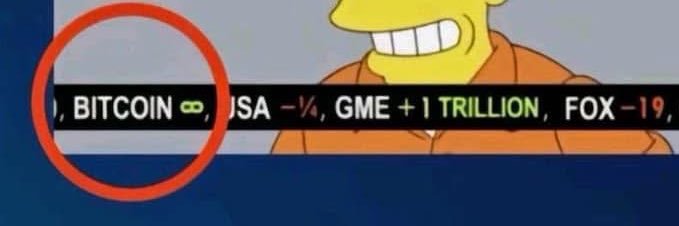
I have so much respect for people who were stock or real estate investors and pivoted to Bitcoin
This proves they are willing to change their mind after being presented with new information
I have zero respect for investors who dismiss Bitcoin without studying it
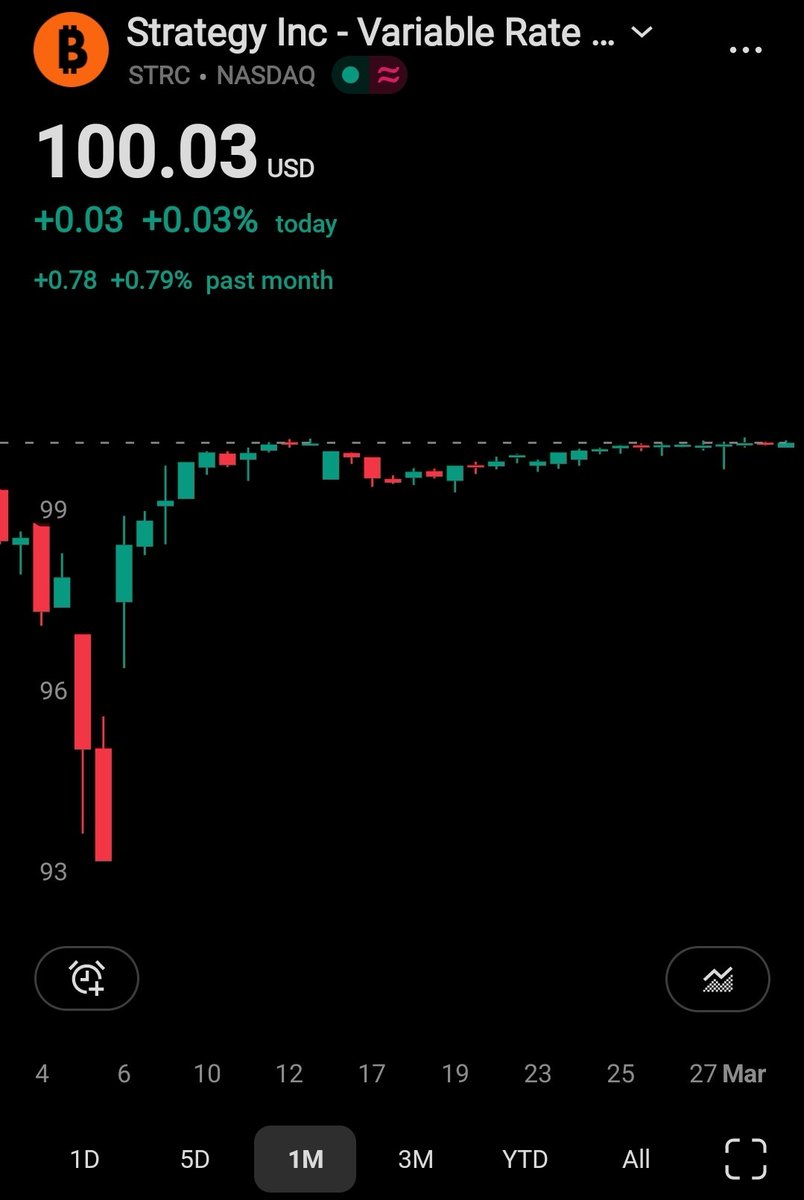
MSTR will go from buying 1,000 BTC per day with $STRC to 2,000 to 5,000 to 10,000 if the price remains below $70K
Saylor was right
No more Bitcoin winter
50% drawdowns are not Bitcoin winter
50% drawdowns are just planting seeds for the next 500% run-up
Today, we're introducing Spectre I, the first smart device to stop unwanted audio recordings.
We live in a world of always-on listening devices.
Smart devices and AI dominate our world in business and private conversations.
With Deveillance, you will @be_inaudible.
As AI continues to commoditize software, venture returns will go from bits to atoms - and vc as an asset class will experience an inverse, going back to what it was invented for post World War ll: technically hard, capital intensive, and important ideas solving humanity’s fundamental problems.
That decade gave us Intel which designed silicon chips, Genentech which pioneered gene editing, and Sun Microsystems which laid the ground work for the modern internet.
I believe we are marching towards what will become the most critical time of technology inflection, where the future will look at today with awe, just like how we admired the heydays of the Roman Empire.