Google has published a paper that might end the transformer era.
For the last 7 years, every major AI, ChatGPT, Claude, Gemini, has been built on the exact same architecture: The Transformer.
But Transformers have a fatal flaw.
To remember context, they have to process every single word against every other word. It’s called quadratic complexity. As your prompt gets longer, the compute cost explodes.
The alternative is the old-school RNN (Recurrent Neural Network). RNNs are incredibly cheap and fast, but they have a fixed memory size. If you give them a long document, they get amnesia.
Until today.
Google researchers published Memory Caching: RNNs with Growing Memory.
And it fixes the biggest bottleneck in AI.
Instead of an RNN having a fixed, rigid memory that constantly overwrites itself, Google gave it a "save" button.
The technique allows the RNN to cache checkpoints of its hidden states as it reads.
The memory capacity of the RNN can now dynamically grow as the sequence gets longer.
They built four different variants, including sparse selective mechanisms where the AI actively chooses exactly which checkpoints matter most.
The results rewrite the rules of efficiency.
On long-context understanding and recall-intensive tasks, these new Memory-Cached RNNs closed the gap with Transformers.
They achieved competitive accuracy without the explosive, quadratic compute cost. It perfectly bridges the gap between the cheap efficiency of an RNN and the massive capability of a Transformer.
We have spent billions scaling Transformers because we thought they were the only way an AI could remember a long conversation.
But Google just proved we don't need to process the whole history every single time.
We just needed a smarter cache.
Ghostty is leaving GitHub. I'm GitHub user 1299, joined Feb 2008. I've visited GitHub almost every single day for over 18 years. It's never been a question for me where I'd put my projects: always GitHub. I'm super sad to say this, but its time to go. https://t.co/DQDemHdytV
This is insane 🤯
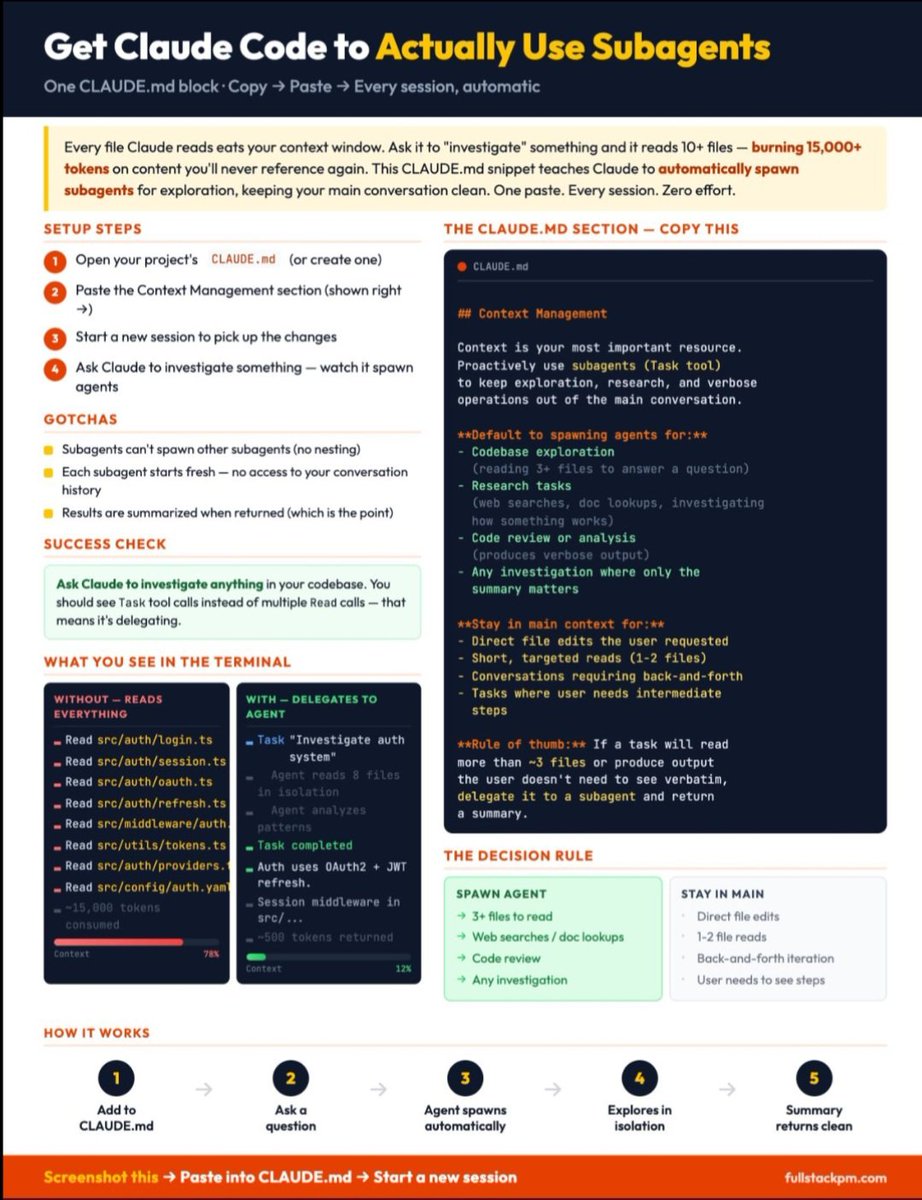
Most people using Claude Code are wasting thousands of tokens… without realizing it.
Every time Claude reads files to “investigate” something, it eats your context window.
10+ files → 15,000+ tokens gone
And most of that information is never used again.
That’s the hidden productivity killer.
But there’s a simple fix most developers don’t know about:
Subagents.
Instead of letting Claude read everything in your main session, you can force it to spawn subagents that investigate things in isolation.
Your main conversation stays clean.
Your context window stays intact.
And Claude becomes dramatically more efficient.
Here’s the trick 👇
Add a Context Management block inside your CLAUDE.md.
Then tell Claude:
• Use subagents for exploration
• Delegate research & multi-file analysis
• Return only summarized insights
Now Claude behaves like a true AI research team instead of a single assistant.
Example rule:
If a task needs to read 3+ files → spawn a subagent.
That one rule alone can save tens of thousands of tokens across a project.
Result:
• Faster sessions
• Cleaner context
• Better reasoning
• Less token burn
Tiny configuration.
Massive workflow upgrade.
AI tools aren’t just about prompts anymore.
They’re about architecture.
And the people who understand this will build 10x faster than everyone else.
@progressief_lib@Ape149@USTradeRep And direct voting in eu parlament members elections are just hallucinations? When country ratify treaty of EU grants rights to make law. We can says that elections of US president is less democratic as it goes via electors then elections or EU parlament members which is direct.
@PowsinogaZubr@oficerKRK No nie do końca - Nowy York technicznie zamknął Manhattan dla samochodów (3 pasy do 1 małego) a jakoś ludzie tylko zmienili środek transportu
@bigfoot115bis@MajaHermanMD@8isieniebac No generalnie to rząd i sejm wprowadza regulacje i prawo - lekarze tak jak każdy inny może lobbować więc to rowie mocno można narzekać że przedsiębiorcy i pracownicy są niekompetentni że utrzymują taki system...
@ostrowtom I tego nie podważam - jednocześnie wybór suboptymalnrgo środka z punktu widzenia miasta powoduje jeszcze większe przeciążenie już przeciążonej infrastruktury.
@MarcinKrakowPL@oficerKRK Plus jeszcze dodam że ilość planów modernizacyjnych jakie miał Kraków w okolicach 2013 r. na modernizację ciągów rowerowych też była ogromna, a realizowano je zazwyczaj przy okazji innych "większych" remontów żeby było taniej np ciąg Wielickiej od Kabla
@MarcinKrakowPL@oficerKRK Patrząc na ostatnie 20 lat Krakowa ? Kontrapasy dla małego ruchu przy parkingach, śluzy rowerowe na skrzyżowaniach, obligatoryjne punkty mobilności, usuwanie świateł na pierwszej obwodnicy - jest tego trochę