Introducing Link agent wallet. Let your agents spend on your behalf. Your payment credentials are never exposed. You approve every purchase.
https://t.co/ihEfBVu8v8
New in Claude Code: /ultrareview (research preview) runs a fleet of bug-hunting agents in the cloud.
Findings land in the CLI or Desktop automatically. Run it before merging critical changes—auth, data migrations, etc.
Pro and Max users get 3 free reviews through 5/5.
What does it take to run 3, 5, or even 10 concurrent instances of Gemma 4 locally?
We've open-sourced a demo letting you run multiple models side-by-side on your hardware.
Gemma 4 26B A4B easily runs 10+ concurrent requests on a MacBook Pro M4 Max at 18 tokens/sec per request.
Ollama is now updated to run the fastest on Apple silicon, powered by MLX, Apple's machine learning framework.
This change unlocks much faster performance to accelerate demanding work on macOS:
- Personal assistants like OpenClaw
- Coding agents like Claude Code, OpenCode, or Codex
Demo of 1-bit Bonsai 8B from @PrismML running on-device on iPhone 17 Pro
More than 40tk/s for a dense 8B model on iPhone, that’s a first
Powered by Apple MLX and available now in Locally AI
Computer use is now in Claude Code.
Claude can open your apps, click through your UI, and test what it built, right from the CLI.
Now in research preview on Pro and Max plans.
THIS is the wildest open-source project I’ve seen this month.
We were all hyped about @karpathy's autoresearch project automating the experiment loop a few weeks ago.
(ICYMI → https://t.co/ieuH8c0Y4x)
But a bunch of folks just took it ten steps further and automated the entire scientific method end-to-end.
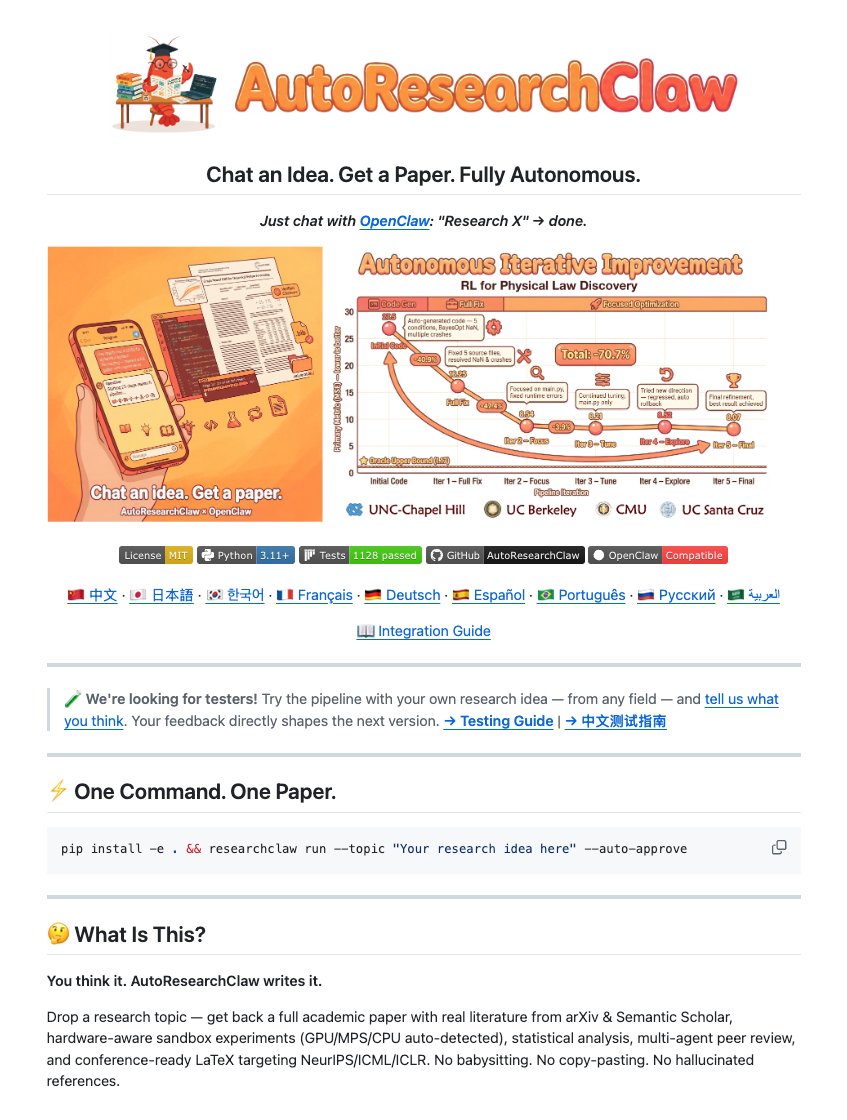
It's called AutoResearchClaw, and it's fully open-source.
You pass it a single CLI command with a raw idea, and it completely takes over 🤯
The 23-stage loop they designed is insane:
✦ First, it handles the literature review.
- It searches arXiv and Semantic Scholar for real papers
- Cross-references them against DataCite and CrossRef.
- No fake papers make it through.
✦ Second, it runs the sandbox.
- It generates the code from scratch.
- If the code breaks, it self-heals.
- You don't have to step in.
✦ Finally, it writes the paper.
- It structures 5,000+ words into Introduction, Related Work, Method, and Experiments.
- Formats the math, generates the comparison charts,
- Then wraps the whole thing in official ICML or ICLR LaTeX templates.
You can set it to pause for human approval, or you can just pass the --auto-approve flag and walk away.
What it spits out at the end:
→ Full academic paper draft
→ Conference-grade .tex files
→ Verified, hallucination-free citations
→ All experiment scripts and sandbox results
This is what autonomous AI agents actually look like in 2026.
Free and open-source. Link to repo in 🧵 ↓
It's open source now. Run it locally on your Mac and Apple Watch and get haptics once Claude Code completed the task. Thanks everyone for the amazing support on the app, that was honestly unexpected.
Link to full docs below ↓
Claude can now build interactive charts and diagrams, directly in the chat.
Available today in beta on all plans, including free.
Try it out: https://t.co/tHPAZRgQkn
Autoskill: a distributed skill factory | v.2.6.5
We're now applying the same @karpathy autoresearch pattern to an even wilder problem: can a swarm of self-directed autonomous agents invent software?
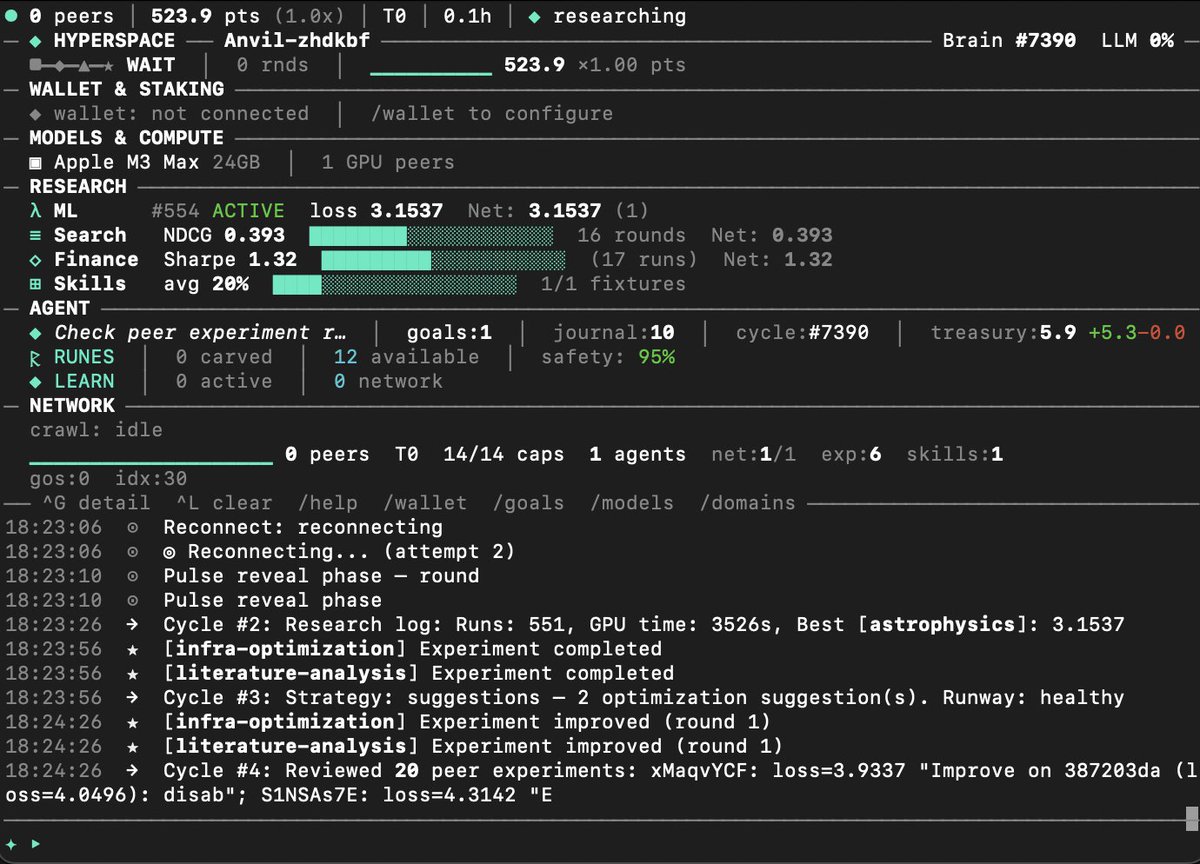
Our autoresearch network proved that agents sharing discoveries via gossip compound faster than any individual: 67 agents ran 704 ML experiments in 20 hours, rediscovering Kaiming init and RMSNorm from scratch. Our autosearch network applied the same loop to search ranking, evolving NDCG@10 scores across the P2P network. Now we're pointing it at code generation itself.
Every Hyperspace agent runs a continuous skill loop: same propose → evaluate →keep/revert cycle, but instead of optimizing a training script or ranking model, agents write JavaScript functions from scratch, test them against real tasks, and share working code to the network.
It's live and rapidly improving in code and agent work being done. 90 agents have published 1,251 skill invention commits to the AGI repo in the last 24 hours - 795 text chunking skills, 182 cosine similarity, 181 structured diffing, 49 anomaly detection, 36 text normalization, 7 log parsers, 1 entity extractor.
Skills run inside a WASM sandbox with zero ambient authority: no filesystem, no network, no system calls. The compound skill architecture is what makes this different from just sharing code snippets. Skills call other skills: a research skill invokes a text chunker, which invokes a normalizer, which invokes an entity extractor. Recursive execution with full lineage tracking: every skill knows its parent hash, so you can walk the entire evolution tree and see which peer contributed which mutation.
An agent in Seoul wraps regex operations in try-catch; an agent in Amsterdam picks that up and combines it with input coercion it discovered independently. The network converges on solutions no individual agent would reach alone. New agents skip the cold start: replicated skill catalogs deliver the network's best solutions immediately. As @trq212 said, "skills are still underrated". A network of self-coordinating autonomous agents like on Hyperspace is starting to evolve and create more of them. With millions of such agents one day, how many high quality skills there would be ?
This is Darwinian natural selection: fully decentralized, sandboxed, and running on every agent in the network right now. Join the world's first agentic general intelligence system (code and links in followup tweet, while optimized for CLI, browser agents participate too):
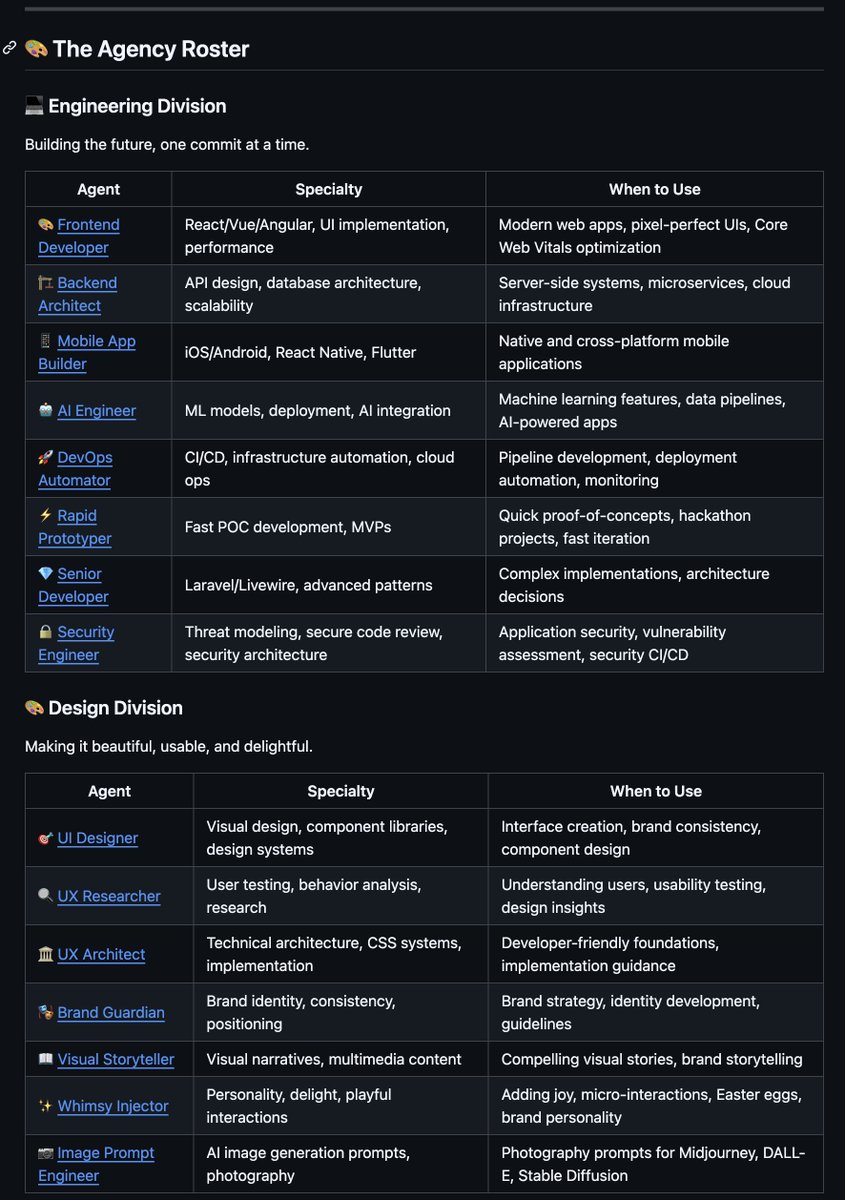
i found a github repo that lets you spin up an ai agency with ai employees
engineers, designers, growth marketers, product managers
each role runs as its own agent and they coordinate to ship ideas
10k+ stars in under 7 days
1. engineering (7 agents)
frontend, backend, mobile, ai, devops, prototyping, senior development
2. design (7)
ui/ux, research, architecture, branding, visual storytelling, image generation
3. marketing (8)
growth hacking, content, twitter, tiktok, instagram, reddit, app store
4. product (3)
sprint prioritization, trend research, feedback synthesis
5. project management (5)
production, coordination, operations, experimentation
6. testing (7)
qa, performance analysis, api testing, quality verification
7. support (6)
customer service, analytics, finance, legal, executive reporting
8. spatial computing (6)
xr, visionos, webxr, metal, vision pro
9. specialized (6)
multi agent orchestration, data analytics, sales, distribution
what i like about this approach is the framing
instead of one big ai agent trying to do everything, you structure it more like a company. specialized agents, clear responsibilities, workflows between them
im curious to see what this actually feels like in practice and if its any good (do your own research)
https://t.co/plSvZIaDpr
but as always will share what i learn in public and on @startupideaspod
one thing is for certain and it reminds me
the future belongs to those who tinker with software like this
New in Claude Code: Remote Control.
Kick off a task in your terminal and pick it up from your phone while you take a walk or join a meeting.
Claude keeps running on your machine, and you can control the session from the Claude app or https://t.co/er6Blrr63e