“.. It’s a little bit like paying your mortgage with your credit card,” James Sullivan, the co-head of global fundamental research at JPMorgan Chase, told @CNBC. “It can work for a while, but eventually the mismatch starts to become more obvious.”
https://t.co/7JdRsVlJXt
@elonmusk Bandwidth is half of it. Most congestion control still assumes a stable path and a stable RTT. LEO is neither. Area needs innovation all the way down the stack.
@Cloudflare and @Starlink should be building that together.
The U.S. has 2,441 proposed data-center projects scheduled to break ground between 2026 and 2028, representing as much as $2.48 trillion in planned investment. That pipeline is roughly 5 times the cost of building the original Interstate Highway System (inflation-adjusted) —except this infrastructure doesn’t move cars; it moves intelligence.
Thanks @ssankar for putting NVIDIA Nemotron 3 Ultra to the test with no post-training.
24 hours later, it was outperforming frontier models on the tasks @PalantirTech customers needed to solve.
My wife left me today. She said it was because I “never stop talking.” I said the yen carry trade is a $20 trillion leveraged bet that the Bank of Japan will never normalize rates and she said “I’m taking the dog.”
Let me explain to you what I was trying to explain to her.
For thirty years Japan ran rates at zero. Zero. Free money. So the entire planet borrowed yen for nothing and bought literally anything with yield. Treasuries, Mexican peso bonds, Nasdaq, your uncle’s crypto. That’s the carry trade. It’s not a strategy. It’s a short volatility position wearing a business casual outfit.
Then in August 2024 the BOJ raised rates 15 basis points. FIFTEEN. And the yen ripped, the Nikkei fell 12% in a day, and the VIX printed 65. That was the tremor. That was the trailer.
She said “you said this last year.” I said YES AND I WAS RIGHT, THE MARKET JUST FORGOT, and she started packing.
Japan’s debt-to-GDP is roughly 250%. The BOJ owns over half the JGB market. They are the market. There’s no price discovery, there’s a guy in Tokyo with a printer and a dream. Every basis point higher on the long end costs them real money on debt they can never actually repay in real terms. So what do you do when you can’t default and you can’t pay? You inflate. You always inflate. It’s the only tool that doesn’t require anyone to vote.
She said “our marriage counselor thinks you have anxiety.” I said your marriage counselor doesn’t know what the 30-year JGB is doing and she said “NOBODY KNOWS WHAT THE 30-YEAR JGB IS DOING, THAT’S THE POINT, PAUL.”
My name isn’t Paul. That’s how far gone we are.
Anyway I’ve got canned goods, a Kagoshima yield curve chart laminated above the bed, and nobody left to explain it to. So it’s you now. Buckle up.
Multiple independent Garmin trackers recorded Nirmal Purja “Nims Dai” 10 elite climbing team on Broad Peak drop in minutes (9:38 AM).
Yet, the official alarm wasn’t raised until 10:00 PM. Why did Base Camp ignore the telemetry for 12.5 hours?
🧵 THREAD DISCOVERY 👇
#Nimsdai
TLDR- Avalanche hit 9-9:30 a.m. on July 30.
Formal alert didn't go out until 10 p.m. (12-13 hour delay).
Base-camp staff reportedly failed to raise the alarm sooner despite GPS data.
Weather limited night flights.
Negligence.
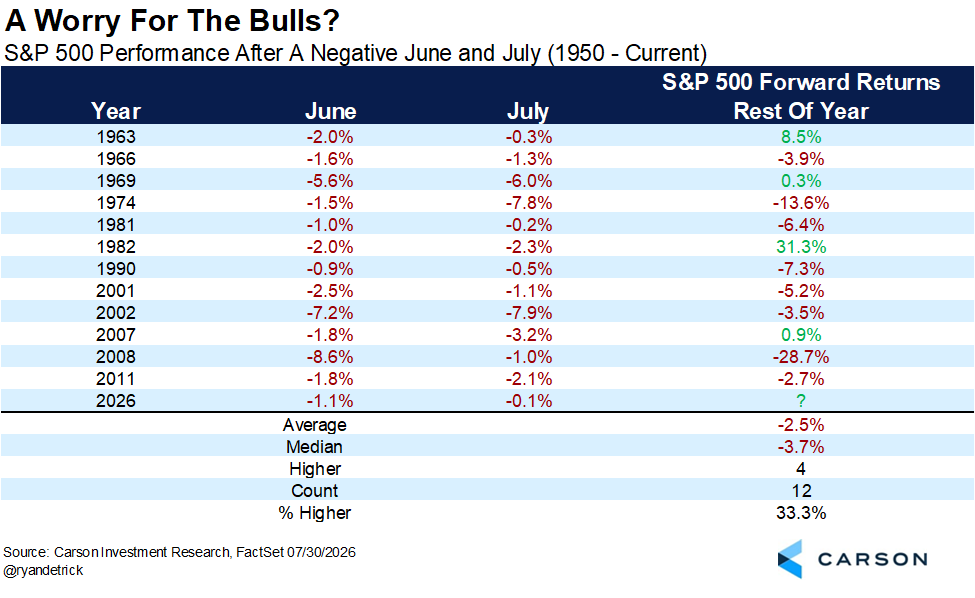
July tried, but finished down 0.1%.
Prepare to hear a LOT about this from the bears, but down in June and July has been weak for the rest of the year historically.
Spain’s entire budget will be destroyed by illegal migrants.
It’s basic math: if Spain offers free stuff to migrants that is above 90% of the living standard of Earth, they create a forcing function for 90% of Earth to move to Spain, which is around 7 billion people!
“Greatness does not come out of intelligence, it comes from character.
Character is not formed out of smart people: it is formed out of people who have suffered.”
— Nvidia CEO, Jensen Huang
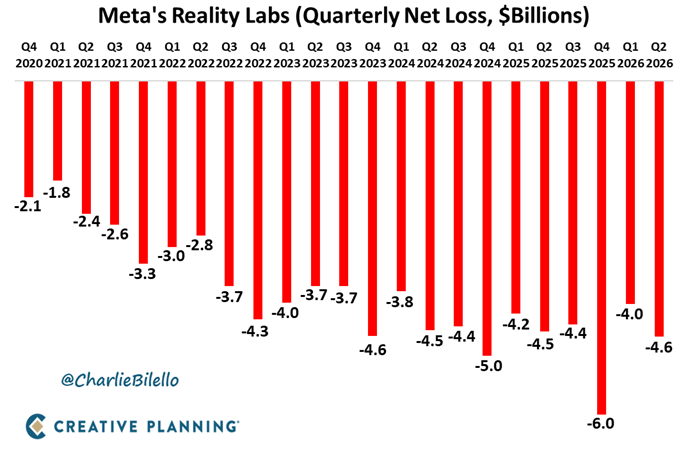
Meta's Reality Labs unit lost another $4.6 billion in Q2, bringing its cumulative losses since 2020 up to $87 billion. We've never seen a public company light money on fire to this extent. $META
From Samsung Electronics Q2 Earnings Call
Q: Do you expect the current memory shortage to persist into next year? If possible, could you also share your medium- to long-term outlook for memory demand?
A: The rapid acceleration of agentic AI is driving an explosive increase in token consumption. This is fueling unprecedented demand not only for AI servers but also for general-purpose computing servers.
In practice, AI frontier model developers that have been unable to secure sufficient cloud capacity from hyperscalers are now requesting allocations from neocloud providers as well. This has translated into large-scale memory procurement by server OEMs that primarily serve those neocloud customers.
Even so, memory shortages mean that many frontier AI companies are still unable to secure the infrastructure they need. To address this, they have begun sharing their medium- to long-term demand forecasts directly with us and expressing their intention to purchase memory from Samsung. We are also seeing the start of requests for long-term supply agreements (LTAs) to secure additional volume.
As the adoption of agentic AI continues to accelerate, memory demand is expanding at an exceptionally rapid pace. Industry supply remains well below demand. Even with increased industry-wide capex, it takes more than three and a half years from the construction of a new fab to wafer production. As a result, meaningful supply expansion through new capacity additions will take considerable time. We therefore believe a significant increase in industry supply before 2028 is unlikely.
Based on the demand visibility we currently have from customers, a substantial amount of unmet demand will roll over into next year, creating additional supply pressure. We expect the memory shortage in 2027 to be even more severe than it is this year, with tight supply conditions likely to persist into 2028.
Looking beyond 2029, it is still too early to make definitive projections. However, as AI token demand continues to surge, large customers building long-term AI infrastructure are expected to continue requesting multi-year supply agreements.
These long-term agreements are well aligned with our objective of hedging future business risks. We intend to prioritize contracts with customers that can provide firm, long-term demand commitments.
Over time, this should allow us to transition away from the historically cyclical nature of the memory industry toward a more stable and predictable business model.
With improved long-term demand visibility through LTAs, we will be in a better position to execute a more flexible supply strategy. Following our existing approach of securing cleanroom infrastructure in advance and installing production equipment in line with demand, we expect to further strengthen this disciplined and flexible capacity expansion strategy.
“Even with increased industry-wide capex, it takes more than three and a half years from the construction of a new fab to wafer production. …We therefore believe a significant increase in industry supply before 2028 is unlikely.”
From Samsung Electronics Q2 Earnings Call
Q: Do you expect the current memory shortage to persist into next year? If possible, could you also share your medium- to long-term outlook for memory demand?
A: The rapid acceleration of agentic AI is driving an explosive increase in token consumption. This is fueling unprecedented demand not only for AI servers but also for general-purpose computing servers.
In practice, AI frontier model developers that have been unable to secure sufficient cloud capacity from hyperscalers are now requesting allocations from neocloud providers as well. This has translated into large-scale memory procurement by server OEMs that primarily serve those neocloud customers.
Even so, memory shortages mean that many frontier AI companies are still unable to secure the infrastructure they need. To address this, they have begun sharing their medium- to long-term demand forecasts directly with us and expressing their intention to purchase memory from Samsung. We are also seeing the start of requests for long-term supply agreements (LTAs) to secure additional volume.
As the adoption of agentic AI continues to accelerate, memory demand is expanding at an exceptionally rapid pace. Industry supply remains well below demand. Even with increased industry-wide capex, it takes more than three and a half years from the construction of a new fab to wafer production. As a result, meaningful supply expansion through new capacity additions will take considerable time. We therefore believe a significant increase in industry supply before 2028 is unlikely.
Based on the demand visibility we currently have from customers, a substantial amount of unmet demand will roll over into next year, creating additional supply pressure. We expect the memory shortage in 2027 to be even more severe than it is this year, with tight supply conditions likely to persist into 2028.
Looking beyond 2029, it is still too early to make definitive projections. However, as AI token demand continues to surge, large customers building long-term AI infrastructure are expected to continue requesting multi-year supply agreements.
These long-term agreements are well aligned with our objective of hedging future business risks. We intend to prioritize contracts with customers that can provide firm, long-term demand commitments.
Over time, this should allow us to transition away from the historically cyclical nature of the memory industry toward a more stable and predictable business model.
With improved long-term demand visibility through LTAs, we will be in a better position to execute a more flexible supply strategy. Following our existing approach of securing cleanroom infrastructure in advance and installing production equipment in line with demand, we expect to further strengthen this disciplined and flexible capacity expansion strategy.
A strong and secure open ecosystem is important for the world to benefit from AI. We’ve always supported and contributed heavily to open source and science from Jax to Transformers to AlphaFold to Gemma open models which have now been downloaded 300M+ times. And the standards framework we’ve proposed supports responsible deployment of both open and proprietary models.
This woman, Editor-In-Chief at the Economist , is excruciatingly painful to listen to. It’s people like her that are allowing the West to be destroyed.
Luxury belief brigade in all its glory.
CIA funded or just the regular crowd of Islamic and other far left groups sponsoring these latest protests?
America is afraid of strong united India and will do everything it can to tear it apart. They've been doing in the open for decades. Modi remains the most popular world leader, by a long shot.
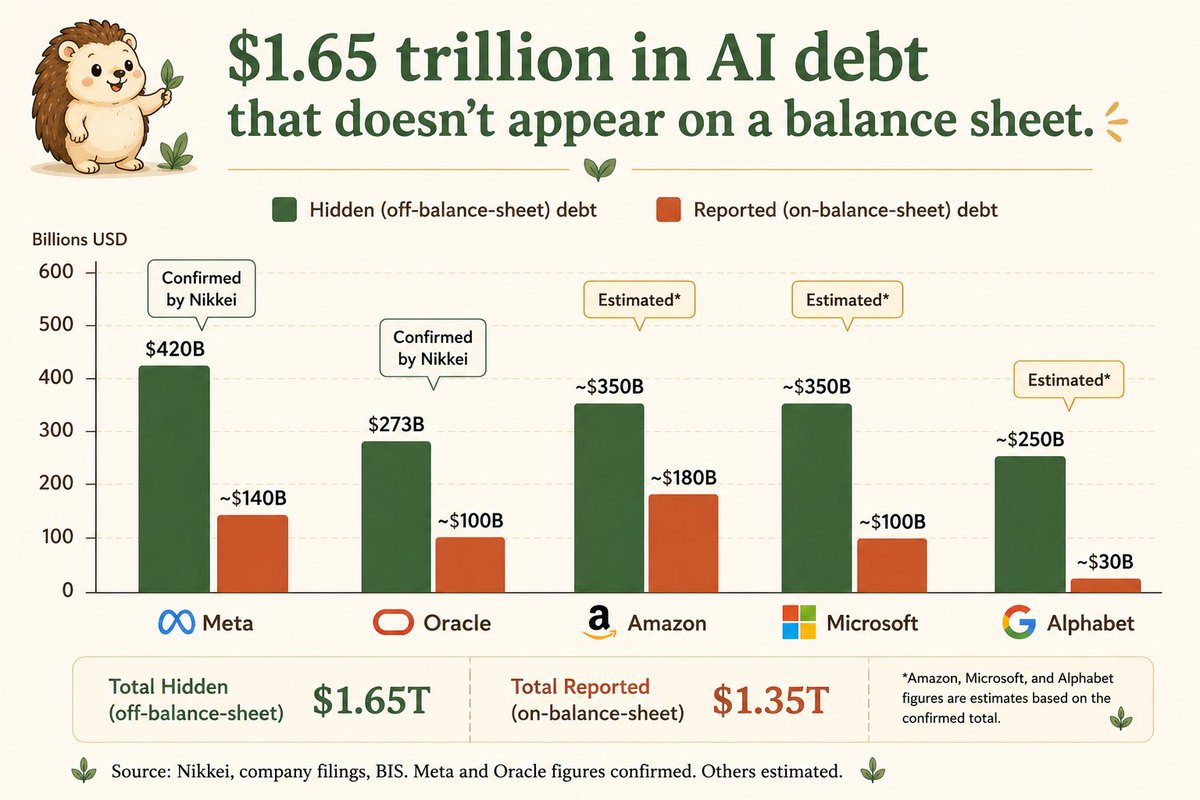
🦔A Nikkei investigation found that Alphabet, Microsoft, Amazon, Meta, and Oracle have $1.65 trillion in debt that doesn't appear on their balance sheets, more than the $1.35 trillion they officially report. These are GPU contracts, data center leases, and joint ventures that don't count as debt under accounting rules until the facilities go live. Meta's hidden debt is $420 billion, triple its reported debt. Oracle's grew 30-fold in four years. All five declined to comment.
My Take
Nikkei examined the actual filings and put a number on something the BIS already flagged as "shadow borrowing" back in March. These companies owe more off their balance sheets than on them, and the accounting rules let them keep it that way until the data centers go live. That's legal, but it means investors looking at quarterly earnings this week are seeing less than half the picture.
Four of these five report earnings in the next two weeks. The reported debt will look manageable. The $1.65 trillion in footnotes won't make the headlines. But when those data centers start operating, the leases hit the books all at once. If AI demand comes in below projections, those facilities get marked down and the losses land on the investors and insurance policyholders who funded the construction through private credit and project bonds without realizing how much total exposure they were carrying.
Hedgie🤗
My initial reaction to Kimi 3:
- it’s an over-reaction shockingly similar the DeepSeek panic
- models like Kimi 3 accelerate and grow the inference market faster than without
- Kimi 3 distilled Fable and therefore big training infra still required for leading edge. No Fable, no Kimi 3.
- the only reason the training market declines is if we believe we created the ultimate model which we haven’t achieved. We are far away from super-intelligence.
- it could pose a P&L challenge to Anthropic and OpenAI.
- this is good for hyperscalers
- this is good to neutral for chipmakers