1/7 🥥 New speculative decoding method!
Introducing DCOCO: Contextual Correction of Parallel Drafts.
Parallel drafters are fast, but lose context between predicted tokens.
DCOCO restores it without giving up parallelism.
Up to 6.6× faster than vanilla decoding. 🧵
@patchwanders@Base44@Lovable@Replit We sample rather than rerun everything: each update gets 3 new-feature checks, 1 integration check, and 1 earlier-feature check, even for functionality the update wasn’t meant to change.
Which model should you trust to keep building your app on @Base44, @Lovable, or @Replit as it gets more complex?
Our latest paper benchmarks how coding models handle evolving apps with interdependent features. Check it out 👇
Even frontier models struggle when coding features depend on each other!
Introducing EvoWeb, a new long-horizon coding benchmark: 32 apps × 10 interdependent requests. After every coding-agent update, a browser agent QA-tests the live app.
📄 https://t.co/PO1ZGrYPYH
@OwainEvans_UK@Butanium_ Related to our Faithfulness Serum work (ACL 2026): we improve post-hoc explanation faithfulness using attribution guidance. Curious whether this could help diagnose what drives CoT override. https://t.co/UpJlCShM2r
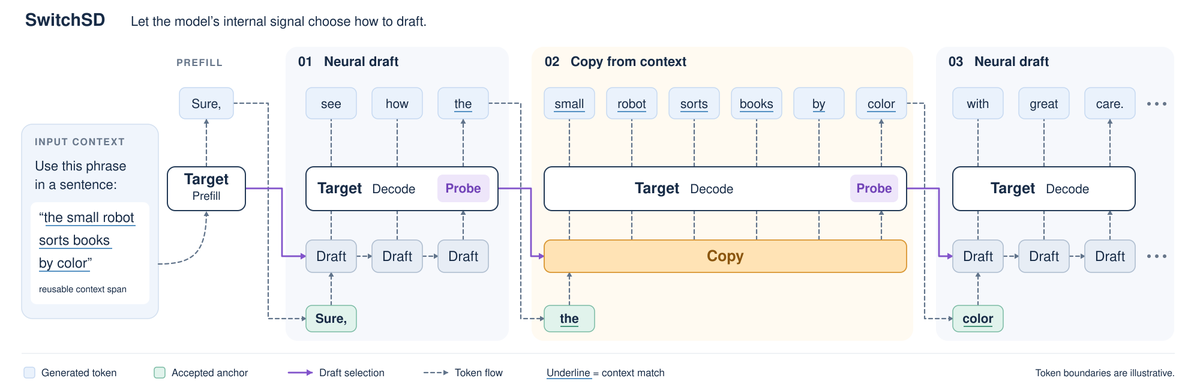
SwitchSD improves LLM speculative decoding by using a lightweight signal from the LLM’s internal representations to predict when to copy from context vs. when to use a drafter 🚀
A fun intersection of interpretability and acceleration!
Congrats to @roy_eisenstadt and the team! 🎊
1/10 Accepted to #NeurIPS2026! 🎉
Can an LLM tell us when to copy instead of running a neural drafter?
We introduce SwitchSD: speculative decoding that uses the target model’s hidden states to switch between neural drafting and context copying. Here’s the story.
1/
Text-to-video models generate beautiful videos, but they still struggle to follow complex prompts.
Relations like left/right, towards/away, on top of, behind, or even multi-stage instructions are often generated incorrectly.
In our new paper, accepted to SIGGRAPH Asia 2026, we introduce CVG, an inference-time guidance method that improves compositional video generation without retraining or architectural changes.
Looking forward to presenting this work at ACL 2026 as an oral presentation!
🗓️ Sunday, July 5
🎙️ Oral Session D: Special Theme – Explainability of NLP Models 1
🕘 9:30 AM
📍 Harbor G
Come by if you’re attending ACL! happy to chat about the paper!
📄 🚨
You ask an LLM why it generated an answer.
It gives you a clean, confident explanation.
The problem is
it’s often not the real reason.
We measure this gap, then close it with Faithfulness Serum.
Accepted to the #ACL2026 main conference
📄 https://t.co/UpJlCShecT
1/6 🧵
We hope everyone is excited for ACL2026@San Diego.
Feel free to take a look at the published papers below!
Main: https://t.co/HX601lc9sc
Findings: https://t.co/ubamZnIGT8
Demos: https://t.co/84UCDvlSum
Industry track: https://t.co/WTbMWb7tSA
#NLProc#ACL2026
We hope everyone is excited for ACL2026@San Diego.
Feel free to take a look at the published papers below!
Main: https://t.co/HX601lc9sc
Findings: https://t.co/ubamZnIGT8
Demos: https://t.co/84UCDvlSum
Industry track: https://t.co/WTbMWb7tSA
#NLProc#ACL2026