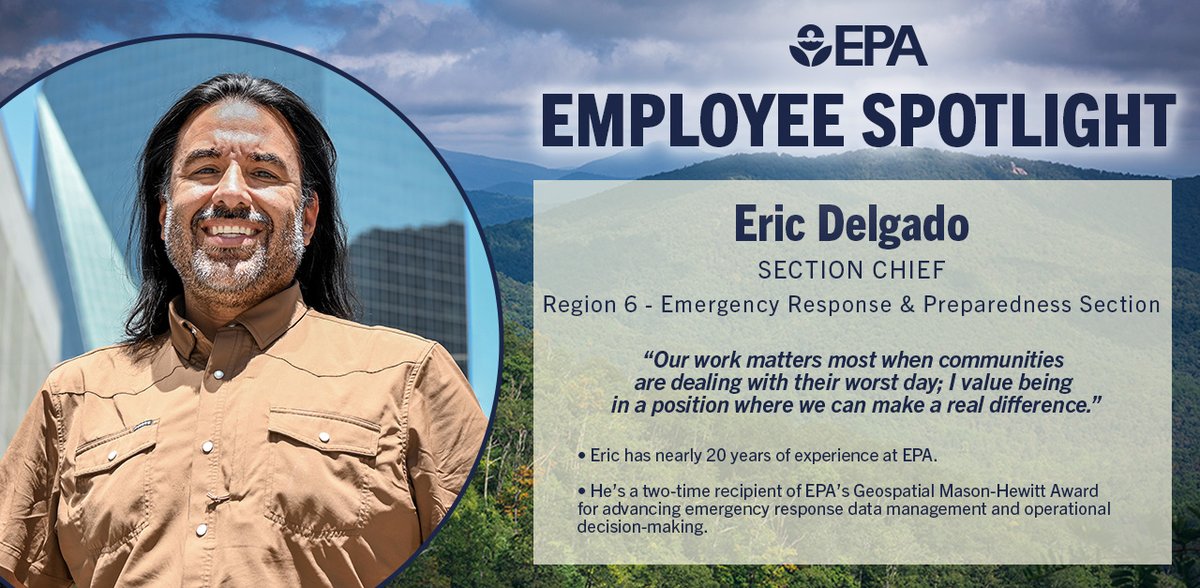
⭐ EPA Employee Spotlight ⭐
Eric Delgado, a Section Chief in @eparegion6's Emergency Response and Preparedness Section.
Eric leads a multidisciplinary workforce responsible for emergency response, removal actions, oil spill preparedness, major event planning and responder development across five states and Tribal lands.
He’s motivated by the mission and responsibility that comes with being there when communities need EPA most. He’s also motivated by developing people and is proud of the work Region 6 has accomplished to strengthen On-Scene Coordinators’ development and mentoring. Eric enjoys solving hard problems, bringing people together, cutting through the noise, and finding a path forward.
The career advice he’d give his younger self is that leadership has a lot less to do with having all the answers and a lot more to do with earning people’s trust. Don’t wait until you have the title to lead.
Outside of work you can find Eric spending time with his wife and three sons, or behind the camera shooting sports photography.
Thank you making a difference at EPA and beyond!
Here is my view on what’s wrong with funding of scientific research in the UK, and how I would change the focus if it was up to me!
There is a long list of things that UKRI needs to weigh when making decisions about funding for research and facilities, and driving growth is not one of them. The reason is that the whole of UKRI’s portfolio is essential for driving growth - indeed the research ecosystem is one of the necessary foundations of growth. The point I made at the Labour Conference is quite simple. UKRI’s budget is 0.65% of government expenditure, at a little under £10 Bn per year. That is a very tiny leaver when seen through the prism of attempting to use it to make a step change in economic growth - especially when the leaders of UKRI and the Research Councils are not economists and should not be economists! Their expertise lies in research. BUT, and this is the key point - if by fiddling around trying to use this tiny budget (in relative terms) to make a noticeable change in growth you damage the fundamentals, then you run the real risk of damaging the growth potential of the rest of the economy. Universities, research labs, education and inspiration are all essential for growth. This is what UKRI should be focused on because they are the custodians of this VERY valuable but fragile world-leading ecosystem. So, I would say to UKRI, do the thing you are supposed to do, do it well on behalf of the rest of the economy, and do nothing else.
🎸 Before he takes the stage, Kingfish takes some iconic Met guitars for a spin.
Grammy-winning, Billboard chart–topping guitarist Christone “Kingfish” Ingram stopped by The Met to try out instruments ahead of his upcoming Met Live Arts Guitar Icons performance, where he'll journey through the past and future of the blues alongside his all-star band plus a few special guests featuring The Met collection.
🗓️ October 2 and 3 at 7 pm
📍 The Met
🎟️ Buy tickets and learn more → https://t.co/May1nPd5mq
Super excited to gift you all my book in an audio version!
@atoastolifebook is now available on #audiobook#audible for your listening pleasure.
https://t.co/8vQtfeGw9t
https://t.co/JYYt6n21o2
#merrychristmas
Ever wanted to fuck me? Now you can!
Get the one and only toy modeled after my REAL PUSSY, in collaboration with @_LightningStar, here ⬇️
https://t.co/aD24QONU3o
Some basic lessons for new investors to live by:
1/ Ignore the crowd. You make money by going against the consensus.
2/ Always pick stocks where you feel you have a research edge.
3/ You rarely go wrong investing in the company with the best product.
4/ Don’t listen to management. They are paid to be bullish.
5/ Study competitors, suppliers, and customer behavior. Be a product junkie.
6/ Have in your mind what you think a stock is worth, which is different from price.
7/ Be able to articulate in one sentence why you own a stock.
8/ Develop specific downside scenarios that would cause you to sell the stock.
9/ The highest quality of growth is unit growth, then pricing, then margin expansion, then cash reinvestment.
10/ Be wary of companies that grow by buying other companies.
11/ Sell discipline is selling a stock once it exceeds your price target, or if your investment thesis changes.
12/ Short stocks that have bad businesses, and not because they trade at high P/Es.
13/ Two big value creators are brand extension and TAM expansion stories.
14/ High P/Es are a function of high future growth rates, and not the industry.
15/ When investing in growth stocks always look for a controversy (“fight”).
16/ Buy stocks that can leverage key secular megatrends, and avoid those that will be hurt by them.
17/ Always consider cannibalization of existing products when sizing up new product opportunities.
18/ Be wary of “hockey stick” sales forecasts absent new products or expansion to new distribution channels.
19/ Stock buybacks are accretive if the E/P ratio exceeds the after tax cost of debt or return on cash.
20/ Price cuts rarely add value since they often create a race to the bottom.
21/ Stocks are cheap if price is less than the present value of future cash flows. A high P/E does not make a stock expensive.
Building an NHS fit for the future means making our hospitals more resilient for extreme weather in the winter and extreme heat in the summer, and investing in new operating theatres, children's wards, maternity units and mental health facilities.
More: https://t.co/p1x3Hm4qq9
Today, we’re launching Small Town PAC.
We’re going to show up in small towns, organize in places too many people have given up on, and build power with the folks who call these places home.
If Democrats want to win in more places, we’ve got to start showing up in more places.