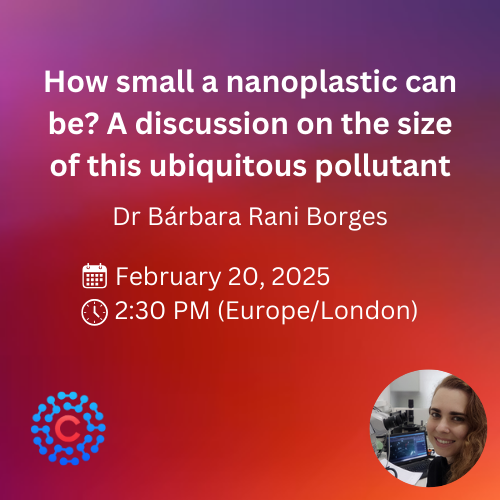
Join #CPPlastics author @barbararaniborg for our webinar:
How small a nanoplastic can be? A discussion on the size of this ubiquitous pollutant
🗓️20th Feb 2025
⏰ 2:30 pm (London)
Register for this informative event here: https://t.co/NCwq4xCHSa
#plastics#nanoplastics
Check out our recent paper published in Environmental Science & Technology:
"Biofragmentation of Polystyrene #Microplastics: A Silent Process Performed by Chironomus sancticaroli Larvae"
https://t.co/zYlm7Vqha3
@GlauHerzer@PhDVoice@PostdocVoice Not really... but kinda hahah. The first was in engineering and the second was in Environmental Sciences. I know it was a lot of work, but I'm glad I did it. I wasn't happy with the idea of having a career in the field of engineering.
Hoje finalizamos o primeiro Encontro Científico sobre Microplásticos, ocorrido do Instituto de Química da USP. Foi um sucesso e de representatividade nacional. Já pensamos no próximo para 2024.
Quanto menores os fragmentos de plástico, maior o dano ambiental
Pesquisas realizadas no Instituto de Biociências (IB) da USP indicam riscos de partículas de material sintético para animais de água doce
https://t.co/FHPw4zztwa
A reminder that Elsevier made $10.5 BILLION in 2022 from selling your academic journals and articles behind paywalls, and make more profit than Amazon, Google, and Apple every year…
And paid the academics who wrote the articles $0
And paid the reviewers of the articles $0
Metrics like number of papers, citations, H-index, international collaborations, and journal impact factor can be easily faked, yet we still use them to judge scientists and make decisions. Time to rethink how we evaluate scientific work?