Agency > Intelligence
I had this intuitively wrong for decades, I think due to a pervasive cultural veneration of intelligence, various entertainment/media, obsession with IQ etc. Agency is significantly more powerful and significantly more scarce. Are you hiring for agency? Are we educating for agency? Are you acting as if you had 10X agency?
Grok explanation is ~close:
“Agency, as a personality trait, refers to an individual's capacity to take initiative, make decisions, and exert control over their actions and environment. It’s about being proactive rather than reactive—someone with high agency doesn’t just let life happen to them; they shape it. Think of it as a blend of self-efficacy, determination, and a sense of ownership over one’s path.
People with strong agency tend to set goals and pursue them with confidence, even in the face of obstacles. They’re the type to say, “I’ll figure it out,” and then actually do it. On the flip side, someone low in agency might feel more like a passenger in their own life, waiting for external forces—like luck, other people, or circumstances—to dictate what happens next.
It’s not quite the same as assertiveness or ambition, though it can overlap. Agency is quieter, more internal—it’s the belief that you *can* act, paired with the will to follow through. Psychologists often tie it to concepts like locus of control: high-agency folks lean toward an internal locus, feeling they steer their fate, while low-agency folks might lean external, seeing life as something that happens *to* them.”
We're organzing the "Quantify Uncertainty and Hallucination in Foundation Models" workshop at #ICLR2025!
📢 Call for Papers: Submit your work by February 2, 2025 (AOE).
🔗 More details: https://t.co/JYg5pgUtSO
Look forward to seeing your submission and participation in the workshop.
Spent the past two days learning Mamba, SSM, and relevant concepts. The outcome is this written note "Exploring Mamba: A High-Level Guide to State Space Models" https://t.co/8mm5Y0JIcg. Kindly check it out if interested!
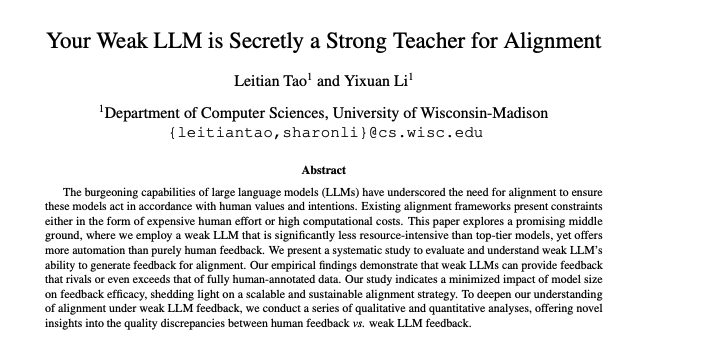
🔥Your Weak LLM is a Secret Alignment Powerhouse!
Scaling alignment with pure human or AI feedback (GPT-4) isn't cheap 💸. It demands enormous human effort or computing power. Our new study reveals a hidden gem: even weak LLMs with just 125M parameters can provide powerful feedback for aligning AI systems🚀—saving time, money, and computation. It even outperforms advanced LLMs like GPT-4. 🤯
💡Why it matters? Weak LLMs offer a sweet middle ground between between labor-intensive human feedback and costly, compute-heavy AI feedback. They are automated, low-cost, and enable rapid iteration for research and deployment.
@LeitianT's research pushes the boundaries of AI alignment and opens up new ways to think about how weak AI models can complement human efforts in making smarter, safer systems. The work showcases that these models can match or even surpass the performance of human feedback or large models like GPT-4. 📉
✅ Key takeaway: Our findings show that model size isn’t everything. Bigger isn’t better when it comes to providing feedback. Weak LLMs proved more effective when the feedback was generated with task-specific focus rather than prompt-engineered GPT-4 responses. 🎯
Beyond performance, weak LLMs offer the potential to drive faster and more responsible AI alignment. We’ve demonstrated their reliability across various model families, evaluation metrics, and tasks, representing a major step toward scalable and cost-effective alignment.
🔍 Deeper insight on weak LLM vs human feedback: We went beyond just quantitative metrics, diving deep into a qualitative comparison between weak LLM and human feedback. Surprisingly, in cases where the weak LLM disagreed with human annotations, nearly half of the weak LLM’s responses were of higher quality. This finding highlights that human feedback isn’t always the gold standard—weak LLMs can actually surpass human judgment in many cases! Read our Section 4 for more 🧐
📝 Full paper: https://t.co/3IniVQvzPp
#AI #Alignment #MachineLearning #LLMs #GPT4 #Research #ResponsibleAI #AIalignment
Easy way to fix academia: Add a negative offset to all citation counts in Google Scholar. Every new paper starts at -100 citations and has to claw its way out of that hole.
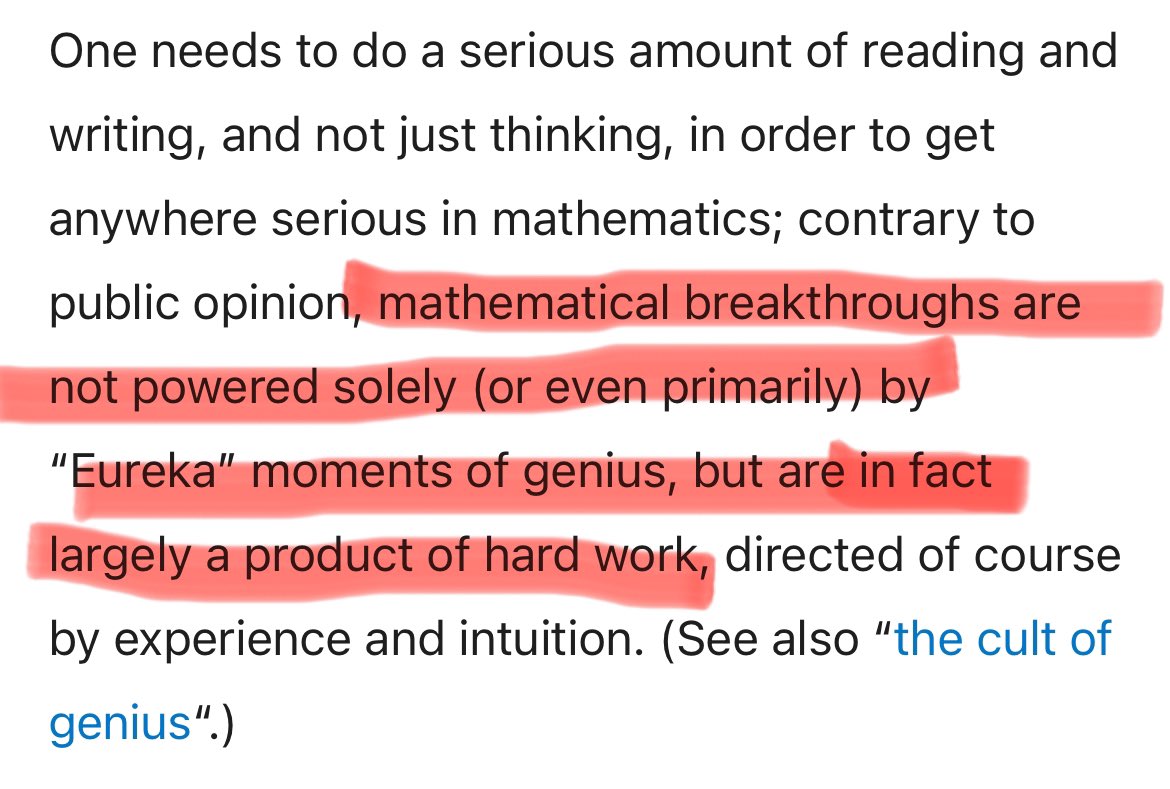
“mathematical breakthroughs are not powered solely (or even primarily) by ‘Eureka’ moments of genius, but are in fact largely a product of hard work” —Terry Tao
https://t.co/5r3TpC9Oti