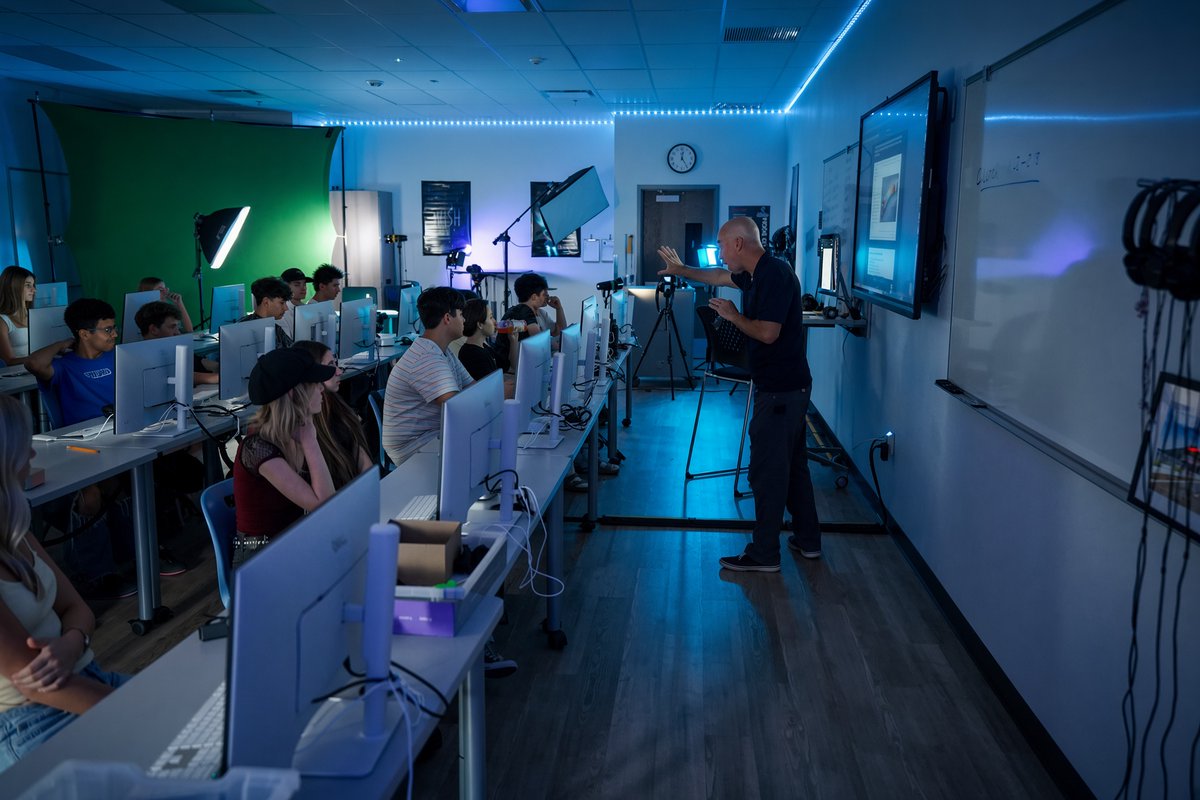
I run Crismon High School's two-year Film & TV pathway: student crews, a three-camera studio, work that hits real screens. Before this, 30 years in post (The List, Native Horse on PBS). In production or broadcast? Spend a half-day with my students: https://t.co/XCNziGlheO
@joelcomm Yeah, I’m absolutely mesmerized by it all. Really enjoying building stuff. just launched a film festival in Queen Creek, Arizona, for students and building websites, apps, tools, and so many amazing things. It’s just really, really fun
Arizona high school filmmakers: this is your invitation.
The first Queen Creek Student Film Festival is free and open to every high school student in Arizona. Make a narrative short film, 8 minutes or less.
Entries open December 14. Deadline April 2. The top 8 films screen on the big screen Friday, May 7, 2027.
Students: your teacher enters your film, so show them this. Teachers: the rules and the entry form are at https://t.co/RyIdi6zwU3
Made by the students of Crismon High School Film & TV.
#CrismonTV #QCSFF
Last year our student morning show cost me my weekends.
This year I edited the first episode by talking. I never touched the editing software. An AI ran it while I gave notes, the same notes I'd give a human editor.
Here's the whole story in 10 minutes: the one instruction that sold me, what it got wrong, how I fixed it, and why I unlocked the studio and let the students run the shoot.
The takeaway: you don't need prompts. Know what you want, and say it the way you'd say it to an editor.
Your first step is at the end of the video.
Teacher or business owner, and want to do this where you work? Message me. Glad to talk it through. Not looking to be sold anything.
I edited our whole student morning show and never touched the editing software. I talked to an AI the way I'd talk to an editor.
Here's the part people get wrong: you don't need special prompts. You need to know what you want.
After 30 years of editing, I know the words. Jump cut. Chroma key. J cut. Color grade. So I say, "your key is off right there on her shoulder, clean that up," and it does.
Whatever your job is, you already know its words.
Try it: pick one job you know cold. Tell an AI what you'd tell a helper: who it's for, what matters most, what to leave out. Then give it one note, the way you would a person.
Full video Thursday.
Teacher or business owner, and want to do this where you work? Message me. Glad to talk it through. Not looking to be sold anything.
«Practice any art… no matter how well or badly, not to get money and fame, but to experience becoming, to find out what's inside you, to make your soul grow»
— Ian McKellen reciting Kurt Vonnegut
This is the first 30 seconds of Episode 1 of the Crismon Network, our student morning show. It airs Monday.
A note from our teacher, Barrett Sanders:
I'm halfway through my second year of teaching after 30-some years in the film industry, and my first year, I wanted the show to look great because it was about me. Last year I micromanaged every process on 11 shows. It was stressful. I wanted it perfect, and I wanted the staff to think it was incredible.
This year I'm learning to let go. For this shoot, I unlocked the studio doors and left. An hour later the crew came back and handed me an SD card. One of them showed up four minutes early to tell me how rough it went: so-and-so wasn't listening, so-and-so was overstepping. Then the rest of the crew walked in still going at it. "You did this." "That's not your job." I just listened and smiled inside.
That's them figuring it out. It's okay for them to fail. It won't be smooth, and that's what working in a team really looks like: learning to fix it among yourselves. And they still made a great show. It's a personal lesson for me and a big step for our program. It's about them, and I'm letting it be about them.
The crew who made it:
Directors: Mason Marquez and Dexter Purvis
Floor director: Mary-Elizabeth Pearson
Assistant floor director and camera: Lucas Jensen
Switcher: Lucas Gibbons
Prompter: Mikayla Coplen
Prompter and camera: Brayden Barnes
Hosts: Laney Vrolyks and Joey Scibona
Crew: Olivia George
Teachers building a program like this: ask us anything. Message @barrettsanders.
#CrismonTV
@JamesAnaquad Hey there - Yes, this is really like magic. I've never experienced anything like this! I just talked to the machine, it put the entire thing together. Truly like I had a magic wand. Yes, just connect Claude to DaVinci Resolve Studio. You need the Pro version.
I've edited film and TV for 30 years. This is my second year teaching it to high schoolers.
This week I edited a full episode of our school's morning show and never touched the editing software. I gave notes, the way I'd give them to an assistant. An AI ran the software and did the button work. (The AI was Claude, @claudeai, running DaVinci Resolve, @Blackmagic_News.)
I barely used AI before this school year. Last year I tried one small thing: getting it to draft our morning show script. It made things up, and I had to check every line.
It still isn't all smooth. At one point my screen showed an old version of the edit, and I thought the AI had failed. It hadn't. I'll show you moments like that too.
Here's what I'm going to share: what I've handed off in editing, in production, and in the paperwork around teaching. Plain words, the real steps, and what went wrong, so you can try it. The goal is simple: hand off the busywork, so there's more of you for the people in front of you.
One thing to try today: open any AI tool, paste in something you wrote this week (a rubric, a script, an email) and ask, "What's unclear here?" That's step one.
Teacher or business owner, and want to do this where you work? Message me. Glad to talk it through. Not looking to be sold anything.
SpaceX has just unveiled a massive new $50 billion Supercomputing Campus that they want to build in Cochise County, Arizona.
All info:
• Up to 6 GW across the 9 supercomputing buildings
• Construction starts 2027
• Size of each supercomputing building: ~493,000 square feet.
• Total supercomputing building space: 4.44 million square feet, excluding support facilities.
• SSVEC residential customers are projected to see electricity bill reductions of 10–40%.
• Up to 24 GWh of grid-connected battery storage to provide backup power, stabilize the regional electric grid, support local voltage, and absorb fluctuations in electricity demand. Among the largest planned battery installations in the United States.
• Additional solar generation in the region is planned to supply renewable electricity during the day and reduce demand on the local grid.
• No dedicated on-site power plant or fuel storage yard is planned.
• Each supercomputing building will have 10 MW of natural-gas-powered standby generation for critical equipment, operating only during utility outages and periodic testing.
• No gas turbines will be installed at the site.
• SpaceX plans to fund $3.6 billion in grid infrastructure upgrades, transferred to AEPCO at no cost to its members.
• Up to $260 million annually in additional benefits for cooperative members at full buildout, on top of residential bill reductions.
• Up to $200 million annually for cooperative members statewide, in addition to SSVEC benefits.
• The supercomputers will use dry cooling with a closed-loop water circulation system rather than evaporative cooling.
• SpaceX projects zero ongoing industrial water consumption.
• The cooling system will be filled initially, with water reused for up to 10 years.
• SpaceX estimates annual water usage equivalent to approximately 20–30 Arizona residential homes.
• Projected annual water use would be less than 2.5% of a single center-pivot irrigation system's annual consumption.
• Permanent jobs: Approximately 1,000.
• Construction jobs: Approximately 5,500.
• Annual property tax revenue: Up to $103 million in estimated new annual revenue.
• Regional economic benefits: SpaceX says its investment will support public education, infrastructure, essential local services, and economic development.
• Local suppliers: SpaceX is encouraging suppliers to participate in construction and development of the campus.
• Noise mitigation: Equipment will be positioned away from neighboring properties where possible, with setbacks and additional screening to reduce noise.
• Nighttime lighting: Outdoor lighting will remain off unless work is underway, with active lights shielded and directed downward.
• Dark-sky protection: The campus will comply with Cochise County's dark-sky requirements to limit light pollution.
• Nighttime construction: SpaceX says it will seek waivers when nighttime construction lighting is necessary.
• Wildlife protection: The campus is being designed with consideration for the region's sandhill crane wintering habitat.
This campus's purpose is to build one of the world's most advanced AI supercomputing campuses to train SpaceX's superintelligence models and support scientific and engineering breakthroughs.
Learn more: https://t.co/i0IUZKP7Wn
If you want to learn how AI agents work, I highly recommend Harvard’s CS2680.
It covers how Claude Code works, how to build your own agent, and how to serve LLMs on GPUs.
https://t.co/DBoWdDeyGb