Many mathematicians are rather childlike, unworldly in some sense, but Grothendieck more than most. He just seemed like an innocent—not very sophisticated, no pretense, no sham. He thought very clearly and explained things very patiently, without any sense of superiority. He wasn’t contaminated by civilization or power or one-up-manship.
-- John Tate
A rich kid can fail upward through connections and nepotism. A poor kid can do everything right and still end up working retail with a master's degree. Meritocracy is the story we tell. Inherited advantage is the system we have.
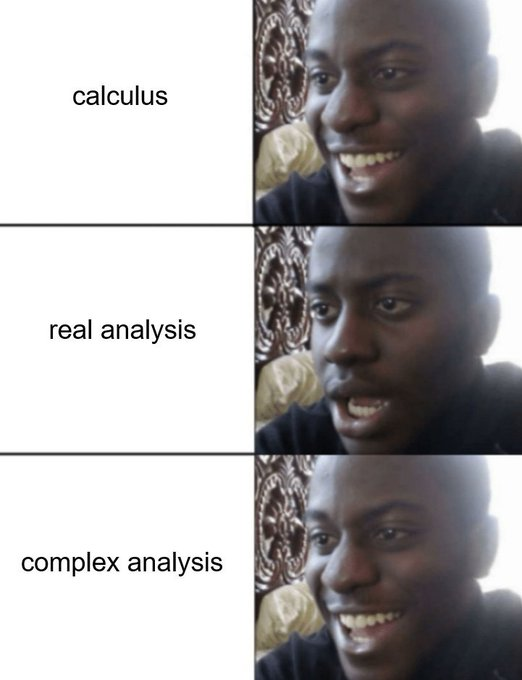
Algebra: These beautiful theorems prove that the universe is intrinsically good and life has a deeper meaning
Analysis: Here is a counterexample
Topology: Everything is the same if you squint hard enough
AI: The proof is obvious to me. All of you go check it
C is a perfectly logical language.
int *p; // pointer to an int
int *p[10]; // array of 10 pointers to ints
int (*p)[10]; // pointer to an array of 10 ints
int (*p)(int); // pointer to a function taking an int and returning an int
wow very readable.
To all the people asking me about what Architecture I use for my Software: my brothers and sisters in Christ, I program in C. The Architecture is obviously Brutalism.
It is important that we all remain really calm about the Navier-Stokes situation.
The problem has not yet a complete proof, and the recent publication from OpenAI is still in revision (and will be for many months). Mathematics is all about human understanding. If a proof is not understandable to humans, then it cannot be considered a proof by any mathematician (can you hear a tree fall in a forest if nobody around?).
The work of understanding, expanding mathematics, enriching human knowledge is what academics need to do now with this document. AI is a tool, undeniably, but human knowledge is the objective.
Another chapter of this story concerns the authorship of the alleged result(s). For years, mathematics has largely been a collaborative field, of course clashes between egos have happened here and there as anywhere else, but mathematicians are known by being really open about recent discoveries and for celebrating original contributions (after all, important theorems are named after the mathematicians who proved them). Working together is a must, while racing against another researcher or team of researchers often ends in a bitter way. In particular, Anthropic and OpenAI do not look like they are collaborating in this. For them, this is a race, a way of pleasing stakeholders, increasing percentages, revenues, numbers... they are, fundamentally, companies. It would be good to remember this.
BTW, if every software engineer were required to take just one year of computer science, we would live in a world where a system with 4 GB of RAM would be perfectly fine for most purposes.
If you are a student in the West, print this and put it on your desk.
A daily reminder of what you will be competing against.
“When I was in college in China, if you don’t have a Russian math textbook, you don’t belong to the elite club.”
This is not a joke.
For decades, Chinese STEM education studied and adopted many elements of the Soviet mathematics tradition — rigorous textbooks, deep problem solving, and a culture that treats mathematics as a serious intellectual discipline.
While some Western curricula debate whether formulas should even be memorized, other countries are training students using problem sets and textbooks that built generations of mathematicians and physicists.
Competition in STEM is global.
And the standards are not getting lower.
If you are a student — study math.
If you are a parent — make sure your kids do.
Start here:
https://t.co/VKD55ApBEp
Study math. Teach your kids math.